Russia Deploys Entire Nuclear Icebreaker Fleet, Securing Year-Round Arctic Energy Exports
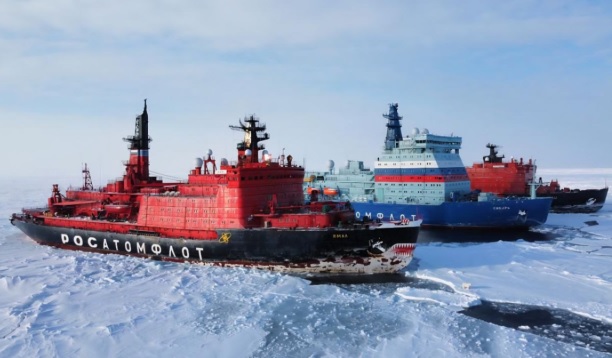
Russia has, for the first time, deployed its entire fleet of nuclear-powered icebreakers simultaneously, a milestone move that underscores Moscow’s determination to secure year-round Arctic shipping lanes and protect its energy exports from Western pressure. The operation brings all eight operational nuclear icebreakers into service at once, ensuring uninterrupted winter navigation to some of the country’s most critical oil and gas terminals deep inside the Arctic.
Russian authorities confirmed that the fleet is being used to keep the Gulf of Ob and the Yenisei Gulf open throughout the winter season. These waterways are the maritime lifelines connecting Siberian production hubs to the Arctic Ocean, serving facilities such as Yamal LNG and the Arctic Gate export terminal. Together, they form the backbone of Russia’s northern energy logistics, allowing liquefied natural gas (LNG) and other commodities to move even during peak ice conditions.
Engineering the Arctic for Year-Round Trade
At the core of the deployment are four Arktika-class nuclear icebreakers, among the most powerful civilian vessels ever built. Each generates approximately 220,000 horsepower and is designed with a dual-draft hull, enabling operations in both deep Arctic waters and shallow river mouths. This capability allows the ships to escort tankers directly from inland ports to open polar seas without the need for seasonal pauses.
Unlike older Soviet-era vessels, the Arktika class represents a new generation of Arctic infrastructure built specifically to support continuous industrial exports. Russia is already expanding this fleet, with three additional ships—Chukotka, Leningrad, and Stalingrad—scheduled for delivery in 2026, 2028, and 2030 respectively.
Alongside them, Russia is constructing the Leader-class icebreaker Rossiya, a vessel designed to break ice more than four meters thick and enable full year-round navigation along the Northern Sea Route by the end of the decade. Officials say the ship is roughly 30 percent complete, and once operational, it will further reduce Russia’s reliance on seasonal shipping windows.
Sanctions and Strategic Adaptation
Western sanctions, imposed after the escalation of the Ukraine conflict, were intended to restrict Russia’s access to capital, technology, and global energy markets. While these measures have delayed certain projects, they have not stopped construction of nuclear icebreakers or broader Arctic infrastructure. The sector relies heavily on domestic financing and long-standing Russian expertise in nuclear propulsion, insulating it from many external constraints.
The full deployment of the fleet is widely seen as a response to Europe’s financial strategy. The European Union has frozen an estimated $210 billion in Russian state assets, with ongoing debates in Brussels about whether those funds can be redirected to support Ukraine. Belgium, which hosts a significant share of the assets through financial clearing systems, has expressed concern over potential legal retaliation from Moscow.
Russia’s answer, analysts say, is structural rather than rhetorical. By securing physical control over export routes, Moscow is reducing the impact of financial restrictions. Energy flows, once heavily dependent on European ports and Western shipping services, are increasingly being redirected northward through Arctic corridors and onward to Asia and other non-sanctioning markets.
A Parallel Export System Takes Shape
The Arctic strategy reflects a broader shift in Russia’s economic planning. From gas fields in northern Siberia to liquefaction plants, ice-class tankers, and nuclear escorts, Moscow is assembling a self-contained export system largely detached from Western infrastructure. Cargoes move without reliance on European ports, Western insurers, or traditional clearing houses, limiting the reach of sanctions to financial assets rather than physical trade.
For Europe, the development highlights a growing disconnect between financial leverage and real-world commodity flows. While Russian funds remain frozen in European jurisdictions, oil, gas, and minerals continue to move through routes that sanctions cannot easily disrupt.
Strategic Signal from the High North
The simultaneous deployment of all nuclear icebreakers is not merely an operational milestone; it is a strategic signal. Russia is demonstrating that it can guarantee energy exports even under extreme Arctic conditions and prolonged geopolitical pressure. As climate change extends the navigable season and new icebreakers enter service, the Northern Sea Route is set to become a permanent pillar of global energy trade.
In doing so, Moscow is reshaping the balance of leverage. Financial assets may be immobilized in Europe, but the physical assets that generate them are increasingly flowing north—beyond Europe’s reach, and firmly on Russia’s terms.
✍️ This article is written by the team of The Defense News.