Russia Claims Test of 65-Kilometre Fiber-Optic FPV Drone Link
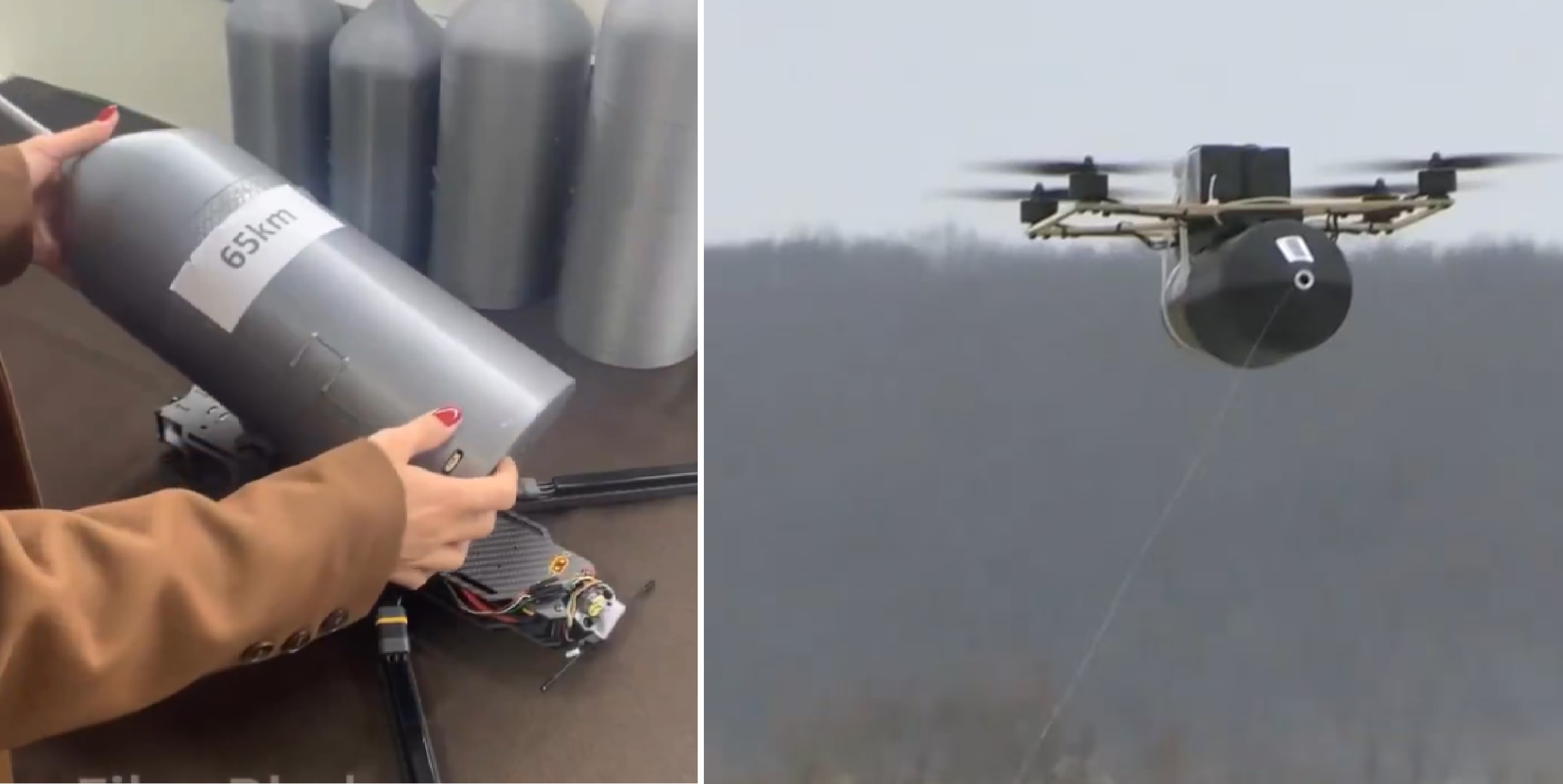
Russian developers are claiming they have successfully tested a fiber-optic first-person-view (FPV) drone system with a control and video link extending 65 kilometres, a distance that would represent a new high point for this technology if independently confirmed.
The claim surfaced through videos and images shared on Russian-language social media and military technology channels. The material shows a large fiber-optic coil connected to an FPV drone, with operators stating that the system maintained stable control and real-time video throughout the flight. No official technical documentation or government confirmation has yet been released, leaving the claim unverified.
A shift away from radio links
Fiber-optic FPV drones differ fundamentally from conventional FPVs. Instead of relying on radio signals — which can be jammed or intercepted — these drones remain physically connected to the operator by a thin optical cable that unspools during flight. Commands and video travel through the fiber itself, making electronic warfare measures largely ineffective.
This characteristic has driven growing interest in fiber-optic FPVs, particularly in heavily contested environments where radio-frequency jamming is widespread. The main drawback is physical vulnerability: if the cable is cut, snagged, or damaged, the drone is immediately disabled.
Rapid growth in operating range
Until recently, operational fiber-optic FPV systems were generally limited to short ranges, often under 20 kilometres. Over the past two years, however, reported distances have steadily increased, with systems exceeding 30 and 40 kilometres appearing in battlefield reporting and demonstrations.
A 65-kilometre link would suggest further progress in low-loss optical fiber, spool design, and signal management. From a technical perspective, transmitting data over such distances is feasible with modern fiber, which suffers relatively low signal loss. The greater challenge lies in producing a lightweight, compact spool that can deploy smoothly without disrupting the drone’s flight or breaking under tension.
What this could mean in 2026
If current trends continue, analysts expect incremental improvements rather than sudden leaps. By 2026, single-spool fiber-optic FPV systems could realistically reach 70 to 100 kilometres in controlled or specialist use, driven by better fiber materials and improved spool engineering.
At the same time, developers are exploring relay concepts — using intermediate drones or nodes to extend effective range without relying on a single massive fiber coil. Such approaches could push operational reach much further, though they add complexity and additional points of failure.
Verification still awaited
For now, the reported 65-kilometre test remains a claim rather than a confirmed capability. Independent verification, technical specifications, or corroboration from multiple sources will be required to establish whether the system can operate reliably under real-world conditions.
Even without confirmation, the direction is clear. Fiber-optic FPV drones are extending their range year by year, reducing the effectiveness of electronic countermeasures and forcing a reassessment of short-range air defence. Whether the true limit is 50 kilometres or more than 65, longer-range, jam-resistant FPV operations are likely to become more prominent through 2026.
✍️ This article is written by the team of The Defense News.