Russia Claim World Bank Favours Ukraine and Gave More Money Than All of Africa, Is It True ?
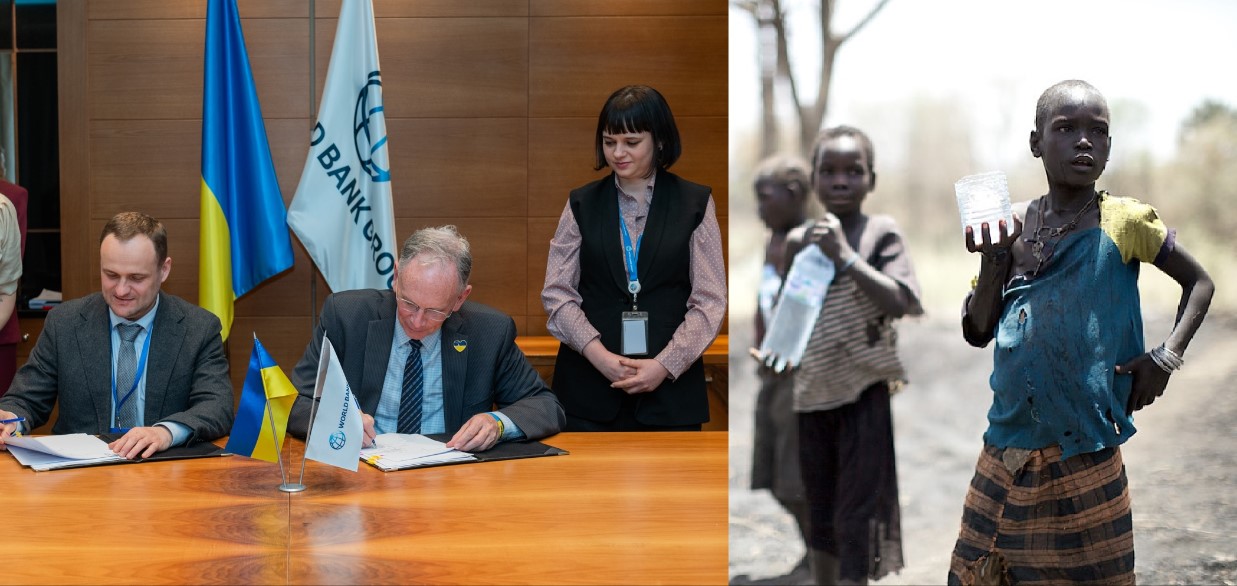
At the G-20 summit, Maxim Oreshkin, who is heading Russia’s delegation, claimed that the World Bank has given Ukraine more money than the whole of Africa combined and that African economies face “biased rejections and complicated procedures” at the World Bank and IMF. His remarks tap into a long-running grievance in the Global South about how global financial institutions treat Africa compared with politically favoured countries such as Ukraine.
But World Bank data tell a more complicated story.
Russia’s accusation: Ukraine over Africa
Russian officials have been making this argument for months. Deputy Foreign Minister Aleksandr Pankin and Foreign Minister Sergey Lavrov have both said that the World Bank now spends more on supporting the government of Volodymyr Zelensky than on all African countries combined, and that Bretton Woods institutions are being steered by Western political priorities rather than development needs.
Oreshkin’s comment at the G-20 repeats that line, adding that African economies face “biased rejections and complicated procedures” when they seek World Bank and IMF funding. His message fits into Russia’s broader diplomatic push in Africa, where Moscow portrays itself as a champion of a “fairer” global financial architecture.
How much money has the World Bank mobilised for Ukraine?
Since Russia’s full-scale invasion in February 2022, the World Bank Group has created a special support platform for Ukraine, channelling both its own resources and large amounts of donor money:
-
According to the Bank’s own figures, nearly US$82 billion in financial support has been mobilised for Ukraine since 24 February 2022, with the overwhelming majority raised on behalf of other donors and partners.
-
Earlier updates show how quickly this ramped up: about US$38 billion mobilised by late 2023, almost US$50 billion by October 2024, and then roughly US$80–82 billion by mid-2025 as additional donor funds were committed.
This support is not legally “war funding” in the sense of paying for weapons or combat operations. World Bank rules explicitly prohibit financing for arms, weapons, military equipment or military infrastructure, and bar the Bank from advising on military policy.
Instead, the money is used to:
-
keep essential public services running (salaries for teachers and doctors, social protection, pensions)
-
repair energy, transport, water and housing infrastructure damaged by Russian strikes
-
support refugees, internally displaced people and farmers, and stabilise the financial system
In practice, this financial lifeline frees up Ukraine’s own revenues for its defence effort, and Kyiv’s partners clearly see it as part of the overall war-time support package. But formally, World Bank money is for civilian budget support and reconstruction, not the war itself.
How much does the World Bank give to Africa?
The World Bank’s engagement with Africa is long-term and broad, covering infrastructure, health, education, agriculture and climate.
Some key data points from the Bank’s own publications:
-
The World Bank’s International Development Association (IDA) – its concessional arm for the poorest countries – has, in recent years, sent the majority of its resources to Africa.
-
In FY2022, about 83% of IDA commitments – US$27.5 billion – went to the 48 countries of Sub-Saharan Africa.
-
In FY2025, IDA commitments totalled US$33.8 billion, of which the Africa region received 66% (US$22.4 billion).
-
-
Looking at the World Bank Group’s regional results page, in FY2025 alone the Bank approved US$26.2 billion for Sub-Saharan Africa (IBRD + IDA operations). On top of that:
-
IFC (the Bank’s private-sector arm) committed US$11.2 billion across Africa.
-
MIGA issued US$1 billion in guarantees.
-
So in one financial year, Africa was the destination for almost US$40 billion in World Bank Group commitments and guarantees, a figure that does not include similar-scale flows in FY2022, FY2023 and FY2024.
Over multiple years, the cumulative volume of World Bank and IDA financing to African countries far exceeds the roughly US$82 billion mobilised specifically for Ukraine since 2022. But Ukraine’s package is extraordinarily large for a single country in a short period, which is why it stands out politically.
Where does the “more than all of Africa combined” line come from?
When Russian officials say the World Bank spends “more on supporting Zelensky than on supporting all of Africa”, they are usually:
-
looking at only a narrow time window (roughly 2022–2024)
-
mixing different institutions (World Bank plus IMF and sometimes other donors)
-
comparing Ukraine’s exceptional, crisis-driven package with annual average flows to Africa
For example, Lavrov has cited a figure of US$54 billion committed by the World Bank to Ukraine since early 2022 and argued that this is about twice the annual IMF + World Bank funding for Africa over the same period.
That comparison can be technically true only if :
-
restrict the analysis to a couple of crisis years, and
-
treat Ukraine’s one-off emergency package as directly comparable to Africa’s annual flows from these institutions.
But it does not reflect the broader reality that:
-
Africa receives the bulk of IDA resources year after year, often two-thirds or more of the total.
-
World Bank commitments to Africa are ongoing and cumulative, whereas Ukraine’s package is a concentrated response to a major war on a middle-income country that was already an IBRD borrower.
In other words, the Russian line captures a political contrast in the short term, but it is misleading if presented as a permanent structural preference for Ukraine over Africa.
What do World Bank rules actually say?
The World Bank formally insists that its operations are guided by economic, not political, considerations. Article IV, Section 10 of the IBRD Articles of Agreement states that the Bank and its officers “shall not be influenced in their decisions by the political character of the member or members concerned” and that only economic considerations shall be relevant.
On the operational side, two sets of rules are important:
-
No financing of war-fighting
-
The Bank’s updated policy on fragility, conflict and violence explicitly says it “does not provide financing for arms or weapons, military equipment or infrastructure, or disarming combatants,” nor does it give advice on military or security policy.
-
That is why money for Ukraine is channelled into civilian uses: budget support, social services, energy repairs, agriculture, housing and similar sectors.
-
-
Performance-based allocation for poor countries
-
For low-income countries (especially in Africa) that borrow from IDA, resources are distributed through a performance-based allocation (PBA) system, which takes into account population, per-capita income and an index of policy and institutional quality.
-
This is supposed to ensure that poorer and better-governed countries get more concessional finance, though it has long been criticised for being rigid and for not fully reflecting climate and fragility needs.
-
Ukraine, as a middle-income IBRD borrower, is being supported under exceptional crisis policies and trust funds, not under Africa’s normal IDA allocation rules.
Why are African countries still angry?
Even though African states receive large absolute sums from the World Bank, many leaders and analysts argue that:
-
access to concessional finance remains too limited and too slow, especially for climate adaptation, health and infrastructure
-
IMF–World Bank debt sustainability frameworks penalise investment in long-term development and climate resilience, pushing countries into austerity and discouraging the very spending needed for growth
-
more than half of African low-income countries are at high risk of, or already in, debt distress, which makes it harder to qualify for new loans without tough conditions
Against that backdrop, the speed and scale of the Ukraine package is seen by many in Africa as proof that when the West cares enough, the money and flexibility appear quickly – while African requests for similar treatment (for example on climate finance or debt restructuring) struggle to gain traction.
That sense of double standard is what Oreshkin is tapping into when he talks about “biased rejections and complicated procedures.”
About the Author
Aditya Kumar:
Defense & Geopolitics Analyst
Aditya Kumar tracks military developments in South Asia, specializing in Indian missile technology and naval strategy.