Rudram-2 Enters Final Development Stretch, Production Clearance Expected in 2026
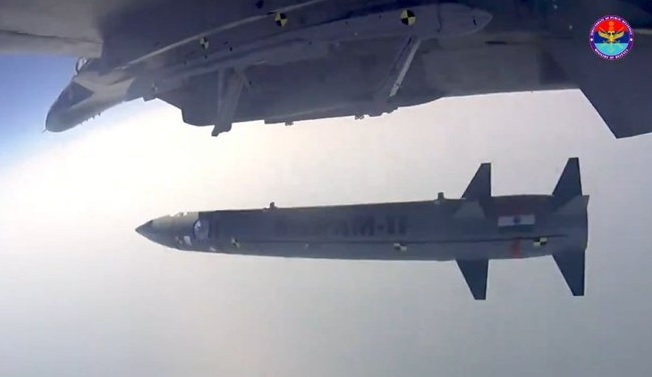
India’s indigenous Rudram-2 air-launched missile programme is entering a decisive phase, with production clearance expected around 2026 and series manufacturing likely to begin roughly 18 months thereafter, according to defence-sector assessments. The missile, designed for long-range precision strike and suppression of enemy air defences (SEAD), is seen as a key addition to the Indian Air Force (IAF) stand-off weapons inventory.
Developed by the Defence Research and Development Organisation (DRDO), Rudram-2 represents the second major variant in the Rudram missile family. With an estimated range of around 300 km and very high terminal speed, the missile is intended to allow combat aircraft to engage hostile radars and high-value ground targets while remaining well outside the densest layers of enemy air defence networks.
The programme gained momentum in May 2024, when the missile was successfully flight-tested from an IAF Su-30MKI fighter aircraft off the eastern coast. The test validated the propulsion system, guidance and control algorithms, and overall flight performance, marking a critical step toward user evaluation trials and eventual induction. Officials described the trial as meeting all primary objectives, reinforcing confidence in the missile’s design.
Rudram-2 missile specifications and design features
In terms of technical configuration, Rudram-2 is a long-range air-launched missile optimised for SEAD and precision strike missions. The missile is assessed to have a maximum range of approximately 300 km, depending on launch altitude and speed of the carrier aircraft. It is believed to achieve very high supersonic to near-hypersonic speeds, commonly cited in defence analyses as up to Mach 5+, significantly reducing enemy reaction time.
The missile uses a solid-fuel propulsion system and is equipped with a multi-mode guidance architecture. This includes inertial navigation supported by satellite guidance for mid-course flight, with terminal seekers tailored to mission requirements. In its anti-radiation configuration, the missile homes in on enemy radar emissions, while additional variants are reported to incorporate imaging infrared (IIR) or similar seekers for land-attack roles. This design allows the missile to remain effective even if a target radar is shut down mid-engagement.
Open-source assessments indicate that Rudram-2 carries a high-explosive fragmentation warhead, optimised to neutralise radar systems, command nodes and hardened installations. The missile is designed for lock-on before launch and lock-on after launch capability, enabling flexible employment across a wide range of combat scenarios. Its stand-off launch profile allows IAF aircraft to fire from well outside hostile air defence envelopes, enhancing platform survivability.
Rudram-2 has been conceived as a multi-role weapon rather than a single-purpose missile. While its core mission remains SEAD/DEAD operations, defence-industry reporting indicates that the system is being developed in both anti-radiation and land-attack configurations. This approach enables a common missile airframe to be paired with different seekers and guidance packages, reducing logistics complexity and increasing operational flexibility for the IAF.
On the integration front, Rudram-2 is already compatible with the IAF’s Su-30MKI fleet and the Mirage-2000, both of which play central roles in strike and air-dominance missions. Subsequent phases are planned to integrate the missile with the Rafale and the forthcoming Tejas Mk2. Defence planners view cross-platform compatibility as essential to maximising the missile’s impact during the opening stages of a conflict.
The projected 2026 production clearance timeline suggests that additional developmental trials and user acceptance tests will continue over the next two years. Series production, expected to begin about 18 months later, would place the missile’s initial operational deployment toward the latter part of the decade, subject to timely certification and industrial readiness.
From a strategic perspective, the induction of Rudram-2 would significantly enhance the IAF’s ability to conduct stand-off strikes against well-defended targets. By enabling launches from several hundred kilometres, the missile reduces the exposure of manned aircraft to surface-to-air missile systems and reinforces India’s push for indigenous, high-end strike capabilities.
✍️ This article is written by the team of The Defense News.