Royal Thai Navy Signs Contract With Thales to Upgrade Its Only Aircraft Carrier, HTMS Chakri Naruebet
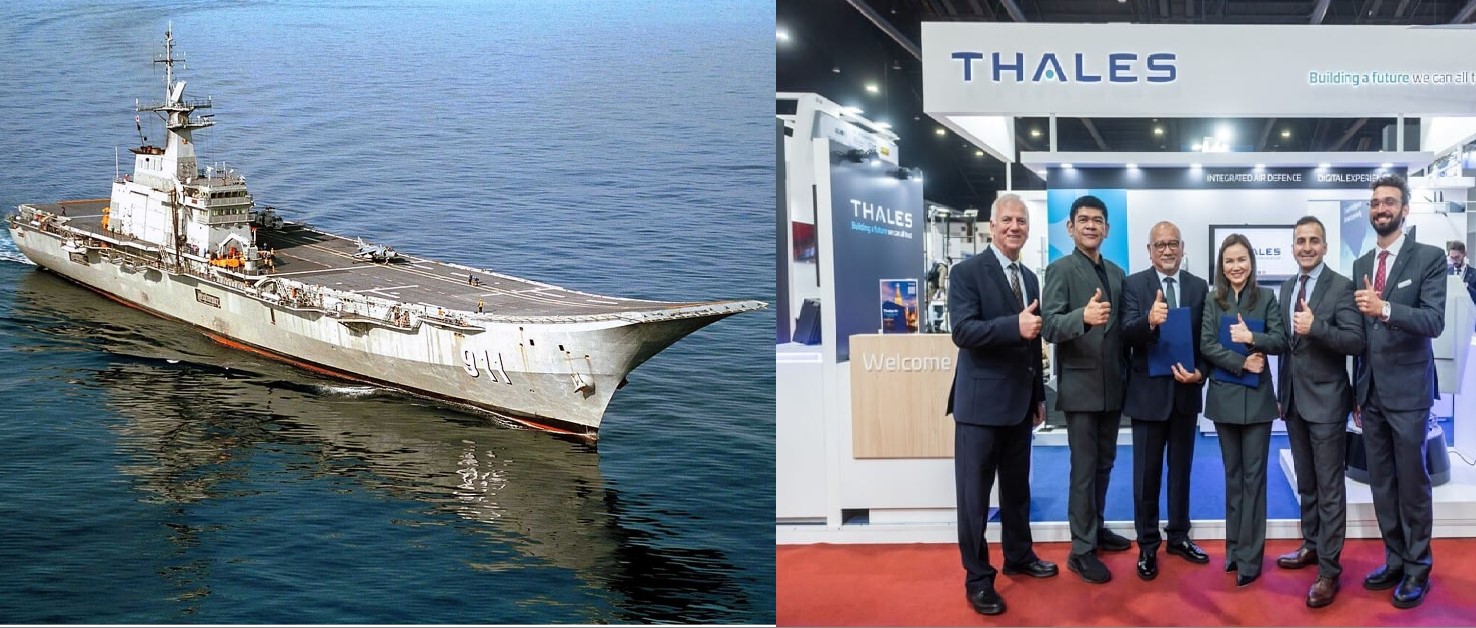
The first day of the Defense & Security 2025 exhibition in Bangkok opened with the usual mix of military hardware, trade delegations, and camera flashes. But a quieter moment — tucked inside the polished, blue-lit Thales booth — carried far more strategic weight for Thailand. Here, representatives of Thales, Universal Communication Systems Co. Ltd. (UCS), and the Royal Thai Navy (RTN) signed a contract that will fundamentally reshape the future of the country’s only aircraft carrier, HTMS Chakri Naruebet.
With that signature, the 28-year-old flagship began its long-awaited journey toward a full modernization of its Integrated Platform Management System (IPMS) — the central system that keeps the ship’s engines, power, and vital machinery alive.
A Carrier Built With Ambition, Now Confronting Age
When the Chakri Naruebet first sailed out of Spain’s Bazán/Navantia shipyard in 1997, she embodied Thailand’s maritime ambitions. At 182.6 meters in length and displacing nearly 11,486 tonnes at full load, she was conceived as a compact but capable light aircraft carrier — at that time operating AV-8S Matador V/STOL jets from her sleek ski-jump deck.
But as the years passed, budgets shifted, aircraft were retired, and modernization needs grew. The carrier continued to serve — primarily as a helicopter platform for S-70B Seahawks and MH-60S Knighthawks, and for disaster relief operations — yet the ship’s internal systems aged out of sync with modern naval demands.
Deep within her hull, outdated consoles and older control processors managed everything from propulsion to damage control. The current IPMS, upgraded once nearly a decade ago, could no longer meet operational expectations. The Royal Thai Navy knew that without replacing it, the carrier’s future would remain uncertain.
A New Digital Heart: What the Upgrade Truly Means
Thales’ newly signed contract isn’t just an upgrade — it is a complete replacement of the ship’s internal management architecture.
The new IPMS will serve as the ship’s central digital nervous system, overseeing:
-
Propulsion control
-
Electrical distribution
-
Mechanical systems
-
Auxiliary machinery
-
Fire and flood detection
-
Ventilation and fuel systems
-
Damage control and emergency automation
With real-time monitoring, intelligent alarm systems, and deeper automation, the ship’s engineering crew will work through a clean, unified, modern interface capable of predicting failures, reducing workload, and enhancing safety.
Thales will provide all critical hardware and software, while UCS will manage local installation, integration, and long-term sustainment, ensuring Thailand gains the technical capability to maintain the system independently.
Built Across Continents, Delivered in Thailand
The modernization effort spans two nations.
In Istanbul, Türkiye, Thales engineering teams will develop and test the software.
Once complete, the new equipment will be shipped to Thailand, where UCS technicians will carefully install it inside the carrier — a delicate process involving cable routing, console replacement, and system alignment.
If all remains on schedule, the project will be completed within 15 months, enabling full operational capability by early 2027.
A Partnership Strengthened
Thales and the RTN share more than five decades of cooperation. Over 80 percent of the Navy’s vessels carry Thales systems — from radars and sonars to combat management systems and mine-hunting sensors. But this marks the first time the RTN has entrusted Thales with the carrier’s platform management.
Following the signing, Nicolas Bernardin, Thales’ Country Director in Thailand, emphasized the importance of the moment:
“Modernising the flagship vessel of the Royal Thai Navy is no easy task… The IPMS will enhance the operational capability of this significant platform and marks a new chapter of partnership between Thales and UCS.”
The Carrier Behind the Upgrade: Full Technical Profile
Understanding the significance of this upgrade means understanding the vessel itself — a ship whose longevity depends entirely on the machinery the IPMS controls.
HTMS Chakri Naruebet, CVH 911
-
Builder: Bazán/Izar (now Navantia), Spain
-
Keel Laid: 1993
-
Commissioned: 1997
-
Role: Offshore patrol helicopter carrier / light aircraft carrier
-
Displacement: Approx. 11,486 tonnes (full load)
-
Length: 182.6 meters (599 ft)
-
Beam: 30.5 meters (100 ft)
-
Flight Deck: 174.6 m × 27.5 m (ski-jump equipped)
-
Propulsion:
-
Combined Diesel or Gas (CODOG) system
-
2× GE LM2500 gas turbines
-
2× Bazán-MTU 16V 1163 TB83 diesel engines
-
Two shafts
-
-
Maximum Speed: ~26 knots (48 km/h)
-
Range: 10,000 nautical miles at 12 knots
-
Crew: Approximately 600+ including air wing
-
Air Wing Capacity: Up to 14 helicopters, typically S-70B or MH-60S
-
Primary Missions: Maritime surveillance, SAR operations, HADR relief, naval training, regional engagement
These specifications reveal the scale and complexity of the vessel — and why a modern, fully integrated IPMS is essential. With thousands of sensors, pumps, valves, engines, and electrical circuits distributed throughout the hull, the carrier cannot function safely without a reliable and modern control network.
Keeping the Flagship Alive for a New Decade
The Chakri Naruebet has seen limited deployments in the past due to budget and maintenance challenges. Yet the ship remains a powerful symbol of national resolve and a versatile platform for both military and humanitarian missions.
By installing a new IPMS, the RTN ensures:
-
Extended service life into the 2030s
-
Higher operational reliability
-
Improved safety and emergency response
-
Lower maintenance costs
-
Enhanced engineering situational awareness
The upgrade revitalizes not only the ship’s systems but its role in Thailand’s maritime strategy.
The signing ceremony at Defense & Security 2025 may have been quiet, but its impact is profound. Over the next 15 months, the carrier will undergo a transformation deep inside its hull, emerging with a modernized, resilient, data-driven engineering core.
When HTMS Chakri Naruebet sails again with her renewed IPMS, she will not simply have been preserved — she will have been reborn, ready to serve Thailand into the next decade with renewed strength and reliability.
About the Author
Aditya Kumar:
Defense & Geopolitics Analyst
Aditya Kumar tracks military developments in South Asia, specializing in Indian missile technology and naval strategy.