Rolls-Royce’s 6th-Gen AMCA Engine Proposal Promises Future-Proof Power, Outshines Safran’s M88-Based Offer
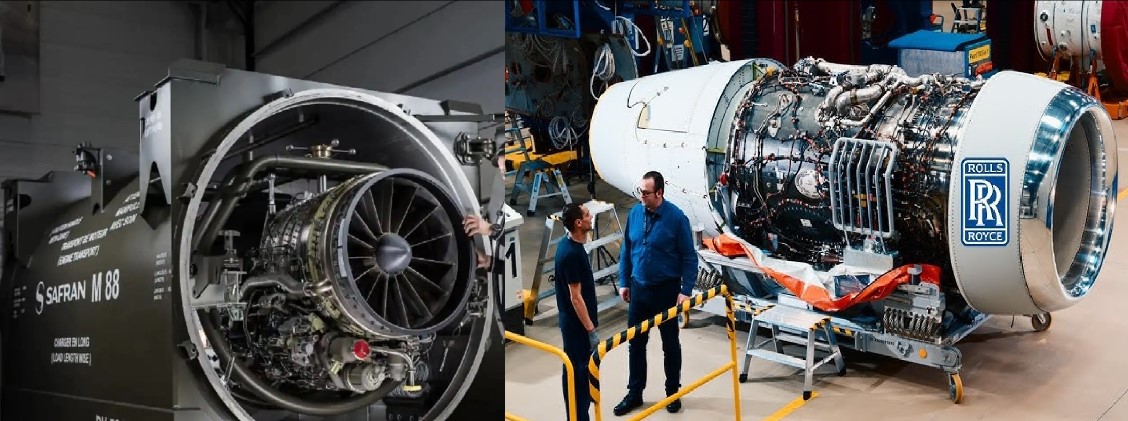
India’s ambitious Advanced Medium Combat Aircraft (AMCA) project has reached a defining moment as it prepares to select a foreign partner for co-developing the engine that will power its fifth-generation stealth fighter. The two contenders—Rolls-Royce of the UK and Safran of France—have both submitted competing proposals, but the stark contrast between the two offers is shaping an increasingly one-sided debate.
At the heart of the Indian requirement is a 110–130 kilonewton (kN) class jet engine for the AMCA Mk2 variant. The decision will not only impact the AMCA program but also India's long-term vision under Aatmanirbhar Bharat—to become a global defence technology and manufacturing hub.
Safran's M88-Based Proposal: Proven but Aged
Safran, the French aerospace company that supplies the M88 engine for the Rafale fighter, has proposed an enhanced version of this fourth-generation engine to meet AMCA's thrust requirements. This derivative approach suggests incremental development based on a legacy platform, backed by experience and proven service in the Indian Air Force (IAF).
While this proposal may offer faster timelines and leverage offsets from India’s previous Rafale deal, it presents critical limitations:
-
The M88 architecture, originally designed for a lighter airframe, might struggle to meet fifth-generation benchmarks like supercruise and low infrared signature.
-
Past cooperation between Safran and India on the Kaveri engine revival faltered due to disagreements over Intellectual Property Rights (IPR) and core technology transfer, sowing doubt about long-term independence.
-
Despite a recent willingness to match Rolls-Royce’s promise of full IPR, analysts remain cautious about relying on French proprietary technologies.
Rolls-Royce’s 6th-Gen Clean-Sheet Approach: A Leap into the Future
Rolls-Royce’s counteroffer represents a radical departure from legacy thinking. Rather than upgrading an older engine, the British firm has proposed co-developing a brand-new engine built from the ground up using sixth-generation design principles.
Key features of the Rolls-Royce proposal include:
-
A Variable Cycle Engine (VCE)—a transformative technology that allows the engine to switch between high-speed and fuel-efficient modes by altering the bypass ratio mid-flight. This improves combat performance, range, and fuel efficiency.
-
A modular core design, capable of being scaled up into a range of engines delivering between 140 to 280 kN of thrust—suitable for heavy fighters, transport aircraft, and even civil aviation platforms.
-
A firm commitment to 100% Transfer of Technology (ToT) and full IPR ownership, ensuring that India gains complete strategic autonomy over the engine's lifecycle, upgrades, and exports.
-
The creation of a domestic engine ecosystem, reducing long-term costs through economies of scale and opening opportunities for use across multiple platforms.
This proposal aligns directly with India’s goal of building a future-ready aerospace ecosystem, enabling it not only to meet current needs but also to future-proof its defence aviation sector for decades.
Strategic and Technological Implications
While both proposals come with political and industrial considerations, the Rolls-Royce offer appears to provide superior long-term benefits:
-
It encourages homegrown innovation through real technology absorption rather than mere assembly.
-
It offers a chance to leapfrog into sixth-generation engine technologies, putting India in a rare league of nations with such advanced propulsion capability.
-
It reduces the risk of foreign dependency and recurring negotiations over access, upgrades, and spares.
For the Gas Turbine Research Establishment (GTRE) under DRDO, which is managing this partnership decision, the stakes are exceptionally high. The failure of the Kaveri engine program, largely due to technological bottlenecks and lack of foreign cooperation, has made Indian policymakers particularly sensitive to IPR ownership and self-reliance.
What Lies Ahead
India is expected to announce its decision by the end of the year. The final choice will determine not just the future of the AMCA but also India’s standing as a global player in aerospace technology.
Choosing Rolls-Royce’s clean-sheet, sixth-generation engine proposal offers a path toward true strategic independence, wider technological applicability, and export potential across both military and civilian aviation.
In contrast, opting for Safran’s M88-based engine might seem familiar, but it risks locking India into an outdated architecture with limited growth headroom.
For a nation aiming to design, develop, and power next-generation fighters and beyond, the smart bet is clearly on a future-focused engine—and that’s exactly what Rolls-Royce is putting on the table.
✍️ This article is written by the team of The Defense News.