Rafael Unveils Hunter Eagle and Ghost Hunter, Advanced Drone Killers at DSEI 2025
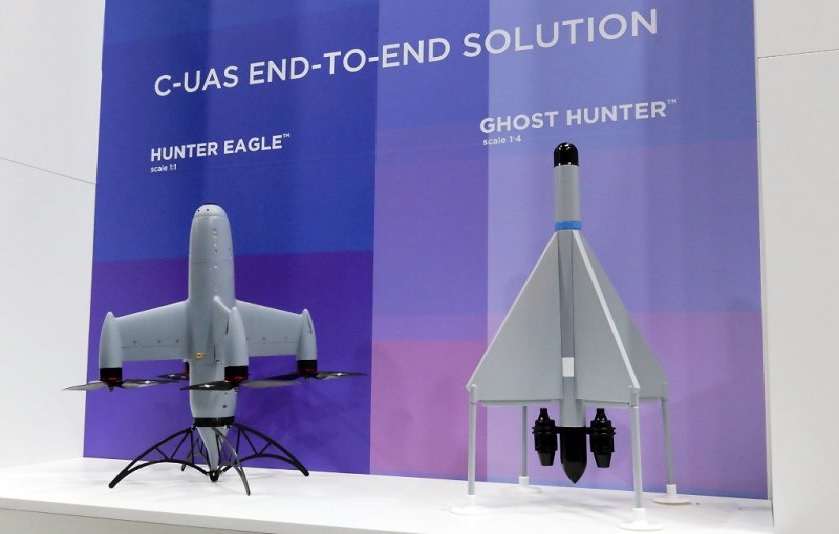
UK : At the Defence and Security Equipment International (DSEI) 2025 exhibition in London, Rafael Advanced Defense Systems showcased two next-generation drone-killing technologies: the Hunter Eagle and the Ghost Hunter. These systems are designed to enhance Rafael's Counter-Unmanned Aircraft System (C-UAS) capabilities, integrating seamlessly with the company's Drone Dome suite.
Enhancing the Drone Dome with Kinetic Effectors
The Drone Dome is a comprehensive C-UAS solution that employs a multi-layered approach to counter drone threats. It combines detection, classification, and mitigation through a suite of sensors and effectors, including radar, SIGINT radiofrequency sensors, electro-optic Speed ER sensors, jammers, and a C4I center. While effective in soft-kill engagements, the proliferation of diverse drone types necessitated the development of hard-kill capabilities.
To address this, Rafael introduced kinetic effectors such as the Samson remotely controlled weapon station and the 10 kW Lite Beam high-energy laser system. The Hunter Eagle and Ghost Hunter further augment this hard-kill capability.
Hunter Eagle: Precision Hit-to-Kill Drone
The Hunter Eagle is a compact, vertical take-off and landing (VTOL) drone designed for precision strikes. With an estimated height of 0.4–0.5 meters and a weight between 5 and 10 kg, it features a cylindrical fuselage housing an electro-optical seeker and cruciform wings equipped with electric motors driving three-blade propellers.
The drone's VTOL capability is supported by a four-legged landing gear, ensuring stability during takeoff and landing. Upon nearing its target, the Hunter Eagle autonomously engages, utilizing its seeker to guide it in the final phase of the attack.
In case of a miss or mission abort, the drone can return to its launch point and land vertically, making it suitable for urban and high-risk environments. Notably, the Hunter Eagle carries an explosive warhead, likely a high-explosive fragmentation type with a proximity fuse, allowing it to neutralize threats without direct impact. The system is designed to be inherently safe, as it does not contain any explosive material until activation.
It can operate individually or in swarms, enhancing its effectiveness against multiple threats. A demonstration is planned for late 2025, with deliveries expected to commence in 2026.
Ghost Hunter: High-Speed Jet-Powered Interceptor
The Ghost Hunter is a larger, jet-powered drone designed for high-speed engagements. The displayed 1:4 scale model at DSEI suggests a height between 1.4 and 1.6 meters and a take-off mass of approximately 50–60 kg.
Its design features a cylindrical fuselage with four delta wings arranged in a cruciform layout, and a radome concealing the radiofrequency seeker. The propulsion system comprises two small turbojets, enabling speeds up to twice that of the Hunter Eagle. Rear-mounted spikes assist in ground stability during launch.
The Ghost Hunter's architecture is still under development, with many details subject to change. The system is slated for its first demonstration in late 2026, with market availability anticipated in 2027.
Strategic Focus on Export Markets
Rafael is actively targeting the export market with these advanced drone-killing systems. The design of the drone bodies facilitates production in customer countries, aligning with Rafael's strategy to offer adaptable and locally manufacturable defense solutions.
This approach aims to strengthen international partnerships and enhance the sovereignty of allied nations in countering emerging drone threats.
The introduction of the Hunter Eagle and Ghost Hunter underscores Rafael's commitment to advancing C-UAS technologies, providing comprehensive solutions that integrate detection, classification, and mitigation capabilities to address the evolving challenges posed by unmanned aerial systems.
✍️ This article is written by the team of The Defense News.