Qatar Warns U.S Over Al-Udeid Base: ‘You Are a Tenant, Not the Owner’
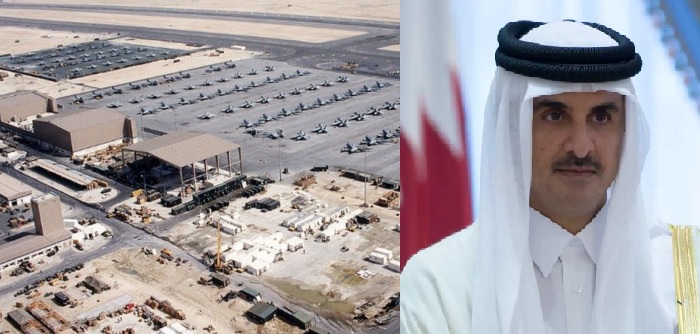
DOHA / WASHINGTON : A blunt warning from a member of Qatar’s ruling family has sent ripples through diplomatic and military circles, underscoring a shifting balance of power between Washington and its long-time Gulf partners. Speaking about the future of Al-Udeid Air Base, the royal figure dismissed the United States as “merely a tenant,” signaling that continued American access to the base can no longer be taken for granted.
The remarks, delivered amid rising regional tensions, carried an unmistakable message: Qatar believes the strategic value of Al-Udeid flows far more to Washington than to Doha. “If Qatar decides to dismantle the American base on its territory, it would not harm us much,” the royal family member said. “For you, it would be like cutting off one of your hands in the Middle East.”
The Strategic Heart of U.S. Power Projection
Located southwest of Doha, Al-Udeid Air Base is widely regarded as the nerve center of American air operations across the Middle East and Central Asia. The installation hosts roughly 10,000 U.S. military personnel and serves as the forward headquarters of United States Central Command (CENTCOM). Within the base operates the Combined Air Operations Center (CAOC), which coordinates air missions spanning Iraq, Syria, Afghanistan, and beyond.
For over two decades, the base has allowed the United States to project power rapidly across multiple theaters, making it indispensable to Washington’s regional military posture. Qatari officials, however, have increasingly emphasized that the facility exists at Doha’s discretion, not as an American entitlement.
Iran Tensions and a Quiet Red Line
The unusually sharp rhetoric comes against the backdrop of renewed friction between Washington and Iran. According to regional intelligence sources, Tehran has warned that any U.S. attack launched from Gulf territory would make host nations legitimate targets for retaliation.
In response, Qatari officials are reported to have conveyed a firm message to the White House: Qatari soil cannot be used for offensive operations that could invite Iranian strikes on the country’s critical infrastructure. The stance reflects Doha’s determination to avoid direct confrontation while preserving its role as a regional mediator.
“They convinced Donald Trump not to bomb Iran,” said one regional security analyst. “Now they’re reminding Washington who ultimately controls access. You cannot operate here without our consent.”
Visible Shifts on the Ground
Signs of strain have already emerged at Al-Udeid. Earlier this week, U.S. defense officials confirmed the withdrawal of non-essential personnel and sensitive equipment from the base, describing the move as a precautionary measure tied to regional tensions. While officially downplayed, the timing has fueled speculation that Washington is reassessing its exposure amid host-nation concerns.
For Qatar, the episode is about asserting sovereignty as much as managing risk. Over the past decade, the country has expanded its diplomatic footprint, positioning itself as an intermediary in conflicts from Afghanistan to Gaza. That confidence, analysts say, has translated into a willingness to speak more openly—even sharply—to allies.
From Security Client to Strategic Equal
For decades, Gulf states were often portrayed as security dependents under an American protective umbrella. The royal family’s remarks suggest that era is fading. Wealth, energy leverage, and strategic geography have given countries like Qatar greater room to maneuver—even when dealing with a global superpower.
“The language coming out of Doha would have been unthinkable twenty years ago,” said a former U.S. diplomat familiar with Gulf relations. “It reflects a belief that the United States needs these bases more than the hosts need the United States.”
An Uncomfortable Reality for Washington
As the United States weighs its next moves in a volatile region, Qatar’s warning serves as a stark reminder of the limits of American power. Al-Udeid may remain operational, but its future now appears tied to a more transactional, conditional relationship.
The tenant, Qatar is signaling, is still welcome—for now. But the landlord is no longer afraid to make clear who holds the keys.
About the Author
Aditya Kumar:
Defense & Geopolitics Analyst
Aditya Kumar tracks military developments in South Asia, specializing in Indian missile technology and naval strategy.
Top 6 Latest Posts


Leave a Comment: Don't Wast Time to Posting URLs in Comment Box

2026-01-18 18:51:02
This the beginning of Qatar becoming another Syria by the direct hands of Israel..the pariah of the world! If Qatari kingdom does not heed to the secret warning by Israel, their ruler's Epstein videos, pictures, and the rest will start getting released on YouTube and other media, in small batches as a warning that in one day the kingdom and of the loose pants ruling class will be a history most by the Qatari masses but through a deep set up of strategic sensitive locations of Qatar, will start blowing to smithereens. Like, the USA, each and every country that has allowed the Israelis to conduct any types of businesses, first thing Mossad and Unit 8200 undertakes very methodically in clear broad daylight is, installing incendiary devices that will cause such damage to the Qatar that the ruling class will instantly get in line to bow to Israel and the rest will be what all the GCC loose-pants have become...totally owned by the Epstein's LolitaLand deleicacies. This planting of such powerful incendiary devices has been going on since back to as early as 1950's and none of the governments every knew. Locations of these planted devices are only know exclusively to Mossad! Go figure.
