Qatar Receives First Boxer RCT30 IFVs With Advanced Anti-Drone Capabilities from KNDS Deutschland
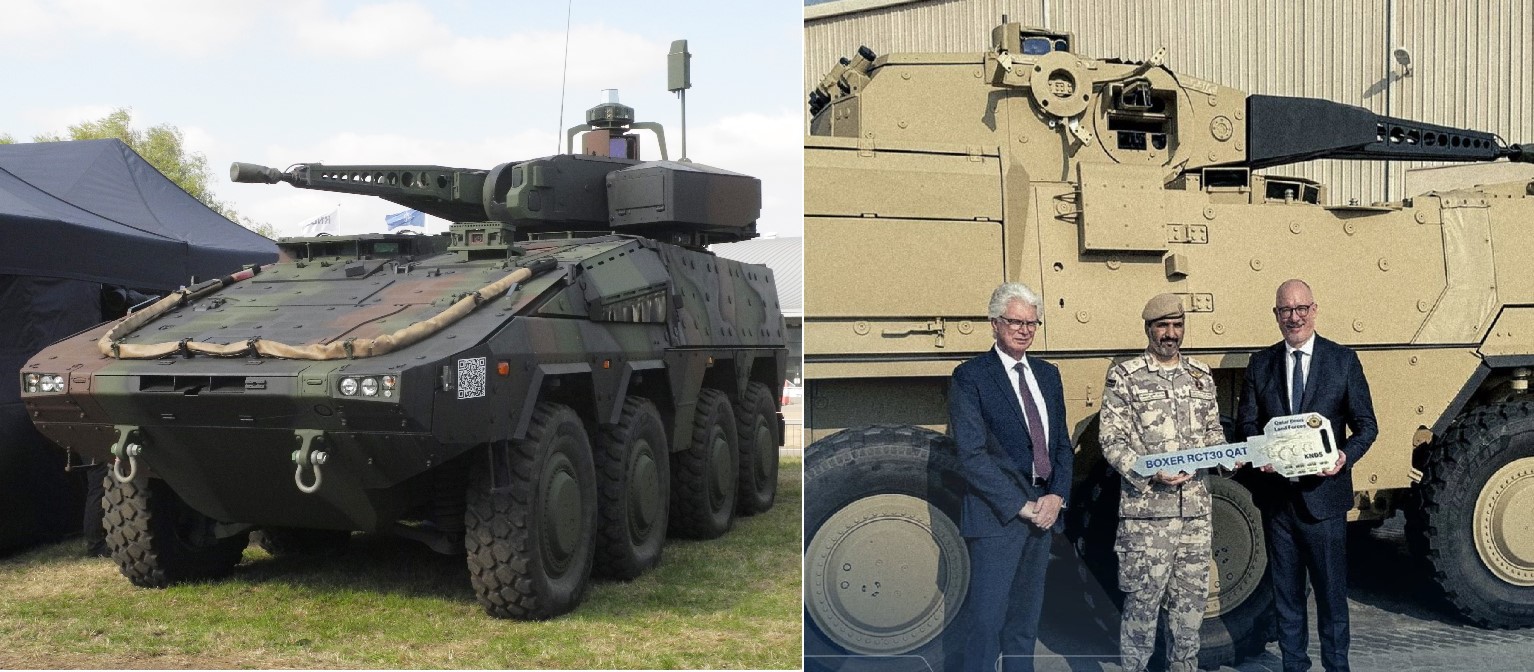
Doha has officially begun introducing its next major armored fleet component. On December 3, 2025, KNDS Deutschland delivered the first batch of Boxer RCT30 infantry fighting vehicles (IFVs) to Qatar, marking a significant step in the modernization of the Qatar Emiri Land Forces (QELF). The delivery launches full-scale induction of one of the most advanced 8×8 IFV configurations currently in production—designed to serve both mechanized roles and counter-drone missions.
Start of a New Armored Era for Qatar
The new Boxers will join a growing mechanized inventory that already includes 62 Leopard 2A7+ main battle tanks, 24 PzH 2000 self-propelled howitzers, 14 Dingo 2 MRAP vehicles, and 6 Wisent 2 armored recovery vehicles. Together, these systems form the backbone of Qatar’s increasingly modern and Western-standard land forces.
Officials connected to the program confirmed that Qatar’s interest in the RCT30 variant accelerated after its appearance at DIMDEX 2024 in Doha, where the vehicle was showcased with an integrated counter-drone suite.
Counter-Drone Capabilities Demonstrated at DIMDEX 2024
During the March 4–6 DIMDEX 2024 exhibition, Qatar displayed a Boxer RCT30 fitted with a passive radio-frequency (RF) detection system. A senior Qatari officer announced that ten vehicles with this counter-drone configuration would be delivered, describing the system as crucial for defending against commercially available drones increasingly used in reconnaissance and strike roles.
KNDS personnel at the event explained how the system works:
-
The passive RF sensor detects emissions from drones flying nearby and determines their approximate location.
-
This positional data is transmitted to the RCT30’s fire-control system to automatically aim the turret for aerial engagement.
-
The vehicle’s electro-optical cameras feed an AI-driven detection software, which can autonomously identify small drones invisible to the human eye.
With two independent detection pathways—RF and EO/AI—the Boxer RCT30 gives Qatar an effective short-range counter-UAS capability, a feature increasingly sought by militaries facing drone saturation on modern battlefields.
RCT30 Turret: Shared Lineage with the German Puma IFV
The core of the new Qatari vehicle is the RCT30 remote-controlled, unmanned turret, also in service on the German Puma IFV. Key features include:
-
MK30-2/ABM 30 mm cannon with a dual-feed system
-
Fire rate of roughly 200 rounds per minute
-
Ammunition types: AP, HE, and air-burst programmable munitions
-
360-degree continuous rotation
-
Elevation from approx. –10° to +45° for both ground and aerial engagements
-
Around 200 ready rounds stored in an armored compartment
-
Inductive programming interface for ABM rounds
The turret is built with extensive shielding around its weapon cradle, drive systems, sensors, and ammunition modules, offering resistance to small-caliber fire and fragmentation.
Boxer IFV Mobility and Protection
The Boxer RCT30 IFV is based on the proven 8×8 Boxer drive module, offering:
-
36.5–38.5 tonne combat weight depending on mission configuration
-
MTU 8V199 engine producing 530–600 kW
-
Over 100 km/h top road speed
-
Operational range beyond 650 km
-
Independent double-wishbone suspension for high mobility
-
Steering on the first two axles for improved maneuverability
-
Central tire inflation and run-flat capability
The drive module is paired with a mission module attached via modular connection points—part of the Boxer’s design philosophy that allows rapid role changes in the field.
A Multinational Production and Upgrade Pathway
The Boxer program is managed by ARTEC GmbH, a joint venture between KNDS Deutschland and Rheinmetall, with manufacturing spread across Germany, the Netherlands, Australia, and the United Kingdom.
Over the years, the platform has progressed through configurations such as A0, A1, A2, A3, B0, and C0, each introducing improvements in engine performance, armor protection, weight capacity, suspension strength, and support for heavier turret systems. This wide industrial base ensures sustained availability of spare parts, long-term software integration, and modernization pathways—advantages that Qatar will now share alongside other Boxer operators.
Global Demand for RCT30 Variants
Several armies are adopting the RCT30 turreted IFV concept for medium-weight formations:
-
Germany plans 148 RCT30-equipped Boxers for its new medium brigades.
-
The Netherlands confirmed 72 RCT30 Boxers for the 13th Light Brigade, with an option for 48 more.
-
Ukraine operates nine Boxer AiTO30 FDC vehicles in counter-drone roles.
These commonalities create a shared logistical ecosystem that Qatar can tap into for ammunition procurement, FCS updates, training, and maintenance.
Implications for Qatar’s Future Force
With the induction of the Boxer RCT30, Qatar enters a new phase of mechanized modernization. The vehicle provides Puma-grade firepower for infantry operations, combined with early adoption of integrated counter-drone systems, addressing one of the fastest-growing threats in modern warfare.
Its advanced networked fire-control system aligns Qatar’s armored fleet with NATO-standard digital architectures, ensuring compatibility with future upgrades and multinational exercises.
As deliveries progress, the Boxer RCT30 is poised to become a central asset in Qatar’s mechanized units, enhancing both traditional battlefield roles and short-range air defense in an increasingly drone-saturated regional environment.
About the Author
Aditya Kumar:
Defense & Geopolitics Analyst
Aditya Kumar tracks military developments in South Asia, specializing in Indian missile technology and naval strategy.