Poland Successfully Tests Three-Stage Suborbital Rocket, Reaches 65 km Altitude
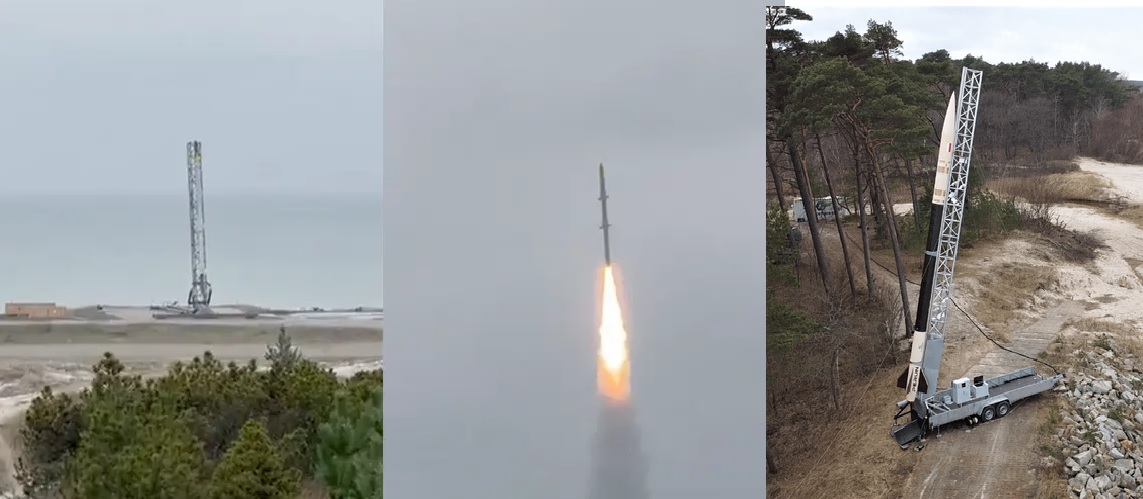
Poland has taken a major leap in its growing aerospace and defense ambitions, successfully test-launching a domestically built three-stage suborbital rocket at the Ustka test range on the Baltic Sea. Deputy Defense Minister Cezary Tomczyk announced the achievement on Monday, calling it an important milestone in the development of Poland’s indigenous missile and space-launch capabilities.
A Rocket That Hit Every Mark
According to Polish defense officials, the rocket reached an altitude of 65 kilometers, completing stage separation, guidance, and trajectory performance exactly as planned. While the system was designed primarily for scientific and technological experiments in near-space, Tomczyk hinted that its capability could extend far beyond research use in the future.
Defense analysts note that a reliable three-stage booster with precision guidance could form the technological basis for tactical long-range strike systems, should Warsaw decide to move in that direction. Although officials stopped short of confirming military intentions, the test’s location at a military range and the Ministry of Defense’s direct involvement signal clear dual-use potential.
Another Polish Rocket Takes to the Sky
The successful launch follows a second milestone at the same site just days earlier. On Saturday, SpaceForest, a rapidly emerging Polish private aerospace firm, conducted a successful test flight of its PERUN suborbital rocket. That vehicle reached an altitude of 50 km, validating flight-control systems and propulsion technologies developed entirely within Poland.
SpaceForest has been working on PERUN under a broader plan to create low-cost reusable rockets capable of carrying small scientific and commercial payloads. The company is also collaborating with European partners on advanced electronics and propulsion systems, aiming to position Poland as a new player in the European small-launch market.
Poland’s Expanding Space Program
Poland's recent progress is the product of a decade of accelerating investment:
-
Polish Space Agency (POLSA), formed in 2014, coordinates national space strategy and partnerships with the European Space Agency (ESA).
-
Poland contributes to ESA missions, including Earth observation, satellite communication, and micro-satellite development projects.
-
Domestic companies such as Creotech Instruments, PIAP Space, and SatRevolution are developing microsatellites, onboard computers, robotic arms, and optical instruments for international customers.
-
In 2023, Poland signed an agreement to participate in NASA’s Artemis program, joining efforts to return humans to the Moon and develop future lunar infrastructure.
-
Work continues on Poland’s EagleEye Earth-observation satellite, built with entirely local industrial participation.
The renewed military interest in space technologies reflects the shifting security climate in Europe. Poland, already one of NATO’s fastest-modernizing militaries, has emphasized missile defense, long-range strike, and high-end reconnaissance as priorities. Suborbital rockets offer a testing ground for propulsion systems, guidance algorithms, and materials that could later feed into more advanced defense programs.
A New Player in Europe’s Rocket Landscape
With two successful suborbital launches in less than a week, Poland has signaled that it is no longer merely an observer in the global launch sector. While the country has long contributed to European scientific missions, these tests demonstrate a shift toward independent national launch capability—a goal typically associated with more established aerospace nations.
As Poland continues developing both government and private launch technologies, analysts say the country could soon join the growing list of European states building indigenous rockets, which includes France, the U.K., Germany, and Spain. For Warsaw, the message is clear: whether for science, industry, or national security, Poland intends to build and launch more of its own hardware into the sky.
With momentum growing across both public and private sectors, these latest tests mark what may be the beginning of Poland’s new era as a space-capable nation.
About the Author
Aditya Kumar:
Defense & Geopolitics Analyst
Aditya Kumar tracks military developments in South Asia, specializing in Indian missile technology and naval strategy.