Poland Seals $10 billion Deal For 96 AH-64E Apache Guardian Attack Helicopters, Largest Apache Operator Outside the US
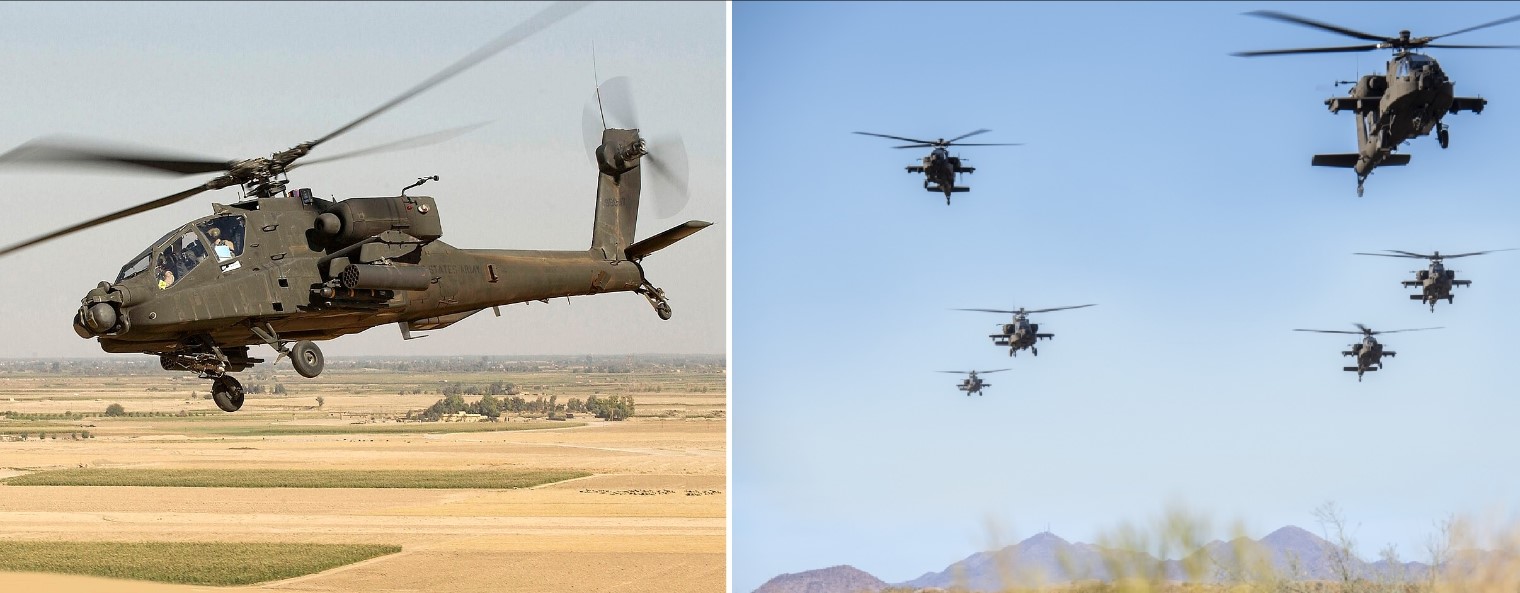
Poland has formally locked in a massive production contract for 96 AH-64E Apache Guardian attack helicopters, cementing its place as the largest Apache operator outside the United States and one of NATO’s most heavily armed land forces. The deal, worth about $10 billion when weapons, training, and support are included, is a cornerstone in Warsaw’s fast-tracked military buildup following Russia’s full-scale invasion of Ukraine in 2022.
From US Approval To Signed Contract
The Apache story for Poland began in August 2023, when the US State Department approved a potential Foreign Military Sales (FMS) package including 96 AH-64E Apaches and a full ecosystem of radars, engines, weapons, training, and logistics, with an estimated value of $12 billion . This cleared the political and legal path in Washington for the helicopter sale.
On 13 August 2024, Poland’s Deputy Prime Minister and Defence Minister Władysław Kosiniak-Kamysz announced that Warsaw had signed the Letter of Offer and Acceptance (LOA) for 96 AH-64E Apache Guardians, describing it as a transformative step for the Polish Armed Forces. The deal was publicized at the 56th Inowrocław-Latkowo Air Base, headquarters of the 1st Land Forces Aviation Brigade, which is expected to become one of the key Apache hubs.
The US Army then awarded Boeing a foreign military sales production contract in late November 2025, valued at nearly $4.7 billion, covering Apache helicopters for several international customers, including the full batch of 96 for Poland. This production contract translates the earlier political approvals into firm manufacturing orders.
Delivery Timeline: 2028 And Beyond
According to Polish government statements and Boeing’s official release, deliveries are scheduled to begin in 2028 and are expected to continue into the early 2030s, with some Polish sources indicating a working window of 2028–2032 for the full fleet to arrive.
To avoid a capability gap and accelerate training, Poland has already signed a separate lease deal for eight AH-64D Apache helicopters from the US Army. That lease, reportedly worth about $300 million, was concluded in early 2025 and allows Polish pilots, ground crews, and commanders to gain hands-on experience with the Apache platform years before the first new-build AH-64E is delivered.
Boeing notes that Poland has already started to train pilots and maintainers and is integrating Apache-related infrastructure into its air bases and logistics system, ensuring that the aircraft can enter service with minimal delay once they arrive from the production line in Mesa, Arizona.
Why The AH-64E Matters For Poland
The AH-64E Apache Guardian is the latest and most advanced variant of the iconic Apache family. Compared to older models, the E-version features upgraded GE T700-701D engines, new composite main rotor blades, and a fully modernized digital architecture. These upgrades improve hot-and-high performance, flight range, and payload, while also enabling faster data processing and integration with other platforms.
The Polish Apaches will be equipped with the standard US-export suite of sensors and weapons, including the mast-mounted Longbow fire control radar, advanced electro-optical systems, and the ability to fire AGM-114 Hellfire or AGM-179 JAGM precision missiles, unguided and guided rockets, and the 30 mm chain gun. In addition, the AH-64E is designed for network-centric warfare: it can share target data over tactical datalinks and cooperate with unmanned aerial vehicles, allowing the helicopter to direct strikes without exposing itself directly.
For Poland, these capabilities are intended to mesh with other new acquisitions such as M1A2 Abrams and K2 Black Panther main battle tanks, HIMARS and K239 Chunmoo rocket artillery, and new air-defence systems like Patriot and Narew. Together, they are meant to create a layered, mobile, high-firepower deterrent along NATO’s eastern flank.
Largest Apache Operator Outside The US
Once the 96 helicopters are delivered, Poland will become the largest Apache operator outside the United States, surpassing long-time users such as the United Kingdom, Israel, and Japan. With this fleet size, Poland will also rank as the second-largest Apache user overall, behind only the US Army.
This scale matters for several reasons. First, it allows Warsaw to distribute Apaches across multiple brigades and regions, while maintaining training, test, and reserve pools. Second, it creates an economic case for deeper industrial cooperation, including potential Polish participation in maintenance, repair, and overhaul (MRO) activities and supply-chain work related to Apache components. Boeing has already highlighted Poland as the 19th global operator and has signalled interest in expanding partnerships with Polish industry as part of the wider deal.
Strategic Signal To Moscow And NATO
Beyond the technical and financial details, the Apache contract sends a clear political message. Since 2022, Poland has positioned itself as one of Ukraine’s most vocal supporters and as a frontline state preparing for high-intensity conflict with Russia should deterrence fail. Large-scale purchases of tanks, artillery, air-defence systems, and now advanced attack helicopters are intended both to bolster Poland’s own security and to reassure NATO allies that the eastern flank will be heavily defended.
At the same time, the deal underlines the deepening defence-industrial ties between Warsaw and Washington. By choosing the AH-64E Apache Guardian and integrating it with US-origin tanks, air-defence batteries, and command-and-control networks, Poland is binding its military future ever more tightly to US technology and logistics. For the United States, the contract reinforces a key NATO partner, expands the global Apache community, and sustains production lines that are vital to American and allied aviation.
With deliveries starting in 2028 and running into the next decade, the Apache fleet will form a central pillar of Poland’s land-attack and anti-armour capability for many years to come — a long-term investment in deterrence at a time when Europe’s security environment remains highly unstable.
About the Author
Aditya Kumar:
Defense & Geopolitics Analyst
Aditya Kumar tracks military developments in South Asia, specializing in Indian missile technology and naval strategy.