Poland Activates Patriot Defenses as Russian MiG-31Ks Armed With Kinzhal Missiles Fly Near NATO’s Northeastern Flank
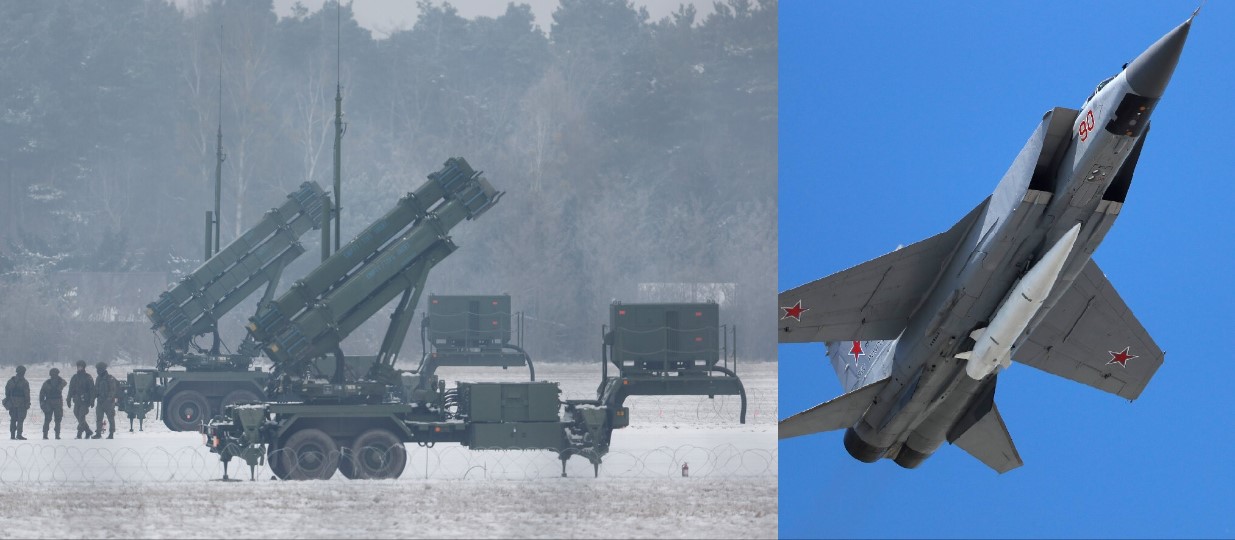
Poland placed its Patriot air-defense systems at Rzeszów-Jasionka Airport on a brief high-alert posture on 28 November 2025 after four Russian MiG-31K fighters, each reportedly carrying a Kh-47M2 Kinzhal aeroballistic missile, flew westward over the Baltic Sea while staying entirely within Russian airspace. The development, first reported by Bild and circulated by regional outlets, prompted an immediate defensive response because of the aircrafts’ long-range strike capability and proximity to NATO’s northeastern flank.
The incident did not involve any airspace violation, but the combination of high-speed interceptor aircraft and hypersonic-capable missiles moving along the alliance’s periphery triggered standard NATO contingency procedures. Officials in Warsaw described the rapid alert as part of a “normal yet necessary” defensive protocol given the strategic importance of Rzeszów, the primary transit hub for Western military aid to Ukraine.
A High-Speed Russian Patrol That Prompted a Rapid NATO Reaction
Radar and allied tracking systems detected the four MiG-31K “Foxhound” aircraft flying west over the Baltic region, maintaining a course inside Russian airspace near Kaliningrad. Defense analysts noted that while such flights are not unusual, the configuration—MiG-31Ks carrying Kinzhals—significantly elevates the threat calculus.
The MiG-31K is a specialized long-range strike variant capable of reaching Mach 2.8 to Mach 3, allowing Russia to position hypersonic weapons at great distances in short timeframes. When paired with the Kinzhal, a missile believed to travel up to Mach 8–10 and strike targets more than 1,500 kilometers away, the aircraft becomes one of Russia’s most potent strategic assets.
Military officials acknowledged that while the flight did not suggest an imminent attack, it had to be treated with maximum seriousness due to the system’s ability to target airbases, command nodes, and logistical hubs deep inside NATO territory.
Polish and German Patriot Units Shift to High Readiness
At Rzeszów-Jasionka, German-operated Patriot batteries deployed under NATO command were shifted to a heightened alert level. These systems include:
-
AN/MPQ-65 phased-array fire-control radar
-
Engagement control stations connected to NATO’s Integrated Air and Missile Defence network
-
PAC-2 GEM-T and PAC-3 MSE interceptors capable of defeating high-speed aircraft, cruise missiles, and short-range ballistic threats
The move ensured rapid engagement capability in the event any trajectory or threat signature indicated a potential strike.
Officials stressed that the alert was precautionary but essential, reflecting how deterrence today relies on instant responsiveness as much as on advanced hardware.
Why Rzeszów-Jasionka Matters
The Rzeszów-Jasionka airfield, located near the Ukrainian border, remains NATO’s most crucial logistics hub for delivering Western weaponry, ammunition, and humanitarian supplies to Kyiv. It is routinely used for:
-
U.S. and European military transport operations
-
Drone, surveillance, and intelligence flights
-
Medical evacuations and rapid equipment transfers
Its importance makes it a high-value target in any escalation involving Russia.
A Polish defense official noted that protecting Rzeszów is “a responsibility shared across the alliance,” given that any disruption could directly affect Ukraine’s battlefield resilience.
A Strategic Message From Moscow
The choice of MiG-31Ks—rather than conventional strike aircraft—suggests the flight may have been intended as a strategic signal. NATO analysts believe the patrol likely aimed to:
-
Test NATO’s integrated air-defense response time
-
Assert Russian long-range strike capability
-
Pressure Western governments as they continue supplying arms to Ukraine
-
Maintain constant psychological signaling along the Baltic corridor
The activity fits broader patterns of Russian military behavior, which increasingly includes long-range sorties intended to gauge NATO’s posture.
A Real-Time Test of NATO Air and Missile Defense
For Poland and the alliance, the incident served as a real-time rehearsal of crisis readiness. It validated the speed and coordination among Polish, German, American, and Baltic commands, while reinforcing that even flights conducted strictly within Russian territory can alter alert levels across NATO’s front line.
A NATO official, speaking anonymously, said the response highlighted “the new reality on the eastern flank, where seconds matter and proximity alone can trigger a full defensive posture.”
Although the Russian aircraft never crossed into NATO territory, their presence—with Kinzhal missiles onboard—was enough to activate a coordinated, high-speed defensive reaction. The brief alert at Rzeszów-Jasionka underscores the sensitivity of the current strategic environment and the importance of protecting NATO’s most vital supply corridor to Ukraine.
In a region where major powers operate in close proximity, even routine flights now carry strategic weight—and require readiness of the highest order.
About the Author
Aditya Kumar:
Defense & Geopolitics Analyst
Aditya Kumar tracks military developments in South Asia, specializing in Indian missile technology and naval strategy.