Pentagon Approves $8.6 Billion Deal for 25 F-15IA Fighters to Israel, With Option for 25 More
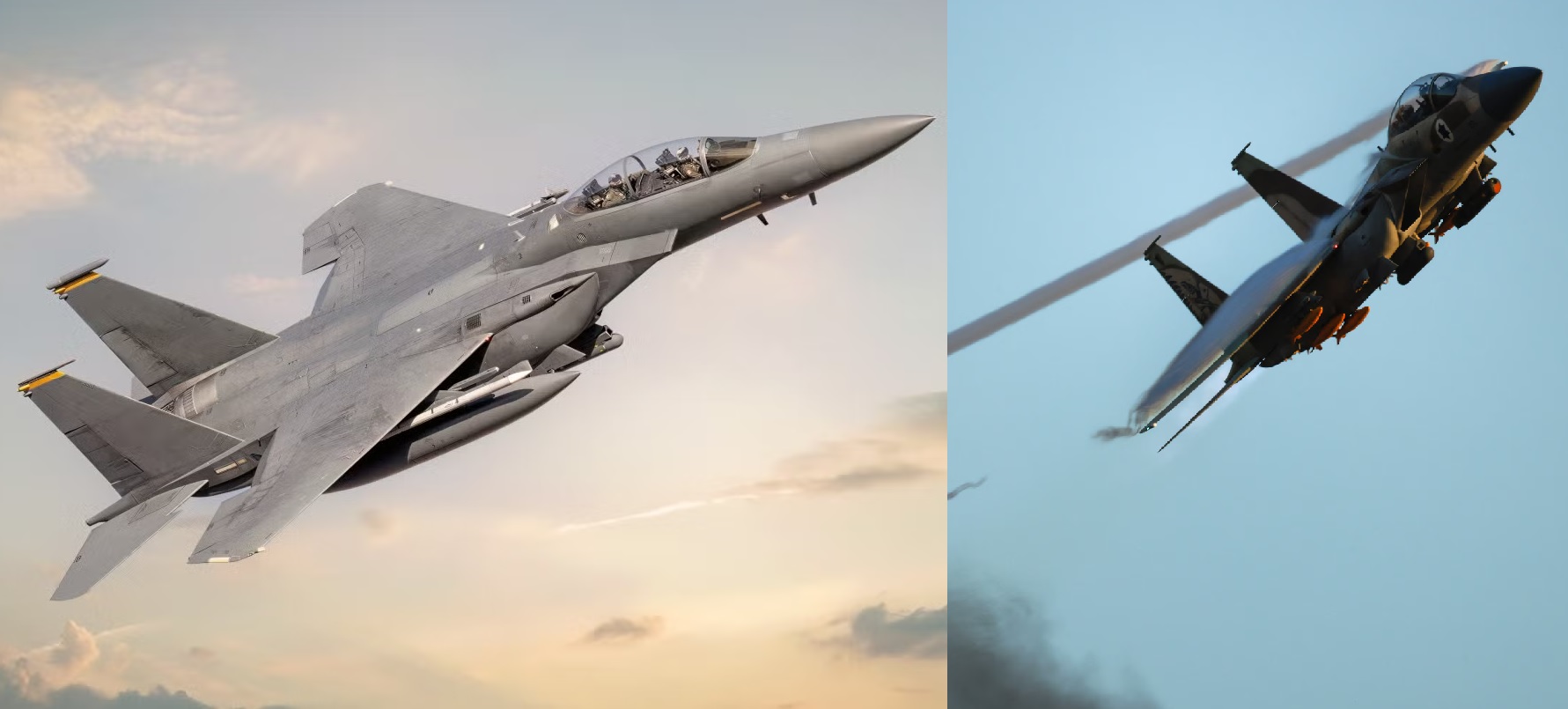
The United States has formally approved Israel’s acquisition of the F-15IA (Israel Advanced) fighter jet, a highly customised variant of the latest F-15EX, in what officials describe as the most significant modernisation of Israel’s F-15 fleet since its induction more than four decades ago.
The approval culminated in an $8.6 billion contract awarded by the Pentagon to Boeing on December 29, 2025, covering the design, integration, testing, production, and delivery of 25 F-15IA aircraft, with an option for 25 additional jets. The agreement is structured as a Foreign Military Sale (FMS) to Israel and follows high-level political engagement between US President Donald Trump and Israeli Prime Minister Benjamin Netanyahu during their meeting at Mar-a-Lago in Florida.
According to the Pentagon, all work under the contract will be carried out in St. Louis, Missouri, with the programme scheduled to run until December 31, 2035.
A Proven Fighter, Reinvented for the Next Decade
The F-15 has been a cornerstone of the Israel Air Force (IAF) since 1976, when Israel began inducting the F-15 Baz. The aircraft etched its place in aviation history in 1979, scoring its first confirmed air-to-air kill and going on to build an unmatched combat record.
Globally, the F-15 family is credited with over 100 air-to-air kills with zero combat losses, a distinction unmatched by any other fighter aircraft. Israeli pilots are believed to account for at least half of these victories, achieved across multiple conflicts in the Middle East.
Despite the introduction of stealth fighters such as the F-35I Adir, Israeli planners have continued to rely on the F-15 for missions demanding long range, heavy payloads, and sustained combat presence—roles that newer stealth platforms cannot always fulfil as efficiently.
What Makes the F-15IA Different
The F-15IA is a tailored evolution of the F-15EX, integrating state-of-the-art US systems with advanced Israeli avionics, electronic warfare suites, and weapon integrations. Compared to the older F-15I Ra’am, which entered IAF service in 1998, the new IA variant represents a generational leap.
The aircraft features a fully digital glass cockpit, dominated by a 10×19-inch touchscreen multifunction display, modern standby instruments, and HOTAS controls. Both crew members are equipped with JHMCS II helmet-mounted cueing systems, enabling 360-degree target acquisition in air-to-air and air-to-ground combat.
At the heart of the upgrade is the AN/APG-82(V)1 AESA radar, replacing the mechanically scanned APG-70 of the Ra’am. The AESA radar offers longer detection ranges, higher resolution, improved resistance to jamming, and seamless integration with electronic warfare systems—dramatically enhancing performance in contested environments.
Survivability is further strengthened by the Eagle Passive/Active Warning Survivability System (EPAWSS), providing advanced threat detection, digital jamming, and countermeasures against modern air-defence networks.
Payload, Range, and the ‘Bomb Truck’ Advantage
One of the F-15’s enduring strengths—now amplified in the IA variant—is its ability to carry exceptionally large and diverse weapon loads over long distances. The F-15IA is designed to support outsized munitions, including heavy bunker-busters, long-range standoff weapons, air-launched ballistic missiles, and potentially future hypersonic weapons, without sacrificing manoeuvrability.
The aircraft remains compatible with key US munitions such as AIM-120 AMRAAM, AIM-9X Sidewinder, JDAMs, and the M61A1 Vulcan cannon, while also integrating Israeli-developed precision weapons and electronic-attack systems. This flexibility has earned the F-15 its enduring nickname within the IAF: the “Bomb Truck.”
Combat Legacy: From Osirak to Iran
Israeli F-15s have been involved in nearly every major IAF operation since the late 1970s. In 1981, they provided escort during Operation Opera, the long-range strike that destroyed Iraq’s Osirak nuclear reactor near Baghdad. During the 1982 Lebanon War, F-15 Baz fighters achieved overwhelming air superiority, downing dozens of Syrian aircraft—including MiG-21s, MiG-23s, and MiG-25s—without a single air-to-air loss.
The type’s legend was further cemented in 1983, when an Israeli F-15 famously landed safely despite losing an entire wing in a mid-air collision during training.
More recently, F-15I Ra’am jets have played a central role in operations over Gaza, Syria, and Lebanon, flying thousands of sorties after October 2023 and delivering heavy precision payloads in coordination with F-35I and F-16I fighters. The platform was also used during Operation Rising Lion in June 2025, when Israeli aircraft struck Iranian nuclear facilities, air-defence sites, and command centres—missions that underscored the continued relevance of the F-15 in long-range, high-risk operations.
Strategic Impact
With the induction of the F-15IA, Israel is effectively future-proofing a platform that has already defined its air dominance for nearly half a century. The new jets will operate alongside fifth-generation fighters, acting as heavy strike platforms, airborne command-and-control nodes, and long-range interceptors, particularly against emerging threats such as ballistic missiles, cruise missiles, and drones.
As regional tensions persist and adversaries invest in layered air defences, the arrival of the F-15IA is set to reinforce Israel’s qualitative military edge—ensuring that a legendary fighter remains at the forefront of Middle Eastern air power well into the 2030s and beyond.
✍️ This article is written by the team of The Defense News.