Pakistan Tests Fatah-4 Cruise Missile : Why Not Effective Against India
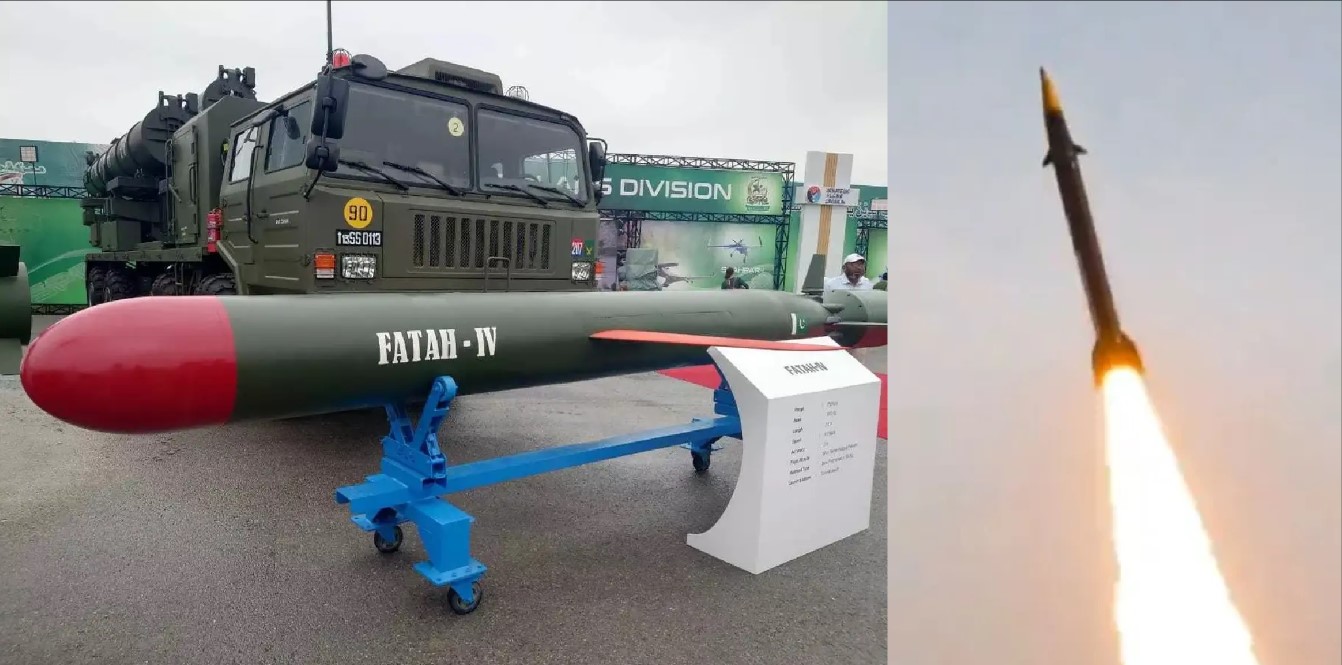
Pakistan on Tuesday announced the successful training launch of its newly inducted and indigenously developed Fatah-4 cruise missile, a weapon system claimed to have a strike range of 750 kilometres. According to the Inter-Services Public Relations (ISPR), the missile is equipped with advanced avionics, state-of-the-art navigational aids, and terrain-hugging flight features designed to help it evade missile defence systems and strike with high precision.
The launch was witnessed by the Chief of General Staff, senior military officials, scientists, and engineers. Pakistan’s President, Prime Minister, Chairman Joint Chiefs of Staff Committee (CJCSC), and service chiefs congratulated the Army Rocket Force Command and scientific community on what was described as another step in enhancing the country’s conventional deterrence.
Claimed Capabilities of Fatah-4
The missile is projected by Pakistan’s military to play a key role in extending the reach, lethality, and survivability of its conventional missile forces. By integrating into the Army Rocket Force Command, the system is intended to give the Pakistan Army an option to engage strategic infrastructure, air bases, and logistics nodes across the Indian border.
The Fatah-4’s defining feature, according to the ISPR, is its terrain-hugging capability—allowing it to fly at very low altitudes, thereby reducing radar visibility. This feature has been a hallmark of cruise missile design worldwide, giving them the ability to bypass static air defence radars and strike with surprise.
Vulnerabilities Against India
While the ISPR emphasized the missile’s advanced guidance and survivability, analysts point out that subsonic cruise missiles like Fatah-4 remain slow-moving and vulnerable to interception. With a likely cruising speed of around Mach 0.7 to Mach 0.8, the missile could take nearly 45 minutes 33 seconds to reach maximum range targets in India.
India’s multi-layered air defence architecture—including the Akash surface-to-air missile system, S-400 Triumf batteries acquired from Russia, and the indigenous Ballistic Missile Defence (BMD) program—provides robust interception capability against such threats. Unlike supersonic or hypersonic missiles, which compress reaction time, subsonic systems such as the Fatah-4 are considered less survivable in contested airspaces.
Strategic Messaging vs. Tactical Reality
The Fatah-4 launch reflects Pakistan’s continued emphasis on missile development as a tool for strategic messaging, particularly in response to India’s expanding air defence and precision-strike capabilities. However, defence think tanks argue that such systems, while domestically celebrated, offer limited deterrent value against a technologically superior adversary like India.
Experts highlight three key points:
-
Range Gap with India’s Systems – India already operates cruise and ballistic missiles with longer ranges and diverse launch platforms, including the BrahMos supersonic cruise missile (with a range of 450–600 km and extended versions under development up to 800 km). The Fatah-4, despite its 750 km range, lacks the speed advantage of BrahMos.
-
Reliance on Conventional Payloads – Unless nuclear-capable, subsonic cruise missiles provide limited escalation value. India’s doctrine of “Cold Start” and rapid mobilization is unlikely to be significantly deterred by Pakistan’s incremental additions to its missile inventory.
-
Technological Catch-Up – Pakistan’s emphasis on labeling systems “indigenous” often masks continued reliance on Chinese design inputs and components, raising questions about the true level of self-reliance in such projects.
Broader Context of Regional Missile Race
The unveiling of Fatah-4 also underscores the missile race in South Asia, where both India and Pakistan have invested heavily in expanding their conventional and nuclear strike capabilities. India has tested and inducted Agni-series ballistic missiles, BrahMos cruise missiles, and is working on hypersonic technologies, while Pakistan has pursued the Babur cruise missile family, Shaheen ballistic missiles, and now the Fatah series.
However, the qualitative gap remains significant. India’s ability to integrate missiles into network-centric warfare systems, coupled with satellite reconnaissance and electronic warfare assets, makes Pakistani systems like Fatah-4 less survivable in a real-world conflict scenario.
About the Author
Aditya Kumar:
Defense & Geopolitics Analyst
Aditya Kumar tracks military developments in South Asia, specializing in Indian missile technology and naval strategy.