Pakistan Signs $4 Billion Libya Arms Pact Under UN Embargo as Army Chief Makes Unverified War Claims
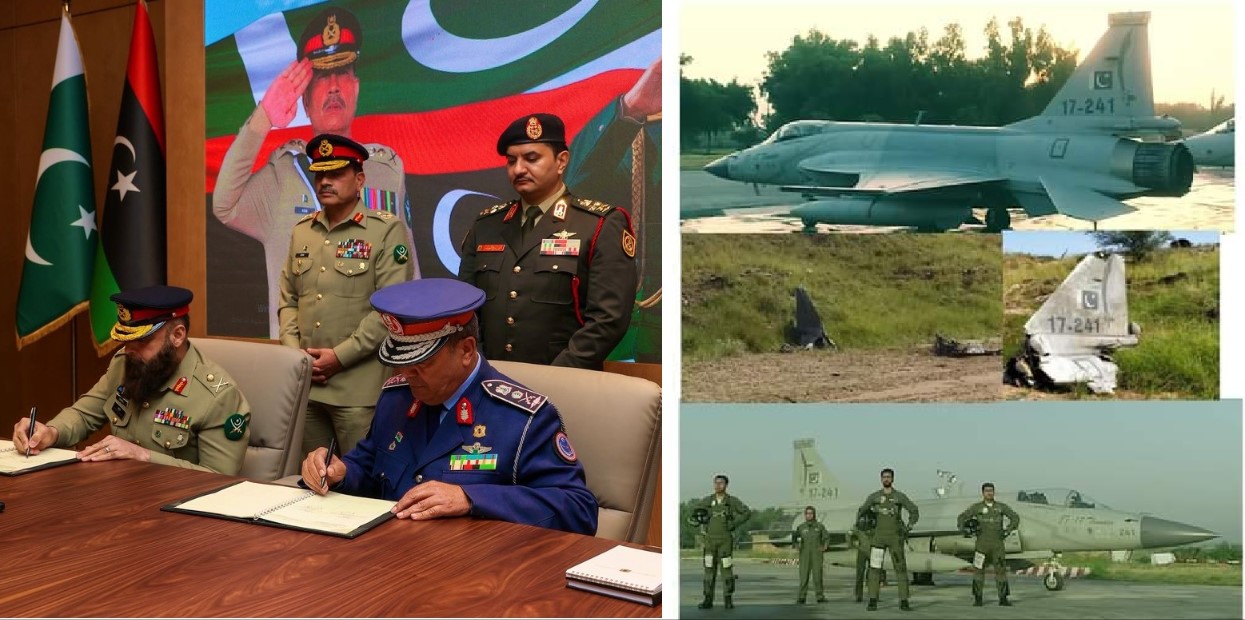
Pakistan and Libya have concluded a major military equipment agreement valued at more than $4 billion, according to a report by Reuters, significantly expanding Islamabad’s defence footprint in North Africa. The deal was finalised after a meeting last week in Benghazi between Pakistan Army chief General Asim Munir and senior leaders of the Libyan National Army (LNA), despite an existing United Nations arms embargo on Libya.
The agreement was sealed during Munir’s engagement with Saddam Khalifa Haftar, the Deputy Commander-in-Chief of the LNA, according to four Pakistani officials familiar with the negotiations. The officials, speaking on condition of anonymity due to the sensitivity of defence matters, said the pact spans land, sea and air force equipment and will be implemented over roughly two-and-a-half years.
Fighter Jets, Trainers and Broader Military Supplies
A copy of the agreement reviewed by Reuters before its finalisation lists the sale of 16 JF-17 multi-role fighter aircraft and 12 Super Mushak trainer aircraft to Libya. The JF-17, jointly developed by Pakistan and China, is the centrepiece of Islamabad’s defence export push, while the Super Mushak is used for basic and intermediate pilot training.
Two of the officials valued the deal at more than $4 billion, while the remaining two placed the figure at around $4.6 billion. In addition to aircraft, the agreement reportedly includes equipment for Libya’s ground and naval forces, though specific systems were not publicly detailed.
The LNA’s official media channel later confirmed that it had entered into a defence cooperation framework with Pakistan covering weapons sales, joint training and military manufacturing, without disclosing further terms.
Agreement Signed Despite UN Arms Embargo
The timing of the deal has drawn attention because Libya remains under a United Nations arms embargo imposed amid years of political instability and armed conflict. The country continues to be divided between rival administrations in the east and west, with the LNA controlling large parts of eastern Libya.
Neither Pakistan nor Libyan authorities have publicly explained how the agreement aligns with the UN restrictions. Analysts say the deal underscores the growing competition among regional and global powers seeking influence over Libya’s fragmented security institutions and oil-backed economy.
Munir’s Speech and Contested Claims on India
During his interaction with Libyan commanders, General Asim Munir highlighted Pakistan’s military experience and domestic defence industry. He said that removing fear allows a nation to achieve its goals and claimed Pakistan had learned this lesson “long ago.”
Munir also reiterated claims regarding Pakistan’s recent clashes with India, asserting that nearly 90 per cent indigenous technology was used by Pakistan during the conflict. He further claimed that Pakistan’s air force shot down Indian Rafale jets, Mirage 2000s, Su-30s and MiG-29 aircraft, and destroyed India’s S-400 air defence system.
India has repeatedly rejected these assertions, stating that Pakistan has not produced a single piece of verifiable evidence to support its claims of downing Indian aircraft or destroying the S-400 system. Indian officials have said no such losses occurred, describing Pakistan’s statements as false and misleading.
India Cites Evidence, Independent Assessments
Indian authorities, by contrast, have pointed to what they describe as multiple forms of evidence, including official briefings, imagery and independent assessments. India has said that independent commercial satellite imagery showed significant damage to Pakistani military infrastructure, indicating heavy losses on Pakistan’s side, including the destruction of air bases and the loss of multiple Pakistani military aircraft
Military analysts and defence experts from several countries have also publicly assessed the conflict, with many concluding that India achieved all its stated operational objectives, while Pakistan failed to meet its military goals. These experts have cited the absence of proof from Pakistan, alongside satellite data and open-source intelligence, to support their conclusions.
Defence Exports and Strategic Outreach
Munir told Libyan leaders that Pakistan was prepared to share its military technology, describing Libya as a “brotherly nation” and stating that a strong armed force ensures the survival of a state.
The Libya deal fits into Pakistan’s broader effort to expand defence exports by promoting its aircraft, training and maintenance capabilities as lower-cost alternatives outside Western supply chains. Islamabad has frequently highlighted its counter-insurgency experience and domestic defence industry, spanning aircraft production, armoured vehicles, munitions and naval construction.
At the same time, Pakistan has been deepening security ties in the Middle East, recently signing a Strategic Mutual Defence Agreement with Saudi Arabia and holding senior-level defence talks with Qatar.
Expanding Presence in North Africa
The Libya agreement is expected to boost Pakistan’s strategic presence in North Africa at a time when Libya remains a focal point of international competition. As implementation moves forward, the deal is likely to face close international scrutiny, both for its implications under the UN arms embargo and for what it signals about Pakistan’s ambitions as an emerging defence exporter.
If you want, I can tighten the language further, add quotes-style attribution, or rewrite it to match a specific Indian or international newsroom tone.
✍️ This article is written by the team of The Defense News.