Pakistan Launches 'PNS Ghazi' Fourth Hangor-Class Submarine Built By China
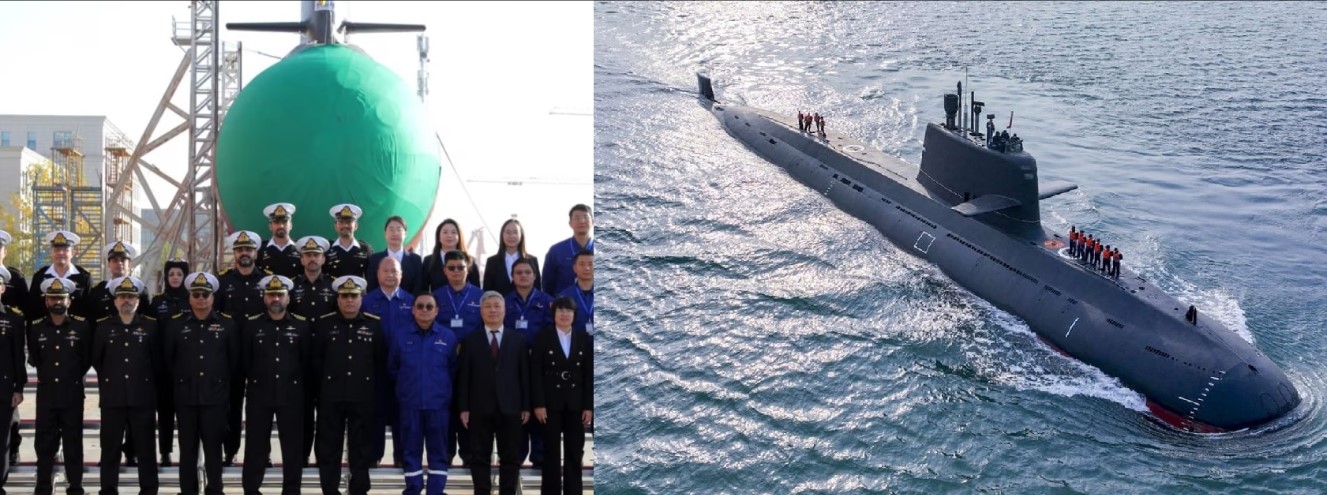
The Pakistan Navy on December 17, 2025, announced the launch of its fourth Hangor-class diesel-electric attack submarine, PNS Ghazi, marking the completion of the China-built phase of one of the country’s most significant naval modernization programs. The launch ceremony was held at the Shuangliu Base of Wuchang Shipbuilding Industry Group in Wuhan, located in China’s Hubei Province, and was attended by senior Pakistani naval officers, Chinese shipbuilding officials, and representatives linked to the 2015 bilateral submarine agreement.
With PNS Ghazi entering the water, Pakistan confirmed that all four Hangor-class submarines constructed in China have now been launched. Pakistani officials stated that the submarines are currently undergoing harbor acceptance tests and sea trials, moving toward the final stages before handover, with operational induction expected from 2026 onward.
Origins of the Hangor-Class Program
The Hangor-class submarine project originates from a 2015 Pakistan–China defense agreement covering a total of eight diesel-electric attack submarines. Under the contract, four submarines are being built in China, while the remaining four are to be constructed in Pakistan at Karachi Shipyard and Engineering Works under a transfer-of-technology (ToT) framework. The agreement is designed to strengthen Pakistan’s undersea warfare capability while developing a long-term indigenous submarine construction base.
Following the launch of Ghazi, Pakistani officials reiterated that progress on the domestically built Hangor-class submarines is continuing. The first Pakistan-assembled boat, PNS Tasnim, achieved a steel-cutting milestone in December 2021 and a keel-laying ceremony in December 2022, highlighting Pakistan’s gradual shift toward sustained domestic submarine production.
Production Timeline and Induction Schedule
The sequence of launches in Wuhan reflects a steady production rhythm at the Chinese shipyard. The lead submarine, PNS Hangor, was launched on April 26, 2024, followed by PNS Shushuk on March 15, 2025, PNS Mangro on August 15, 2025, and finally PNS Ghazi on December 17, 2025.
Pakistan’s naval leadership has linked this tempo to planned induction timelines, with Chief of Naval Staff Admiral Naveed Ashraf stating that the first batch of Hangor-class submarines is expected to enter operational service in 2026, signaling a near-term transition from trials to commissioning.
The submarine program has advanced alongside broader Pakistan–China defense cooperation, including reports of Pakistan’s induction of Chinese-made Z-10ME attack helicopters.
Design and Performance Characteristics
The Hangor-class comprises diesel-electric attack submarines equipped with air-independent propulsion (AIP), a system intended to extend submerged endurance and reduce reliance on frequent snorkeling. The class is commonly associated with a submerged displacement of around 2,800 tonnes, an overall length of approximately 76 meters, a beam of 8.4 meters, and a draught of about 6.2 meters.
Propulsion is believed to be provided by four CSOC CHD620 diesel engines combined with a Stirling-based AIP system. This configuration is reported to allow a maximum speed of around 20 knots, a range of roughly 2,000 nautical miles, an endurance of up to 65 days, and a maximum diving depth of about 300 meters.
Weapons, Strike Capability, and Sea Denial Role
In terms of armament, the Hangor-class submarines are fitted with six 533-millimeter torpedo tubes located in the bow. These tubes support heavyweight wire-guided torpedoes for anti-submarine warfare (ASW) and anti-surface warfare (ASuW) missions, as well as submarine-launched missiles fired through standard torpedo tubes.
Pakistani official statements frequently associate the class with the Babur-3 submarine-launched cruise missile, previously tested by Pakistan and described as nuclear-capable with an estimated range of around 450 kilometers, although operational integration has not been formally confirmed. Beyond strike weapons, the torpedo room configuration also enables the deployment of naval mines, allowing the Hangor-class to conduct sea-denial operations in choke points and littoral approaches.
Stealth Strengths and Detectability Limitations
While the Hangor-class incorporates features designed to enhance underwater stealth, analysts note that the submarines face inherent detectability constraints. Although AIP reduces snorkeling frequency, the boats still depend on diesel engines for battery recharging, a phase that increases acoustic, infrared, and radar signatures, making the submarine more vulnerable to detection by maritime patrol aircraft, surface combatants, and space-based sensors.
The Stirling AIP system, while quieter than conventional diesel operation, produces low-frequency noise and thermal signatures that can be detected by advanced passive sonar systems operated by enemy submarines. In shallow or acoustically complex littoral waters, these signatures may be harder to mask. As conventional submarines, the Hangor-class boats also lack the sustained speed and endurance of nuclear-powered attack submarines, potentially limiting their ability to evade pursuit once detected.
Position Within Pakistan’s Submarine Fleet
The Hangor-class is intended to complement and expand Pakistan’s existing submarine force, which includes three Agosta-90B AIP submarines and two Agosta-70 diesel-electric submarines. The Agosta-90B fleet has been undergoing a mid-life upgrade program under a 2016 contract with Turkey’s STM, with the first upgraded submarine, PNS Hamza, delivered in 2020. The modernization includes upgrades to the combat management system, sonar suite, electronic warfare system, radar, and periscopes, alongside improvements to supporting shore infrastructure such as the very-low-frequency communications facility PNS Hameed in Sindh Province.
Strategic and Symbolic Context
The Hangor-class submarine program carries strong strategic and symbolic significance within the context of Pakistan’s rivalry with India and the evolving undersea balance in the Arabian Sea and Indian Ocean region. The name “Hangor” honors PNS Hangor (S131), a Daphné-class submarine remembered for sinking the Indian Navy frigate INS Khukri during the 1971 war. The original submarine is preserved at the Pakistan Maritime Museum in Karachi.
Continuing this tradition, the first Pakistan-built Hangor-class submarine will be named Tasnim, after Vice Admiral Ahmad Tasnim, who commanded the original Hangor. As PNS Ghazi and her sister ships move closer to commissioning, the program reflects Pakistan’s effort to combine historical legacy, industrial development, and modern undersea capability, even as stealth and survivability challenges remain central to assessments of the class’s future operational effectiveness.
✍️ This article is written by the team of The Defense News.