PLA Showcases Infantry Drill Featuring Soldier with Experimental Exoskeleton
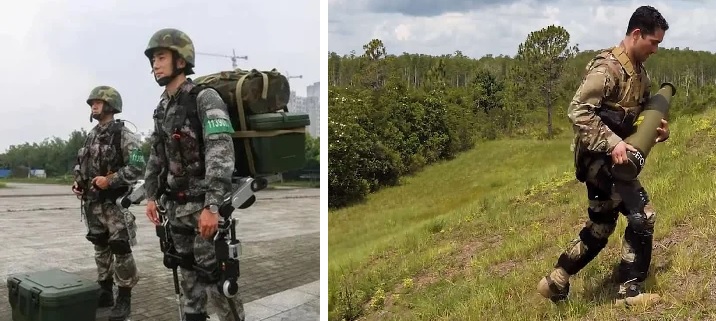
China’s People’s Liberation Army (PLA) has drawn attention with new footage of infantry training in rugged highland terrain, featuring what appears to be a soldier wearing a rudimentary, unpowered exoskeleton frame. The exercise, aired by China’s military-focused CCTV-7 channel, was part of a segment highlighting a unit from the PLA’s 76th Group Army.
The troops, identified by state media as a “model anti-Japanese guerrilla battalion” — a ceremonial title preserved from the Second World War era — were shown advancing under simulated live fire, carrying heavy machine guns and maneuvering across rocky ground. In the midst of the action, one soldier stood out for wearing a metal brace-like device strapped to his legs and back, believed to be a passive load-bearing support.
Reducing the Soldier’s Burden
Unpowered exoskeletons are designed to shift the weight of gear away from the spine and hips, helping soldiers carry loads that can exceed 30–40 kilograms. For infantry operating in mountainous or desert regions, this can mean less fatigue, lower injury risk, and improved endurance during long marches.
While powered versions exist, including battery-assisted models capable of enhancing movement, they remain rare on the battlefield due to limits in battery life, weight, and environmental durability. Passive frames like the one seen in the footage require no power source, making them lighter and potentially more practical for long-duration operations.
China’s Wider Push into Wearable Military Tech
The appearance of even a basic exoskeleton in a televised exercise signals that the PLA may be testing wearable assistive systems in realistic combat scenarios rather than keeping them confined to research labs. In recent years, Chinese defense developers have also unveiled powered exoskeletons for logistics crews, artillery units, and drone operators.
One such system, introduced by defense technology firm Kestrel Defense, integrates control equipment for unmanned aerial vehicles (UAVs) directly into the suit. Images have surfaced of operators launching drones using arm-mounted interfaces, suggesting a vision where infantry could directly control battlefield drones without separate equipment.
Global Trend, Local Adaptation
Militaries worldwide have experimented with similar concepts. The U.S. Army has tested the ONYX powered exoskeleton for support units to reduce back strain and improve mobility during prolonged operations. However, most armies have yet to fully integrate these systems into frontline infantry roles due to cost, reliability concerns, and the need for extensive field testing.
China appears to be following a step-by-step integration strategy, starting with unpowered systems in demanding environments, such as mountain brigades, before considering powered versions for combat troops.
Signals of Future Deployment
The fact that the device was showcased in a national broadcast hints that it may not be a one-off experiment. In Chinese military tradition, high-profile state TV coverage often precedes wider trials, production scaling, or even export offerings.
For now, the PLA’s exoskeleton-equipped infantryman remains an isolated sighting — but it could mark the beginning of a broader effort to blend human endurance with mechanical assistance in China’s push to modernize its ground forces.
✍️ This article is written by the team of The Defense News.