‘Not Happening’: U.S Military Generals Block Trump’s Alleged Greenland Invasion Order
Washington / Copenhagen : A fresh wave of controversy has engulfed Washington after a British tabloid reported that Donald J. Trump has privately ordered America’s most secretive military unit to prepare contingency plans for a potential invasion of Greenland — a move senior US military leaders are said to have forcefully resisted as illegal and politically catastrophic.
According to a report published by the Daily Mail, Trump directed the Joint Special Operations Command (JSOC) to draw up operational plans to seize the vast Arctic island, an autonomous territory within the Kingdom of Denmark. The newspaper cited unnamed sources claiming the order emerged after what they described as a “successful” covert operation targeting Venezuelan leader Nicolás Maduro, an assertion that has not been independently confirmed and has not been acknowledged by US officials.
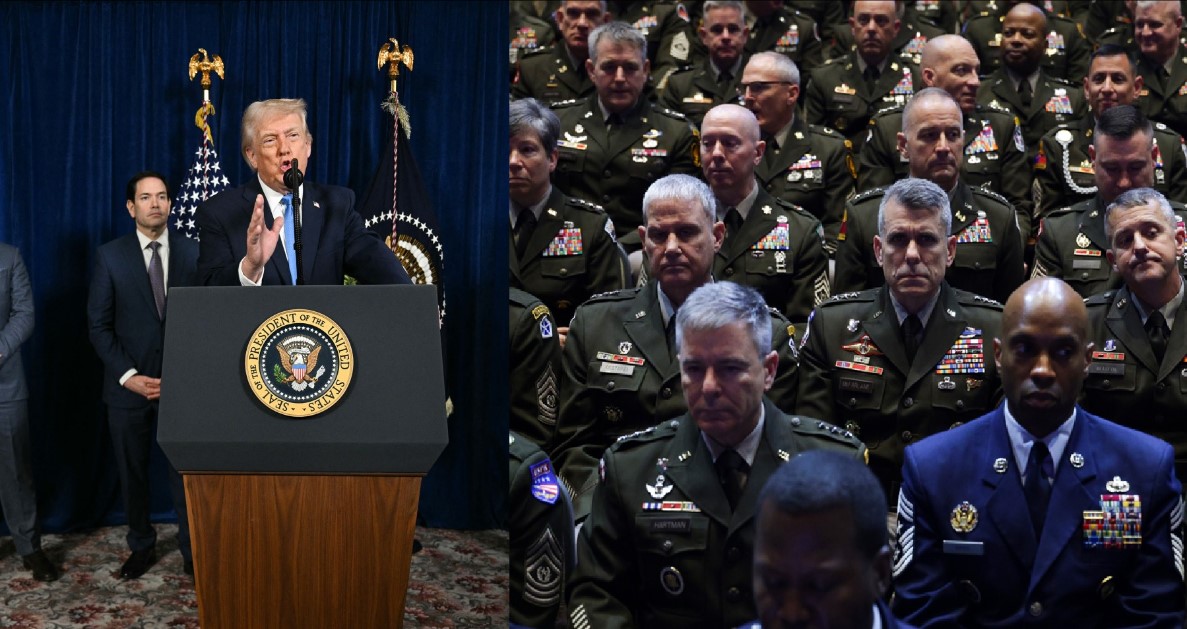
The report says the proposal was immediately met with strong resistance from the US military’s top brass. Members of the Joint Chiefs of Staff are said to have warned the President that any such operation would violate US law without explicit congressional authorisation and would almost certainly fail to secure political support on Capitol Hill. One senior defence source quoted by the paper reportedly dismissed the idea as “not happening,” underscoring the depth of opposition within the Pentagon.
Hawks, Hard Power And Arctic Ambitions
The push for a Greenland plan was reportedly led by Trump’s political adviser Stephen Miller, alongside a group of hardline policy advocates described as emboldened by recent US actions abroad. According to the Daily Mail, these figures believe Washington must move decisively to prevent Russia or China from expanding their influence in the Arctic, a region rapidly gaining strategic importance due to climate change, emerging shipping routes, and access to rare earth minerals.
Greenland, the world’s largest island, occupies a critical geopolitical position between North America and Europe and hosts key US military infrastructure, including the long-standing Thule Air Base, central to America’s missile-warning and space-tracking systems. Trump has repeatedly argued that control of the island is vital to US national security, framing the issue as a zero-sum geopolitical contest with Moscow and Beijing.
In remarks at a White House meeting with oil and gas executives on January 9, Trump again floated the idea of acquiring Greenland, calling it an “absolute necessity” for the United States. “If we don’t do it, Russia or China will take over Greenland,” he said, according to attendees. “And we are not going to have Russia or China as a neighbour.” He added that if a diplomatic purchase could not be achieved, the United States might be forced to act “the hard way.”
Military Pushback And Alternative Proposals
Faced with what sources described as presidential pressure, senior US defence officials are said to have attempted to deflect the discussion by proposing less inflammatory options. These reportedly included stepping up operations against Russian “ghost ships” — vessels allegedly used to evade Western sanctions — or considering limited strikes on Iran, ideas that themselves would carry significant geopolitical risks.
None of these proposals have been publicly confirmed, and the White House has not commented on the Daily Mail report. US defence officials have also declined to discuss internal deliberations, citing national security concerns.
Firm Rejection From Greenland And Denmark
Reaction in Greenland and Denmark has been swift and unequivocal. Greenlandic leaders have repeatedly dismissed any suggestion of annexation, with officials saying there is “no room for fantasies” about the island being absorbed by another country. Copenhagen has likewise rejected Trump’s remarks, reaffirming that Greenland’s future can only be decided by its people.
In recent days, Danish media reported that Denmark’s Defence Ministry has instructed its armed forces to respond immediately to any foreign incursion into Greenland, including opening fire without waiting for political authorisation. The ministry told the newspaper Berlingske that in the event of an attack, commanders must act “without waiting for or seeking orders,” even if a formal state of war has not yet been declared.
The directive follows a period of escalating rhetoric from Washington. US Vice President JD Vance has publicly accused Denmark of failing to adequately defend Greenland, casting the issue in terms of missile defence and what he described as the “civilisational” importance of the Arctic.
Political Motives Questioned
British diplomats quoted by the Daily Mail suggested Trump’s renewed focus on Greenland may also be driven by domestic political considerations. With US mid-term elections looming later this year and Republicans facing the prospect of losing control of Congress, some officials believe the President is seeking to shift public attention away from economic concerns by projecting strength on the global stage.
If the reported discussions are accurate, they are likely to intensify scrutiny of Trump’s use of executive power. Several legal experts have warned that ordering preparations for the invasion of a NATO-linked territory without congressional approval would raise profound constitutional and international law questions.
As of now, the Greenland invasion plan remains, at least publicly, a proposal on paper rather than an active policy. Yet the report has already rattled allies, sharpened tensions in the Arctic and revived fears that great-power competition in the far north could spill into open confrontation — with consequences far beyond the ice-covered island at the centre of the storm.
About the Author
Aditya Kumar:
Defense & Geopolitics Analyst
Aditya Kumar tracks military developments in South Asia, specializing in Indian missile technology and naval strategy.