Northrop Grumman, Colt develop 25 mm grenade launcher for U.S. Army PGS
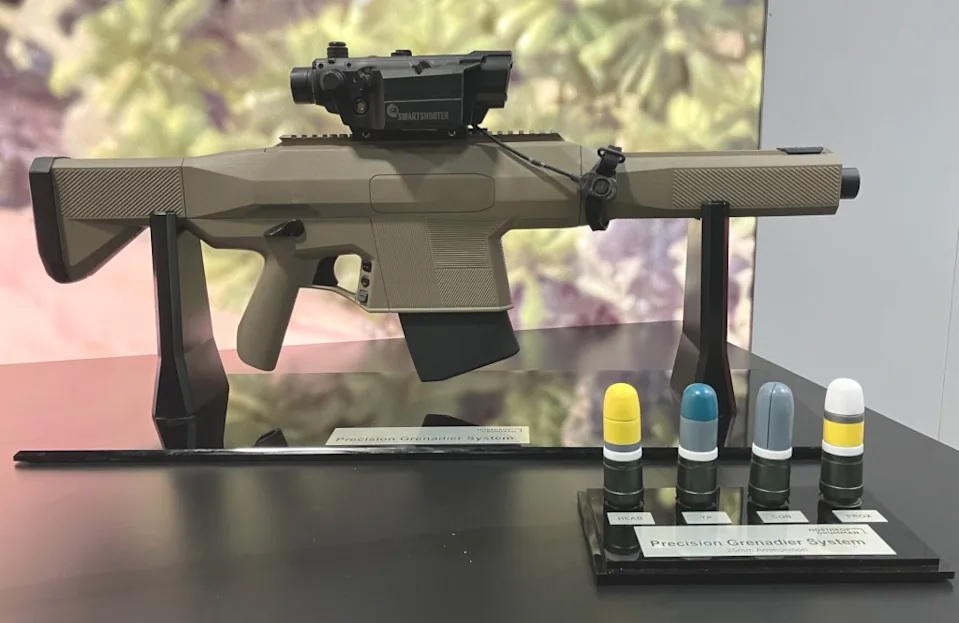
Northrop Grumman, working with Colt, is developing a new 25 mm semi-automatic grenade launcher for the U.S. Army under the Precision Grenadier System (PGS) programme. The weapon is intended to carry forward the precision airburst concept demonstrated by the cancelled XM25 while addressing weight, ergonomics and ammunition flexibility concerns that limited earlier designs. Drawing on technology and munitions work from the XM25 lineage, the new launcher is being re-engineered as a lighter, magazine-fed, rifle-like system that will be easier for dismounted soldiers to carry and employ in short-range engagements.
The launcher itself weighs roughly 5.5 kg and uses detachable five-round magazines, a configuration that gives the weapon a familiar handling posture similar to a conventional automatic rifle. Its design goal is to maintain compact dimensions and soldier ergonomics suitable for close-and-short-range combat while providing an effective engagement envelope extending to at least 500 metres. Central to the capability is a family of 25 mm munitions that includes programmable airburst rounds, which can be set by the weapon’s fire-control system to detonate at a precise distance to engage targets behind cover. Northrop Grumman has also designed or prototyped additional rounds to meet the Army’s evolving requirements: proximity-fuzed rounds for countering small drones, rounds intended to defeat or disable light armoured vehicles, specialized close-range and breaching rounds for urban operations, and inert training rounds for safe practice and system validation.
The integrated fire-control system is a key element of the package and is being developed from first principles to match current Army expectations for size, weight and functionality. Housed within the optical/sighting assembly, the fire-control package is expected to include a laser rangefinder, a ballistic solver, and a fuze programmer that configures each round immediately prior to firing. This ability to program fuzes in the sight enables precise placement of airbursts and allows the launcher to address complex target sets—personnel behind parapets, enemies in defilade, small aerial threats and vulnerable points on lightly armoured vehicles—without relying solely on direct impact effects.
Compared with legacy grenade launchers, the Northrop Grumman design occupies a middle ground. Traditional 40 mm launchers and underbarrel systems provide larger explosive payloads but are generally less suitable for highly precise airbursting at small, defined distances. Crew-served automatic grenade launchers offer high volume of fire but are not a dismounted soldier’s personal weapon. The 25 mm PGS approach emphasizes selectable, programmable effects and a broader ammunition suite in a format that a single operator can carry and operate with rifle-like handling. The trade-offs include reduced per-round explosive mass compared with larger calibres, offset by greater accuracy of effect and the ability to tailor fuzing to the tactical situation.
There are operational and logistical considerations that follow from the design choices. Programmable munitions and electronic fire control increase unit cost and supply chain complexity compared with simpler mechanically fuzed grenades. Training demands and sustainment for electronic components will be greater, and commanders will need to account for magazine logistics and engagement tempo in planning. On the other hand, the magazine-fed, semi-automatic layout provides faster reloads and more agile reaction to changing threats than single-shot or revolver-style grenade launchers, and the modular ammunition suite reduces the need to field separate specialised systems for tasks such as breaching or counter-UAS work.
At this stage the programme remains in development and qualification. Northrop Grumman continues to refine the launcher, its sight and the ammunition family in collaboration with Colt and with reference to lessons learned from the XM25 effort. The company’s stated objectives are to deliver a lighter, more flexible precision grenade capability that can be integrated into dismounted forces without imposing the handling, weight and sustainment penalties that affected previous systems. How the PGS weapon will be adopted and fielded will depend on the Army’s evaluation of performance, cost, logistics and the value of programmable munitions in modern combat scenarios.
About the Author
Aditya Kumar:
Defense & Geopolitics Analyst
Aditya Kumar tracks military developments in South Asia, specializing in Indian missile technology and naval strategy.