Northrop Grumman Delivers Two More MQ-4C Triton UAVs to Australia Air Force
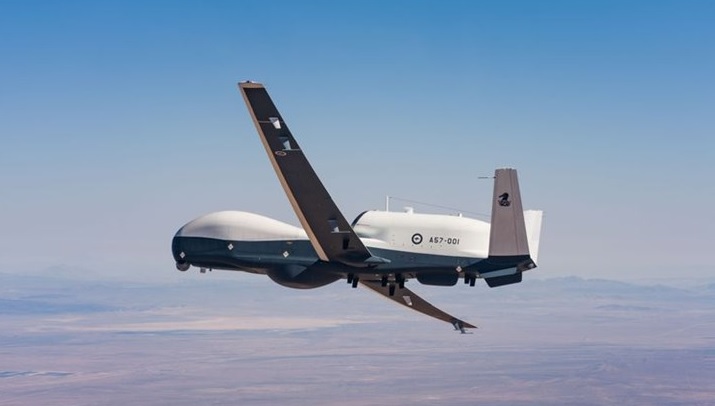
Canberra, August 2025 — In a major step toward strengthening its maritime security, the Royal Australian Air Force (RAAF) has officially received two MQ-4C Triton unmanned aerial vehicles (UAVs) from Northrop Grumman, bringing its operational fleet to three aircraft. The UAVs, delivered in May after a trans-Pacific flight from the United States, are now based at RAAF Base Tindal in the Northern Territory, where they will form the backbone of Australia’s long-range maritime surveillance efforts.
Australia has ordered a total of four MQ-4C Tritons through intergovernmental Letters of Offer and Acceptance (LOA) with the United States. This acquisition marks Australia as the only export operator of the Triton, a high-endurance, high-altitude UAV developed by Northrop Grumman for the U.S. Navy’s Broad Area Maritime Surveillance (BAMS) program.
A Strategic Complement to P-8A Poseidon
The MQ-4C Tritons will work in tandem with the RAAF’s fleet of 12 Boeing P-8A Poseidon aircraft, providing wide-area maritime domain awareness across Australia’s massive Exclusive Economic Zone and surrounding waters. While the Poseidons conduct anti-submarine and strike missions, the Tritons bring unmatched persistence and endurance, capable of flying at altitudes above 50,000 feet for over 24 hours at a time.
This endurance allows each Triton to patrol millions of square kilometers in a single mission, offering a continuous “eye in the sky” that reduces the strain on manned aircraft and expands Australia’s surveillance net across the Indian and Pacific Oceans.
Delivery and Integration
The relocation of the two Tritons from the United States was conducted under operational control from the Naval Air Station Patuxent River in Maryland, with technical stopovers across the Pacific en route to Australia. This complex transfer demonstrated the aircraft’s long-range connectivity and operational integration with U.S. and Australian defense systems.
The MQ-4C Triton’s ground infrastructure at RAAF Tindal has been steadily developed since Australia’s first aircraft arrived in November 2023. The new arrivals will enable Australia to progress toward achieving an Initial Operational Capability (IOC) in the near term, with full operational status expected once the fourth and final aircraft arrives in 2025–26.
Global Fleet and Capabilities
So far, Northrop Grumman has delivered around 30 MQ-4C Tritons to the U.S. Navy, where they are already flying operational missions across the Pacific, Atlantic, and Middle East. The long-term plan is for the U.S. and its allies to sustain five continuous reconnaissance orbits worldwide, ensuring 24/7 global maritime coverage.
Equipped with a multi-sensor suite, including advanced radars, electro-optical sensors, and communications intelligence systems, the Triton can detect, classify, and track maritime targets across enormous swathes of ocean. Its semi-autonomous capabilities allow operators to manage multiple aircraft simultaneously, significantly expanding surveillance coverage with fewer personnel.
Strategic Importance for Australia
For Australia, the arrival of more Tritons underscores the country’s shift toward a more autonomous and resilient surveillance capability, amid growing regional security challenges in the Indo-Pacific. The Northern Territory base provides an ideal launch point for persistent surveillance of key sea lanes, including the South China Sea, the Malacca Strait, and Australia’s northern approaches.
By pairing Tritons with Poseidons, Australia can achieve a layered surveillance strategy, combining long-range persistence with the flexibility of manned operations. This capability is seen as critical to protecting Australia’s maritime trade routes, monitoring illegal fishing, and supporting allied operations in the broader region.
With three MQ-4C Tritons now operational and a fourth on the way, Australia is emerging as a global leader in long-endurance maritime surveillance. The platform’s ability to provide persistent, high-altitude coverage across vast ocean spaces marks a new era in the Royal Australian Air Force’s intelligence, surveillance, and reconnaissance (ISR) capabilities. Alongside its Poseidon fleet, the Triton will give Australia one of the most advanced maritime patrol frameworks outside the United States.
✍️ This article is written by the team of The Defense News.