North Korea Unveils Combat-Ready Global Hawk and Reaper-Style Drones at Air Force Anniversary
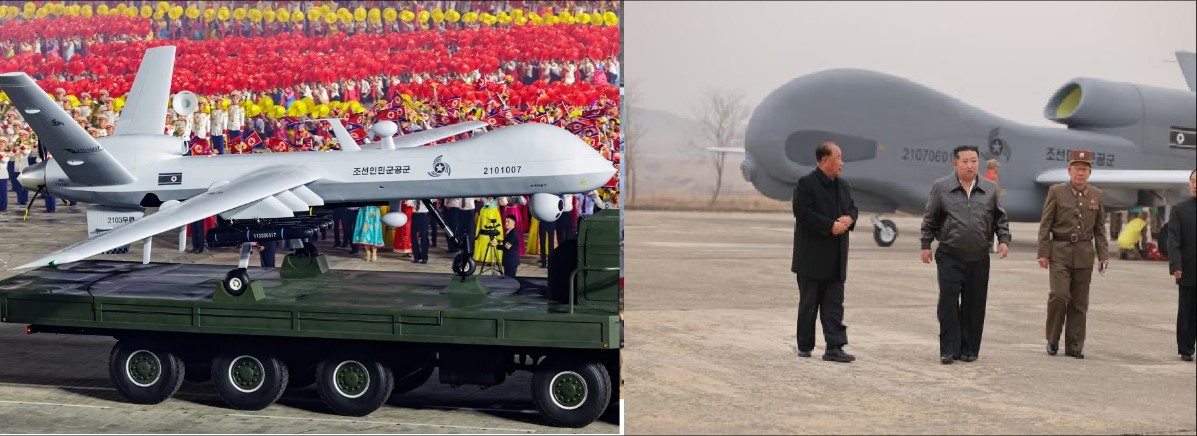
On 28 November 2025, In a recent ceremony marking the 80th anniversary of the Korean People’s Army Air Force (KPAF) at Kalma Airbase, state media from Korean Central News Agency (KCNA) prominently displayed two of North Korea’s most ambitious unmanned aerial systems — the Saebyeol-4 and Saebyeol-9. The presentation, complete with operational markings and personnel of the 59th Gil Yong Jo Hero Regiment, strongly signals that these drones are now considered front-line assets rather than experimental hardware.
Analysts who reviewed the images noted the striking resemblance of the Saebyeol-4 to the U.S. RQ-4 Global Hawk, and of the Saebyeol-9 to the MQ-9 Reaper. According to recent assessments, North Korea currently operates at least two Saebyeol-4 units and six Saebyeol-9 units.
What the Saebyeol-4 Brings: Strategic Reconnaissance Ambitions
The Saebyeol-4, described in state media as a “strategic reconnaissance drone,” is engineered for high-altitude, long-endurance surveillance missions. It reportedly has a wingspan of 30–35 meters and a fuselage length of 10–15 meters — dimensions resembling those of Global Hawk–type UAVs.
Notably, its landing gear appears borrowed from older airframes — specifically those of the Chinese-built J-7 fighter — suggesting resourceful reuse of existing parts. Some observed airframes have been fitted with a satellite-link antenna, hinting at ambitions for long-range control and potential operations hundreds of kilometers from North Korean territory.
However, experts caution that while the drone copies the shape of the RQ-4, it lacks the advanced SAR radar, sensors, and high-end communications that make the Global Hawk effective.
Saebyeol-9: From Showpiece to Strike Asset?
The Saebyeol-9 is characterized as a “multi-purpose attack drone” — a domestic counterpart to the MQ-9 Reaper. It has a 20-meter wingspan and a 9-meter fuselage, and photographs from the Kalma event show it in operational markings, indicating combat-ready deployment.
Multiple hardpoints under its wings suggest the ability to carry air-to-surface weapons or modular payloads. But questions remain about the quality of sensors, targeting systems, and data links.
Earlier models showed variations in wing geometry, fuselage coloring, dorsal antenna design, and air intake shape, implying an evolving design, not a finalized production line.
Production, Testing, and Strategic Context
The unveiling underscores North Korea’s strategic push into unmanned aerial warfare. The drones are linked to the Panghyon Airbase UAV development complex, believed to include a major production and test facility.
Satellite images from 2025 show new 40-meter-wide UAV hangars, confirming that these UAVs are part of a sustained production effort, not isolated prototypes.
This aligns with Kim Jong Un’s directive at the 8th Party Congress (2021) to develop unmanned platforms capable of surveilling or striking targets at 500 km or more. Repeated tests since 2023 and Kim’s inspection of the drone complex in September 2025 further highlight the seriousness of the program.
What This Means for Regional Security
Even if less advanced than U.S. or Chinese UAVs, the Saebyeol series could still shift regional dynamics:
-
The Saebyeol-4 could expand Pyongyang’s long-endurance surveillance over coastal zones, air corridors, and naval movements.
-
Its high-altitude cruising (above 10,000 m) may complicate interception by older air defense systems.
-
The Saebyeol-9 could conduct limited precision strikes on radars, depots, or artillery sites, or be used for air-defense saturation missions.
Concerns are heightened by increasing North Korea–Russia military cooperation, which might provide improvements in engines, navigation electronics, or weapons integration.
But substantial uncertainties remain, including:
-
the reliability of communication links,
-
the accuracy of targeting systems,
-
and the endurance and payload capacity of both drones.
A Signal of Intent — and a Reminder of the Unknown
The appearance of the Saebyeol-4 and Saebyeol-9 during a major KPAF anniversary is both symbolic and strategic. It signals Pyongyang’s intention to field modern aerial capabilities and complicates the military planning of Seoul, Tokyo, and Washington.
Yet, despite the dramatic displays, the true operational performance of these UAVs remains unproven. For now, they serve primarily as deterrent messaging tools — but ongoing production and testing suggest that North Korea aims to transform them into real combat assets.
About the Author
Aditya Kumar:
Defense & Geopolitics Analyst
Aditya Kumar tracks military developments in South Asia, specializing in Indian missile technology and naval strategy.