North Korea Unveils 8,700-Ton Nuclear-Powered Submarine As Experts Flag Possible Russian Support
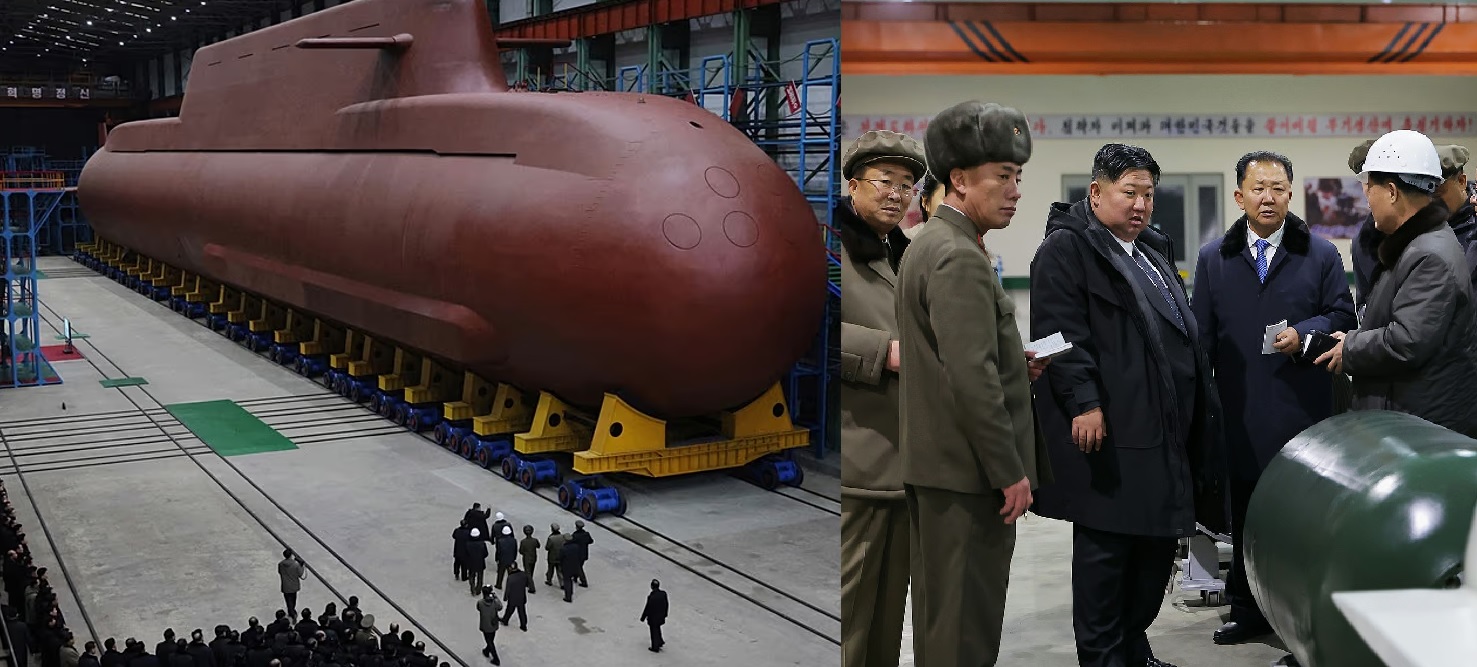
North Korea has revealed fresh details of what it claims is an 8,700-ton nuclear-powered strategic missile submarine, a development that analysts say could fundamentally reshape Pyongyang’s ballistic missile and nuclear deterrence posture, while raising growing questions about possible technical support from Russia.
State media reported that Kim Jong Un personally inspected and guided the construction of the submarine at an undisclosed shipyard, describing it as a cornerstone of North Korea’s future naval nuclear force. The disclosure, carried by the Korean Central News Agency, included images showing a largely completed hull, suggesting the project has moved beyond early construction stages.
A Major Milestone In Naval Nuclear Ambitions
With a reported displacement of 8,700 tons, the vessel would be the largest submarine ever built by North Korea. If the claim of nuclear propulsion is accurate, it would represent a dramatic technological leap for a country whose submarine fleet has historically relied on diesel-electric platforms with limited endurance and survivability.
A nuclear-powered submarine would be able to remain submerged for extended periods, operate farther from North Korean waters, and provide a far more survivable platform for nuclear-armed missiles—a long-standing objective in Pyongyang’s pursuit of a secure second-strike capability.
Current Ballistic Missile Strength
North Korea already fields a broad and increasingly sophisticated missile arsenal. Its land-based forces include short- and medium-range ballistic missiles, as well as intercontinental systems such as the Hwasong-17 and the solid-fuel Hwasong-18, both assessed by analysts to have ranges exceeding 15,000 kilometres, theoretically capable of reaching the continental United States.
On the naval side, Pyongyang has conducted multiple tests of submarine-launched ballistic missiles (SLBMs), including the Pukguksong-3 and follow-on variants. These missiles are generally believed to have ranges in the 2,000–3,000 kilometre class, though they have so far been associated with relatively noisy and vulnerable diesel-powered submarines or test barges.
How A Nuclear Submarine Changes Missile Reach
Military experts caution that a nuclear-powered submarine would not automatically extend the maximum design range of North Korea’s SLBMs. Instead, it would significantly expand their operational reach.
By enabling submarines to patrol deeper into the Pacific and remain hidden for longer durations, North Korea could threaten targets such as Guam, Hawaii, and potentially parts of the continental United States using existing or moderately upgraded SLBMs. Future generations of submarine-launched missiles could also be larger, allowing for heavier payloads, improved accuracy, or penetration aids designed to defeat missile defences.
The result would be a far more complex detection and interception challenge for the United States, South Korea, and Japan.
Experts Point To Possible Russian Assistance
A growing number of regional security experts and officials now say the pace and scale of North Korea’s submarine project raise the possibility of Russian technical support, particularly in areas related to nuclear propulsion and submarine design.
Following closer military and political ties between Pyongyang and Moscow in recent years, analysts note that Russia possesses extensive experience in compact naval reactors and submarine construction—expertise that North Korea has never publicly demonstrated on its own.
While Russia has not confirmed any such assistance, and no conclusive evidence has been made public, defence officials in South Korea and allied countries have said the issue is under active scrutiny. Any transfer of nuclear-propulsion technology would represent a serious escalation and a challenge to international non-proliferation norms.
Strategic Messaging And Regional Impact
During the inspection, Kim Jong Un reportedly framed the submarine as a defensive response to what he called intensifying military pressure from the United States and South Korea, including expanded joint exercises and discussions in Seoul about advanced naval capabilities.
The announcement comes as diplomacy remains stalled and North Korea continues to prioritise strategic weapons over engagement. No timeline has been given for the submarine’s launch, sea trials, or operational deployment.
Even so, analysts say the combination of long-range ICBMs, advancing SLBM technology, and a potential nuclear-powered launch platform points to a future in which North Korea’s nuclear force is more survivable, flexible, and difficult to neutralise.
If realised, the program would mark one of the most consequential shifts in the military balance on the Korean Peninsula in decades—one that could reverberate well beyond Northeast Asia.
✍️ This article is written by the team of The Defense News.