Nine Months Later, Indian Army Recovers Bodies of 3 Soldiers Lost in Ladakh Avalanche
In a deeply poignant recovery mission, the Indian Army has successfully retrieved the bodies of three soldiers who perished in a deadly avalanche in Ladakh nine months ago. The soldiers, part of a mountaineering expedition, were engulfed by the sudden avalanche at an elevation of over 18,300 feet. The treacherous conditions made the recovery efforts an arduous task, but the army's unwavering commitment to their fallen comrades saw them through.
Last October, a 38-member expedition team from the High Altitude Warfare School (HAWS) in Gulmarg embarked on an ambitious journey to conquer Mt. Kun in Ladakh. The expedition, which began on October 1, aimed to reach the summit by October 13. However, the unpredictable and harsh weather conditions of the region proved to be a formidable adversary. On October 8, while the team was fixing ropes on a snow wall between Camp 2 and Camp 3 on the Fariabad Glacier, an unexpected avalanche struck, sweeping four soldiers into a deep crevasse. Lance Naik Stanzin Targais' body was recovered soon after the incident, but the bodies of Havildar Rohit Kumar, Havildar Thakur Bahadur Ale, and Naik Gautam Rajbanshi remained trapped under thick layers of ice and snow.
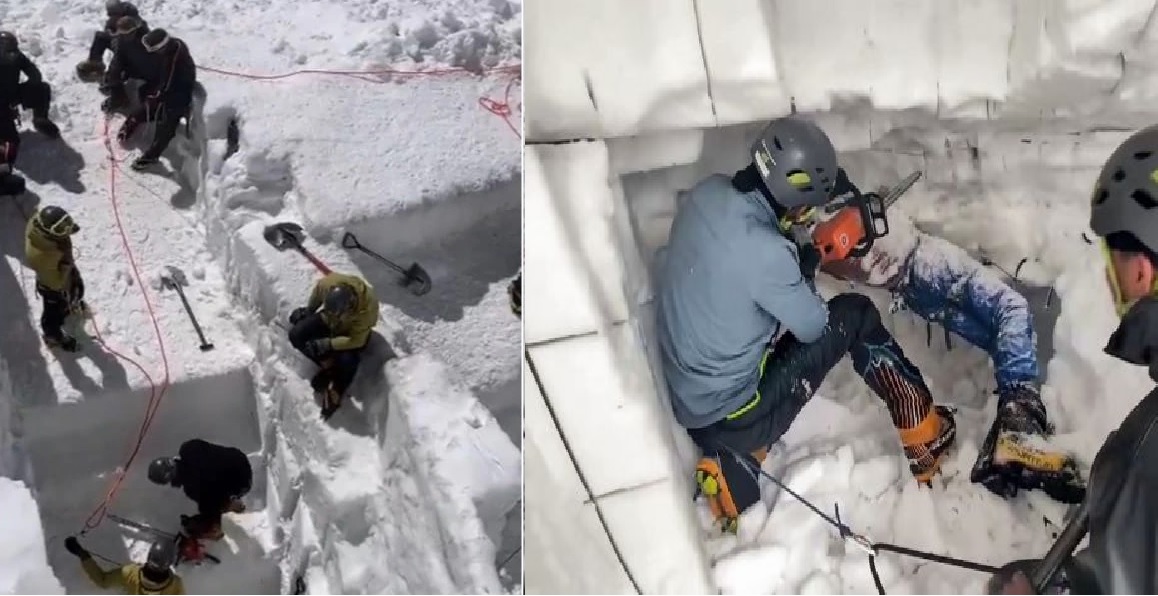
The Army, embodying its ethos of 'Leaving No Man Behind,' initiated "Operation RTG" (Rohit, Thakur, Gautam) on June 18. This mission was a testament to the Army's dedication and respect for their fallen comrades. The rescue team comprised 88 expert mountaineers who faced the extreme conditions of the high-altitude region to recover the bodies. A road head camp was established about 40 kilometers from Khumbathang, serving as the staging ground for the specialized equipment, survival kits, and other essentials needed for the operation. Two helicopters were on standby to assist in the transportation of the bodies and the rescue team if required.
The mission's base camp was set up at an altitude of about 14,790 feet, 13 kilometers from the road head. Maj Gen Bruce Fernandez, Commandant of HAWS, was stationed at this base camp, overseeing the recovery efforts. Brigadier S S Shekhawat, the Deputy Commandant of HAWS and an experienced mountaineer, led the search operation personally, emphasizing the importance of the mission.
The rescue team established a forward base camp on June 25, approximately three kilometers from the incident site. With satellite phones, special tents, advanced tools, and dedicated helicopters stationed 20 kilometers away, every precaution was taken to ensure the safety of the search party. The team faced formidable challenges at an altitude of 18,300 feet, where the bodies were buried deep within the crevasse.
The breakthrough came on July 4, when the remains of Havildar Rohit Kumar of the Dogra Scouts were found under about 30 feet of snow and ice. His body was airlifted to Khumbathang by helicopter. With renewed resolve, the team continued their grueling efforts and on July 7, recovered the body of Havildar Thakur Bahadur Ale of the Gorkha Rifles, located 10 feet deeper in the crevasse. The relentless pursuit continued, and on July 8, the body of Naik Gautam Rajbanshi of the Assam Regiment was finally retrieved.
The bodies of the three soldiers were handed over to their families with full military honors, bringing a sense of closure to their loved ones who had waited nearly nine months to bid them a final farewell. Brigadier Shekhawat, who has climbed Mt. Everest three times and received the Kirti Chakra for his valor, described 'Operation RTG' as the most demanding mission of his life. "Dug for nine days straight, 10-12 hours every day at 18,700 feet," he said. "The grueling effort, both physically and mentally, tested the resilience of the entire team."
The recovery of the bodies of Havildar Rohit Kumar, Havildar Thakur Bahadur Ale, and Naik Gautam Rajbanshi stands as a poignant reminder of the perils faced by the soldiers of the Indian Army and their indomitable spirit in ensuring that no comrade is ever left behind.
✍️ This article is written by the team of The Defense News.