Newly Discovered Craters on Mars Named After Indian Scientist and Towns 'Lal Crater ,Mursan and Hilsa Craters'
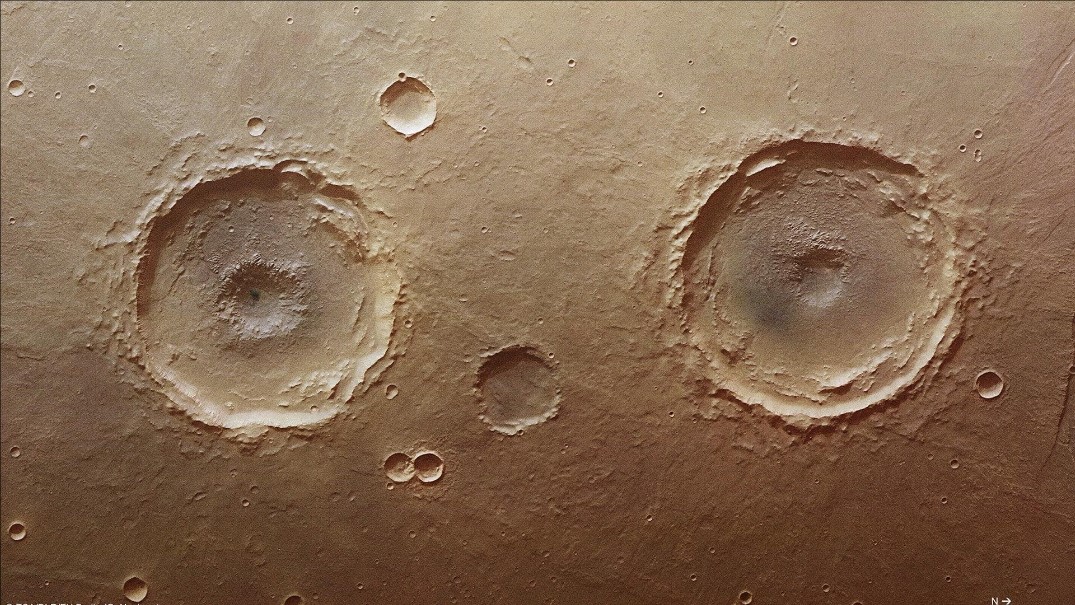
Three newly discovered Martian craters have been named after physicist Devendra Lal and the towns of Mursan and Hilsa, highlighting significant geological findings on Mars.
Three craters recently discovered on Mars have been named in honor of the renowned cosmic ray physicist Devendra Lal and the towns of Mursan and Hilsa in northern India. This naming was approved by the International Astronomical Union (IAU) Working Group for Planetary System Nomenclature on June 5, 2023. The discovery and naming were facilitated by scientists from the Physical Research Laboratory (PRL) in Ahmedabad, India, a unit of the Department of Space of the Government of India.
The craters are located in the Tharsis volcanic region of Mars, a vast plateau near the equator in the planet's western hemisphere. Tharsis is known for housing the largest volcanoes in the Solar System.
Crater Details:
- Lal Crater: The largest of the three, Lal Crater is 65 km wide. It was named after Professor Devendra Lal, who served as the director of PRL from 1972 to 1983. The crater is significant because evidence suggests that water once moved large volumes of sediment into it, indicating that Mars was once wet and had flowing water on its surface. The subsurface of Lal Crater contains a 45-meter thick sedimentary deposit, discovered using SHARAD (Mars SHAllow RADar sounder) on NASA's Mars Reconnaissance Orbiter (MRO).
- Mursan and Hilsa Craters: These craters, each around 10 km wide, are located on the eastern and western rims of the Lal Crater, respectively. Named after towns in Uttar Pradesh and Bihar, India, they provide a timeline for the infilling process of the Lal Crater, suggesting that the infilling occurred in episodic events.
Scientific Discovery:
The discovery was made within the Mangala crater of Mars using data from SHARAD on the MRO probe. The research team included Rajiv Bharti, Isaac Smith, S. K. Mishra, N. Srivastava, and Shital Shukla. Bharti, Mishra, and Srivastava are affiliated with PRL, while Shukla is with Gujarat University and Smith is from York University in Toronto, Canada.
The PRL release highlights that the entire area of Lal Crater is covered with lava but also contains geophysical evidence of other materials, including significant sedimentary deposits. This discovery adds to the growing body of evidence that Mars once had significant amounts of water on its surface.
Tharsis, the region where these craters are located, is a focal point for studying Martian geology due to its extensive volcanic features. Understanding the sedimentary processes in this region can provide insights into Mars' climatic history and the potential for past life on the planet.
In conclusion, the naming of these craters after an eminent physicist and Indian towns not only honors these namesakes but also underscores the collaborative and international nature of planetary science. The discoveries made in these craters will continue to contribute to our understanding of Mars' geological history.
✍️ This article is written by the team of The Defense News.