Netherlands Orders Skyranger 30 Air-Defence Systems in Major Multi-Million Euro Deal
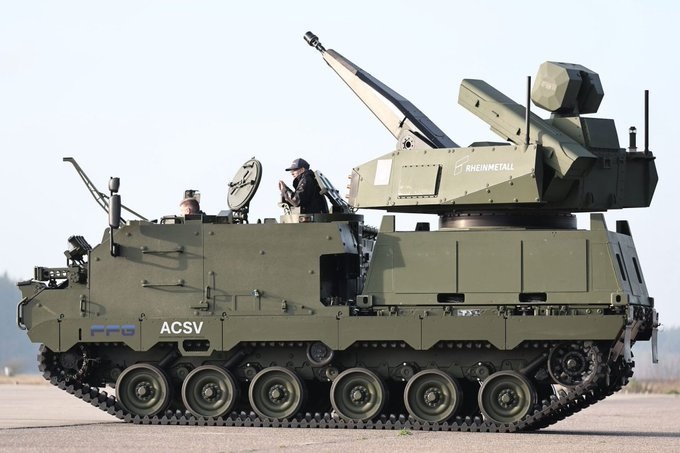
The Netherlands has formally awarded a three-digit-million-euro contract to Rheinmetall for the delivery of Skyranger 30 Short-Range Air Defence (SHORAD) systems, to be supplied in both mobile configurations mounted on FFG’s Armoured Combat Support Vehicle (ACSV) and in stationary fixed-site variants. Deliveries will begin in 2028 and conclude by the end of 2029, marking one of the most significant modernisation steps in Dutch ground-based air defence in over a decade.
Skyranger 30 to Strengthen Dutch SHORAD Layer
The Skyranger 30 is intended to counter the fast-growing threat of drones, cruise missiles, loitering munitions, and low-flying aircraft, forming the short-range tier of the Netherlands’ expanding layered air-defence architecture. Equipped with a 30 mm revolver gun, advanced sensors, and the option to integrate missiles and directed-energy weapons in the future, the system offers rapid engagement capability against small, manoeuvrable aerial targets that traditional artillery often struggles to defeat.
The acquisition aligns with NATO requirements for high-mobility, high-survivability air-defense units capable of protecting manoeuvre formations and critical infrastructure.
Mounted on FFG’s ACSV: Mobility, Modularity, and Maintenance Advantages
For the mobile variant, the Skyranger 30 turret will be installed on the FFG ACSV Gen 5, a modern tracked support vehicle originally developed by German manufacturer Flensburger Fahrzeugbau Gesellschaft (FFG) as a replacement for ageing M113-based platforms.
The ACSV offers several operational benefits:
-
High payload capacity up to 9,000 kg, enabling the integration of sensors, ammunition, and electronic systems without compromising mobility.
-
Modular design, allowing configurations for command, medevac, logistics, recovery, or air defence—simplifying supply chains and training across variants.
-
Tracked mobility, ensuring the Skyranger 30 can accompany mechanised units across difficult terrain where wheeled SHORAD systems may struggle.
-
Commonality with the upcoming Dutch NOMADS missile system, reducing maintenance burdens and logistical complexity.
Its adoption also reflects the Netherlands’ strategy to transition away from legacy vehicles while ensuring compatibility with allied armies, including Norway—one of the first ACSV operators.
Stationary Skyranger: Protection for Critical Infrastructure
In addition to mobile variants, the Netherlands will acquire fixed-site Skyranger 30 systems, designed to defend military bases, airfields, logistics hubs, and high-value infrastructure. Stationary models benefit from:
-
Larger sensor arrays and expanded power availability
-
Higher ammunition capacity options
-
Continuous 360° monitoring for persistent defence missions
By fielding both variants, the Dutch armed forces gain flexible, scalable coverage for static facilities and deployed operations.
Industrial Participation: Rheinmetall Netherlands Takes Major Role
The Skyranger 30 programme will be executed jointly by Rheinmetall Switzerland and Rheinmetall Nederland, reflecting the Netherlands' long-standing policy of linking defence procurement with industrial and technological return.
-
The first three prototypes will be manufactured in Switzerland.
-
Production and assembly for the remaining systems will shift to Rheinmetall’s facility in Ede, Netherlands, significantly enhancing local industry involvement.
-
The contract also includes classroom simulators, system integration services, and an Integrated Logistics Support (ILS) package, ensuring long-term maintainability and operator training.
This approach enhances domestic expertise in modern air-defence technologies and positions Dutch industry for future European SHORAD requirements.
Additional Dutch Modernisation Efforts and Future Orders
The Skyranger 30 purchase comes amid accelerated Dutch investment in air defence, driven by lessons from Ukraine and NATO’s emphasis on counter-drone capabilities.
Ongoing and future air-defence initiatives include:
-
NOMADS (Networked Overwatch and Manoeuvre SHORAD), also based on the ACSV platform and armed with AIM-9X Block II Sidewinder missiles.
-
Upgrades to NASAMS medium-range batteries.
-
Continued modernisation of Patriot PAC-3 MSE systems operated by 802 Patriot Squadron.
-
Procurement of additional Stinger MANPADS and improved sensors.
-
Enhanced F-35 integration into national air-defence networks, supporting real-time target data for ground batteries.
While the current Skyranger contract does not include an officially announced follow-on order, Dutch defence planners have indicated that future expansion remains likely, especially if operational testing between 2028–2029 validates performance and interoperability with other systems. The Netherlands is expected to evaluate missile-equipped Skyranger variants or laser modules as future spiral upgrades.
Part of a Layered Shield Under the Joint Ground-Based Air Defence Command
The procurement reinforces the Netherlands’ multi-layer defence under the Joint Ground-based Air Defence Command (JGBADC), which integrates Dutch and German units and manages all air-defence assets from Stinger teams to Patriot batteries.
By 2030, the Netherlands aims to field one of Europe’s most modernised, multi-layered air-defence networks, capable of responding to high-intensity conflict environments, drone saturation attacks, and hybrid threats.
A Step Toward Future European SHORAD Integration
As European nations race to rebuild short-range air defences, the Dutch Skyranger 30 programme is being watched closely. The combination of ACSV mobility, stationary base-defence variants, and industry participation offers a potential template for other NATO members seeking scalable SHORAD solutions.
With its mixture of mobility, modularity, and modern sensors, the Skyranger 30 is expected to become a core Dutch capability against emerging aerial threats, strengthening both national defence and NATO’s collective shield.
About the Author
Aditya Kumar:
Defense & Geopolitics Analyst
Aditya Kumar tracks military developments in South Asia, specializing in Indian missile technology and naval strategy.