NRT's "Swarm in the Wild": A Game-Changer for Autonomous Drones in GPS-Denied Environments
NRT's "Swarm in the Wild" showcases advanced autonomous drones for GPS-denied environments, revolutionizing disaster relief and military operations with 3D mapping and night vision capabilities.
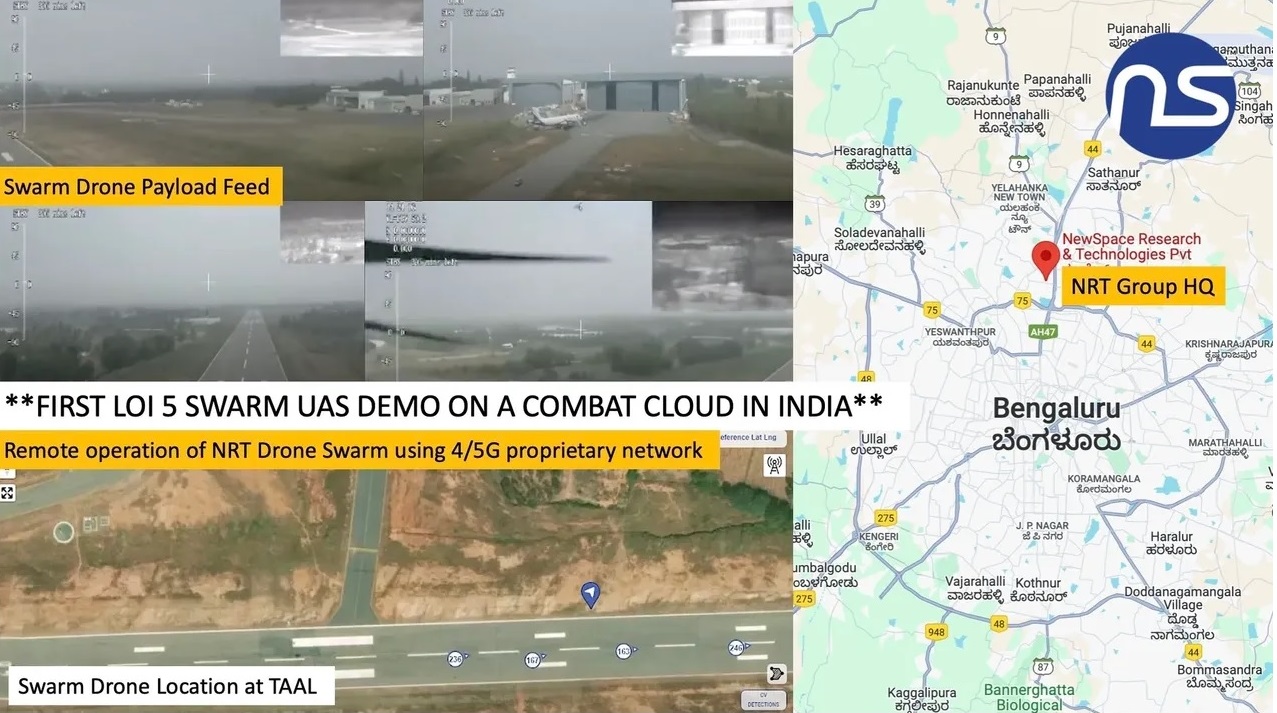
NewSpace Research and Technologies (NRT), a Bengaluru-based aerospace and defense R&D company, has taken a significant leap forward in drone technology with its successful field demonstration, "Swarm in the Wild." This showcase highlighted the impressive capabilities of NRT's autonomous Uncrewed Aerial Vehicles (UAVs), particularly their ability to function effectively in challenging environments where GPS signals are unavailable.
Collaborative 3D Mapping: A Boon for Disaster Relief
One of the most remarkable aspects of the NRT swarm is its ability to collaboratively create 3D maps of the surrounding environment in real-time. This data is invaluable for various applications, especially in disaster response and search-and-rescue operations. Imagine a scenario following an earthquake or a landslide. Traditional methods of surveying the damage and locating survivors can be slow and dangerous. NRT's swarm technology can quickly deploy multiple drones, working together to build a detailed 3D map of the affected area. This data can then be used by rescue teams to identify priority zones, navigate treacherous terrain, and locate survivors much faster and more efficiently.
Enhanced Situational Awareness: Eyes in the Sky, Day or Night
The NRT swarm goes beyond just mapping. The drones are equipped with a powerful suite of sensors, including:
- High and Low-Resolution Video Cameras: These cameras provide detailed visual data for mission observation and analysis. High-resolution cameras can be used to identify specific objects or people, while low-resolution cameras offer broader situational awareness, particularly useful for monitoring large areas.
- On-Board IR Video: This technology allows the drones to operate effectively in low-light or nighttime environments. This is crucial for search-and-rescue missions that might extend into the night, or for military operations requiring covert surveillance.
- LIDAR (Light Detection and Ranging) and Inertial Navigation Systems (INS): These systems work together to ensure precise positioning and mission execution even in the absence of GPS. LIDAR uses lasers to create highly accurate 3D maps of the surroundings, while INS tracks the drone's movement using internal sensors. This combined technology allows the NRT swarm to navigate complex environments and complete missions autonomously without relying on unreliable GPS signals.
Ideal for the Indian Army: Countering Threats in Diverse Environments
The capabilities showcased by NRT's "Swarm in the Wild" make it a perfect fit for the Indian Army, particularly for counter-terrorism operations in forested areas.
- Navigation in Dense Foliage: GPS signals can be easily disrupted by dense tree cover. The NRT swarm's reliance on LIDAR and INS ensures smooth operation even under such conditions.
- 3D Mapping of Forests: The collaborative 3D mapping capabilities can be immensely valuable for creating detailed terrain models of forested regions, helping troops understand the environment and plan operations more effectively.
- Covert Surveillance: With silent operation and night vision capabilities, the NRT swarm can be deployed for discreet reconnaissance missions, pinpointing enemy positions without alerting them.
Looking Ahead: A Future of Autonomous Drone Operations
The successful demonstration by NRT paves the way for a future where autonomous drone swarms play a vital role in various military and civilian applications. NRT's technology offers significant advantages in terms of navigation, data gathering, and situational awareness, particularly in GPS-denied environments. As the technology continues to develop, we can expect even more innovative applications for these versatile aerial platforms.
✍️ This article is written by the team of The Defense News.