NASA to Send Advanced Lunar Terrain Vehicle to the Moon Under Artemis Program
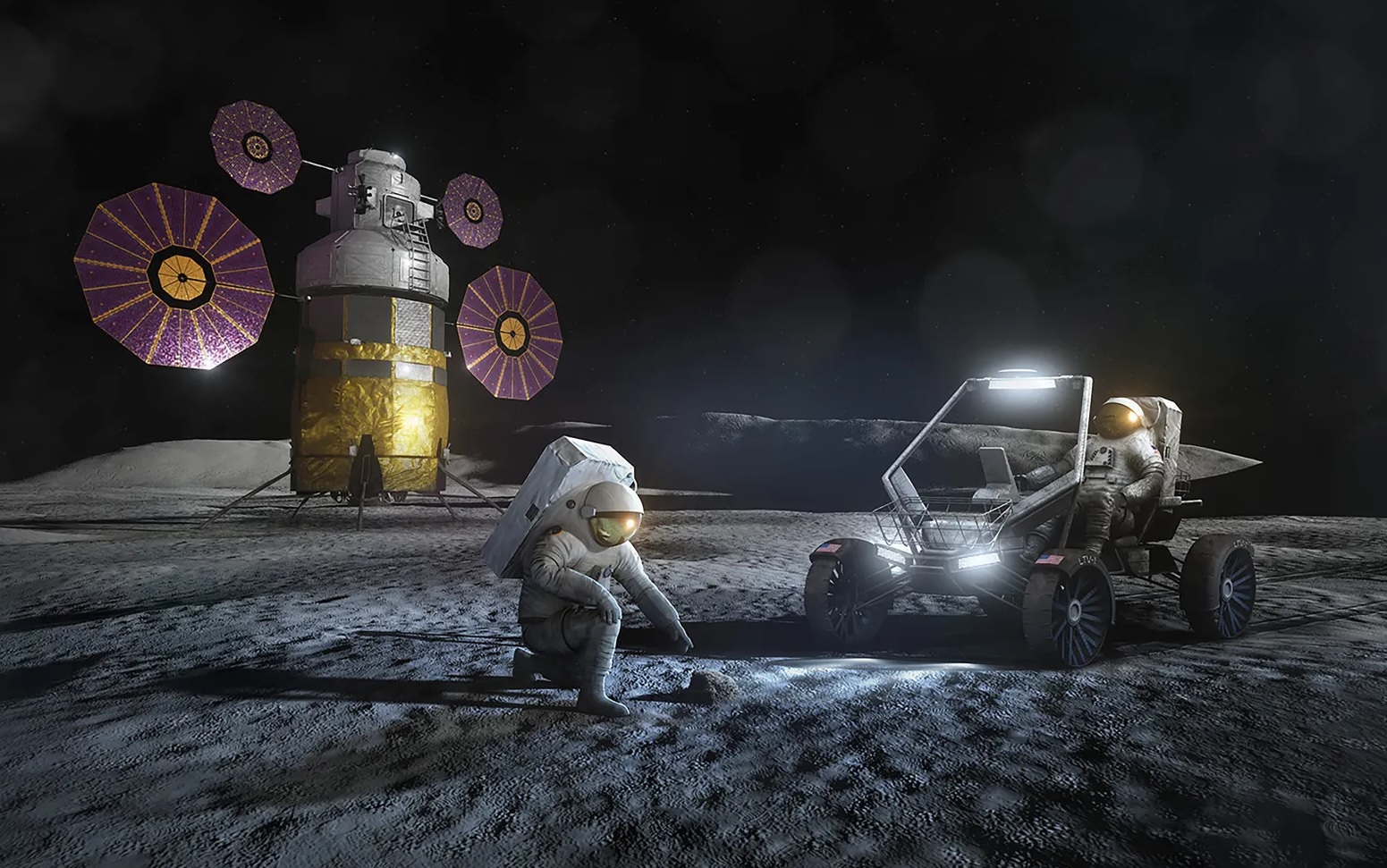
In a major step toward sustainable lunar exploration, NASA has announced plans to send a state-of-the-art Lunar Terrain Vehicle (LTV) to the Moon as part of its ambitious Artemis program. This high-tech rover—built for both crewed and uncrewed missions—will serve as a mobile exploration platform for astronauts working on the lunar surface, particularly near the Moon’s south pole.
The LTV will be the first human-operated rover on the Moon since the Apollo era, but it’s a completely different beast from its 1970s predecessor. Designed to function autonomously and with remote operation capabilities, the vehicle will allow astronauts to traverse large areas of the Moon’s rugged terrain, carry scientific payloads, and conduct experiments even when no humans are present on the surface.
A Rover Unlike Any Before
Unlike Apollo’s Lunar Roving Vehicle, the new LTV is being designed as a multi-functional, electric-powered rover capable of operating in extreme lunar conditions. It must survive the intense cold of the two-week lunar night, drive autonomously or by remote command, and handle rough slopes and rocks on the Moon’s surface. NASA expects the LTV to cover distances up to 20 kilometers in a single day, carry payloads of more than 800 kilograms, and support surface missions lasting several days.
Importantly, the LTV will be deployed before humans arrive at the landing site. It will be operated remotely from Earth to conduct scouting and science operations, paving the way for the arrival of astronauts under Artemis V, expected no earlier than 2030.
Industry Partnerships and a $4.6 Billion Contract Race
In April 2024, NASA selected three industry teams to develop LTV concepts under a competitive program. The teams include:
-
Intuitive Machines, proposing the Moon RACER, a rugged electric rover with solar-powered systems and a towed trailer;
-
Lunar Outpost, partnering with General Motors and Goodyear to develop the Lunar Dawn, focused on high mobility and smart navigation; and
-
Venturi Astrolab, with its FLEX rover, offering modularity and future Mars compatibility.
Each team received a milestone-based, service contract. The total value of the LTV program could reach $4.6 billion, with one final design expected to be selected after demonstration missions in the coming years. The chosen LTV will be delivered to the lunar surface ahead of Artemis V.
Packed with Scientific Firepower
NASA isn’t just building a vehicle—it’s creating a mobile science platform. The LTV will carry three advanced instruments, selected to maximize scientific return from the Moon’s south pole:
-
AIRES (Artemis Infrared Reflectance and Emission Spectrometer): Will map minerals and volatile deposits like water and carbon dioxide.
-
L‑MAPS (Lunar Microwave Active-Passive Spectrometer): Uses radar to probe up to 40 meters beneath the lunar surface, searching for ice and understanding regolith composition.
-
UCIS-Moon (Ultra-Compact Imaging Spectrometer): A satellite instrument that will provide wide-area imaging to complement the rover’s local findings.
Together, these tools will provide the most detailed picture ever of the Moon’s geology and resources—critical knowledge for long-term lunar missions and the eventual goal of Mars exploration.
Why It Matters
The Lunar Terrain Vehicle represents more than just wheels on the Moon. It is central to NASA’s vision of establishing a sustainable human presence on the lunar surface. With the ability to carry crew and cargo over long distances, survive harsh environments, and conduct science even when no astronauts are present, the LTV is a major leap forward in planetary mobility.
Moreover, the technologies developed for the LTV—such as autonomous navigation, energy storage, and remote operation—will lay the groundwork for future missions to Mars and beyond.
The final selection for the LTV provider is expected in the next few years, following successful demonstration tests. Once chosen, the vehicle will be pre-positioned on the Moon in advance of Artemis V, where astronauts will use it to explore one of the most scientifically intriguing and resource-rich regions—the lunar south pole.
As NASA sets its sights on deep space, the LTV will serve as both a workhorse and a pathfinder—driving humanity’s return to the Moon and setting the stage for the next giant leap: Mars.
✍️ This article is written by the team of The Defense News.