Modi Government Turns Down U.S. F-35 Fighter Jet Offer, Backs Defence Self-Reliance
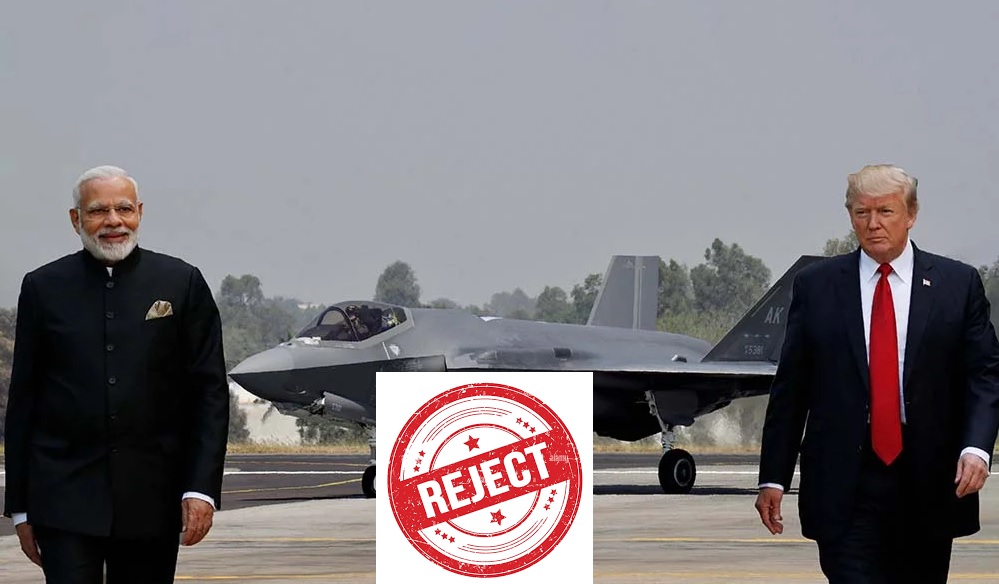
In a strong message underscoring India's commitment to self-reliance in defence, the Modi government has rejected a U.S. offer to sell F-35 stealth fighter jets, signaling a deeper shift toward indigenous military capability and a clear preference for strategic autonomy. The decision was taken even as tensions grow between India and the United States over trade and defence alignments, particularly regarding India’s continued cooperation with Russia.
According to reports from Bloomberg, the U.S. proposal came during Prime Minister Modi’s February 2025 visit to the White House, where President Trump offered to sell the F-35 to India. But New Delhi made it clear that it is not interested in buying the American fifth-generation jets, opting instead to strengthen its domestic capabilities under the "Atmanirbhar Bharat" initiative.
This rejection comes amid growing pressure from Washington over India’s ongoing purchases of Russian oil and weapons, with President Trump even threatening new penalties. But the Indian government has stuck to its policy of non-alignment and defence diversification, placing long-term interests above short-term external incentives.
The F-35 is one of only two operational fifth-generation fighters in the world, the other being Russia's Su-57. With India’s own Advanced Medium Combat Aircraft (AMCA) project still years away from production—likely around 2035—analysts believe India may be leaning towards the Russian Su-57E, which includes technology transfer, domestic assembly at HAL Nashik, and 60% localisation. This aligns well with India’s push to develop indigenous capability, especially through integration of homegrown weapons like Astra missiles, Rudram, and the Virupaksha radar.
At the same time, New Delhi is dealing with a fresh round of trade friction with the U.S. President Trump recently announced a 25% tariff on Indian imports starting August 1, a move that drew concern in India but no immediate retaliation. Commerce Minister Piyush Goyal, addressing Parliament, said India will respond calmly and firmly, focusing on protecting farmers, MSMEs, and small businesses, especially in sectors like dairy and agriculture.
Despite Trump’s increasingly harsh remarks—referring to India and Russia as “dead economies”—the Modi government has taken a measured and fact-based approach. While opposition voices like Rahul Gandhi used Trump’s words to criticize the government, official responses have been focused on data and policy clarity. Goyal, for example, underlined that India is on track to become the world’s third-largest economy, and remains committed to mutually respectful trade ties.
The government's defence roadmap is firmly centered on Atmanirbhar Bharat, with aggressive steps toward:
-
Indigenous production, supported by a growing positive indigenization list.
-
Opening the sector to the private industry, with FDI limits raised to 74%.
-
Mandating technology transfer for foreign defence contracts.
-
A 34-fold rise in defence exports since 2013-14, reaching ₹23,622 crore in 2024-25.
This strategic stance also includes no new defence purchases from the U.S., though India is exploring increased imports of American gas, tech equipment, and gold to reduce trade imbalance.
While the new U.S. tariffs may make India less competitive than peers like Japan (15%), Vietnam (20%), and Pakistan (19%), the government insists that core economic interests will not be compromised.
Ultimately, India’s refusal of the F-35 offer isn't just a procurement choice—it marks a policy direction. It reflects a larger national goal to develop into a self-reliant defence power, ensure technological sovereignty, and become a security provider in the Indian Ocean region—on its own terms.
✍️ This article is written by the team of The Defense News.