Macron Says Europe Must Develop Its Own Missiles and End Reliance on U.S. Arms After Oreshnik Warning
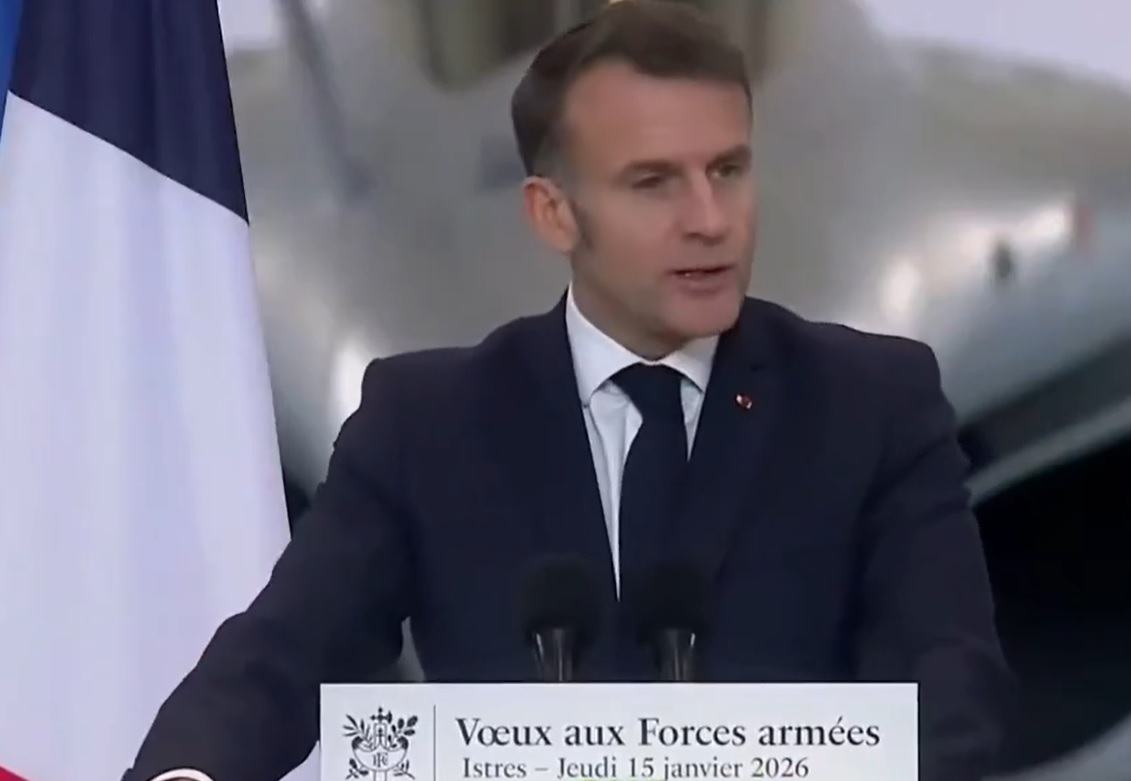
PARIS : French President Emmanuel Macron has issued one of his starkest warnings yet about Europe’s military vulnerability, arguing that the continent must urgently develop its own intermediate-range ballistic missiles (IRBMs) and long-range strike weapons comparable to Russia’s Oreshnik system. His remarks underline a growing belief in Paris that Europe can no longer rely on American weapons or political guarantees as the strategic balance on the continent shifts.
Speaking amid mounting tensions between Washington and its allies, Macron said Russia’s recent use of the Oreshnik missile against targets near Lviv was a “clear signal” that Europe now sits squarely within range of modern Russian strike systems. The message, he suggested, was not only aimed at Kyiv but at every European capital still dependent on U.S.-supplied deterrence.
A Warning on Dependence
Without naming Washington directly, Macron delivered an unmistakable message to fellow European Union members: Europe’s security cannot rest indefinitely on American missiles and American political will. Recent statements from U.S. leaders questioning the value of North Atlantic Treaty Organization without U.S. leadership, he argued, have exposed how deeply Europe depends on the United States for advanced weapons, missile defenses and long-range strike capabilities.
Macron said that dependence weakens Europe’s credibility in crises and limits its freedom of action. “If others decide whether our deterrence functions, then it is not truly ours,” he noted.
Oreshnik and the New Reach of Russian Power
At the center of Macron’s argument is the Russian Oreshnik intermediate-range ballistic missile, a system he described as emblematic of Moscow’s willingness to reintroduce weapons once banned from Europe. With ranges believed to extend well beyond 1,000 kilometers, Oreshnik places much of Europe within reach from Russian territory or forward deployments, including Belarus.
Macron said Russia’s expanding arsenal of conventional and nuclear-capable missiles has already altered the strategic map, forcing Europe to confront a reality long avoided since the end of the Cold War.
Reviving Europe’s Long-Range Ambitions
To answer that challenge, Macron called for a rapid acceleration of the European Long-Range Strike Approach (ELSA). The initiative was launched in 2024 by France, Germany and Poland, and later joined by the United Kingdom, Italy, Sweden and the Netherlands. Its goal is to pool resources, industrial capacity and research to create European-controlled long-range strike systems.
According to Macron, collective development is the only realistic way for Europe to field missiles capable of rivaling systems like Oreshnik. Such capabilities, he said, would reinforce Europe’s conventional and nuclear deterrence while signaling strategic autonomy to both allies and adversaries.
France’s Offer: Technology and Experience
Macron stressed that France is uniquely positioned to anchor the effort. Paris fielded S2 and S3 intermediate-range ballistic missiles until 1996 and has maintained an unbroken tradition of strategic missile development through its submarine-launched ballistic missile (SLBM) program since the 1960s. Today, France’s M51 SLBM remains one of the most advanced in service.
That legacy, Macron argued, gives France critical know-how in propulsion, guidance and warhead integration that could be shared within a European framework. He insisted, however, that the project must be genuinely European, not a rebranded national program.
A Treaty Era Ends
The renewed push comes in the shadow of the Intermediate-Range Nuclear Forces Treaty, which from 1987 to 2019 banned all ground-launched ballistic and cruise missiles with ranges between 500 and 5,500 kilometers in Europe. For more than three decades, European NATO members avoided developing or deploying such systems.
That restraint collapsed when the United States withdrew in 2019, citing Russian violations, including the development of the 9M729 cruise missile with an estimated range of around 1,000 kilometers. Since then, Russia has openly expanded its intermediate-range capabilities, while Europe has largely stood still.
What Europe Already Has — and What It Lacks
European countries do possess advanced missile technologies, but mostly at shorter ranges. France and the United Kingdom operate nuclear deterrents at sea, with France’s M51 and Britain’s Trident-based force. Several European states field sophisticated air-launched cruise missiles, including France’s ASMP-A, the Franco-British Storm Shadow/SCALP, and Germany’s Taurus KEPD 350. Naval cruise missiles, such as France’s MdCN, further extend Europe’s conventional reach.
What Europe lacks, however, are ground-launched intermediate-range ballistic missiles under European political control — the very category now highlighted by Oreshnik’s appearance on the battlefield.
A Strategic Crossroads
Macron’s intervention marks a decisive moment in Europe’s defense debate. By openly questioning reliance on U.S. weapons and urging the development of European IRBMs, he has pushed the conversation beyond incremental defense cooperation toward strategic autonomy.
Whether Europe will heed that call remains uncertain. Political divisions, budget constraints and fears of escalation persist. Yet Macron’s warning is clear: in an era where Russia fields new missiles and U.S. commitments appear less predictable, Europe’s continued dependence on American arms may itself become a strategic liability.
About the Author
Aditya Kumar:
Defense & Geopolitics Analyst
Aditya Kumar tracks military developments in South Asia, specializing in Indian missile technology and naval strategy.
Top 6 Latest Posts
Leave a Comment: Don't Wast Time to Posting URLs in Comment Box

2026-01-18 21:46:46
Yeah, that'll be the day. NATO is a freaking joke as is Brussels. Both are filled with a plethora of pompous pseudo-monarchs who walk around all day nose-in-the-air and chest-pumped-up egos thinking they're worth more than they are. Face it, none of them want to work together. All they want is to be the leader.
