Mach Industries Enters Counter-Drone Swarms Race With Dart, a Low-Cost Kinetic Solution for U.S
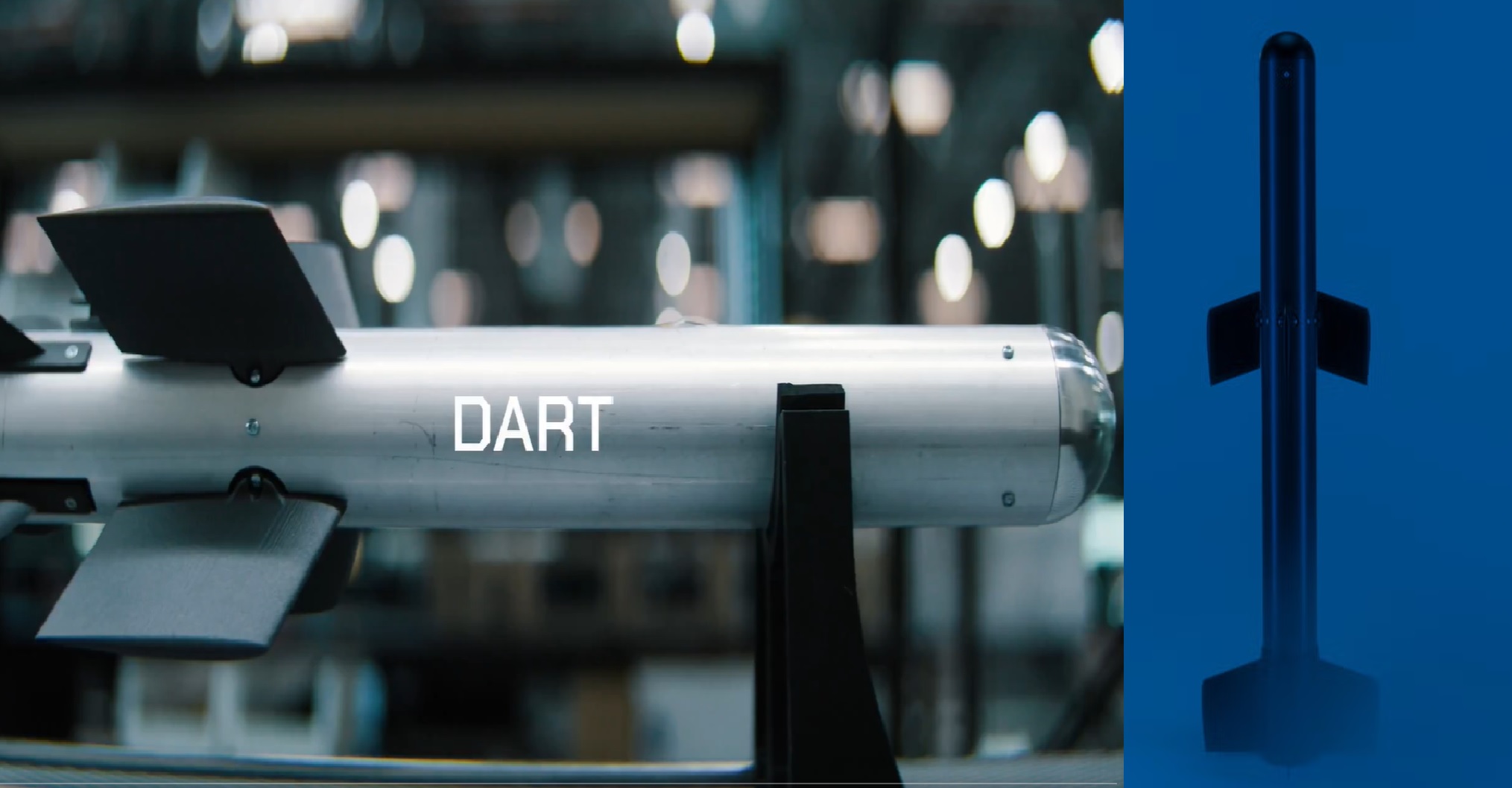
HUNTINGTON BEACH, California : Mach Industries has introduced Dart, a new counter-uncrewed aerial system (C-UAS) centered on a low-cost, kinetic surface-to-air interceptor that the company says can be installed at fixed sites or mounted on moving platforms, as militaries confront the growing reality of mass-produced drones and coordinated swarm attacks.
The company is pitching Dart as an effort to reset the economics of air defense in an era where inexpensive one-way attack drones can be fielded in large numbers. In its announcement, Mach said Dart was developed after running simulations “against all known assets of adversarial nation-states,” describing the result as a missile designed for high-volume deployment, supported by a purpose-built radar that it claims costs “orders of magnitude less” than legacy air-defense systems.
A System Built Around Detection-to-Engagement
Mach describes Dart not as a standalone missile, but as a self-contained, end-to-end C-UAS system spanning detection and tracking, command-and-control, and kinetic engagement. The architecture is built around an internally developed frequency-modulated continuous-wave (FMCW) ground radar, paired with low-cost interceptors, creating what the company calls a complete “sensor-to-engage” capability.
This approach is intended for high-throughput operations, particularly in environments where traditional air-defense systems become prohibitively expensive when used against cheap, attritable aerial targets.
In its product description, Mach frames Dart as a “terminal interceptor”, designed to be deployed close to the asset being defended—including forward operating bases, critical infrastructure, logistics hubs, and high-value military sites—and then scaled from small, localized deployments to networked defensive grids depending on threat density.
Interceptor Performance: Range and Engagement Envelope
Mach Industries has not publicly disclosed precise performance specifications, including Dart’s exact missile range. However, based on the company’s positioning of Dart as a short-range, point-defense interceptor optimized for counter-drone missions, industry analysts estimate an effective engagement range in the low-to-mid tens of kilometers, likely between 10 and 25 kilometers, depending on target type, altitude, and radar configuration.
The interceptor is optimized for low-altitude, low-radar-cross-section targets, prioritizing reaction time, engagement rate, and cost efficiency over long-range reach typically associated with traditional surface-to-air missile systems.
Why Mach Says Legacy Defenses Don’t Scale
Mach’s Dart announcement comes amid a broader reassessment of air defense driven by recent conflicts, where uncrewed systems have been used at unprecedented scale. The company argues that three trends are undermining existing counter-drone approaches:
Radio-frequency jamming is becoming less reliable as drones adopt autonomy and hardened navigation;
Traditional kinetic systems struggle to keep pace with swarm-style attack volumes; and
Legacy air-defense architectures often fail to deliver a favorable cost-per-shot ratio when intercepting drones that may cost only a few thousand dollars.
Mach’s central argument is that air defense must evolve from defeating small numbers of high-end threats to stopping large salvos of low-cost systems without exhausting expensive interceptors or limited firing capacity.
Target Set: Group 1–3 Drones, Including Swarms
Mach says Dart is engineered to defeat Group 1–3 uncrewed aerial threats, explicitly including coordinated drone swarms. These categories encompass systems ranging from small commercial-style drones to larger tactical unmanned aircraft, many of which are commonly used for base harassment, reconnaissance-to-strike missions, and one-way attack roles.
By focusing on these threat classes, Mach aims to address scenarios where defenders are often forced into unfavorable cost exchanges, spending far more to intercept a drone than the drone itself costs to produce.
Manufacturing as Strategy: “Vertically Integrated” and “Forge”
Mach is emphasizing how Dart is built as much as what it does. The company says Dart is produced through its “Forge” manufacturing model, a vertically integrated ecosystem that combines design, testing, and production under one roof.
This approach is intended to accelerate iteration, reduce supply-chain dependencies, and enable rapid scaling in response to operational demand. Mach has previously described Forge as central to its strategy of rebuilding parts of the defense industrial base around high-rate, cost-controlled production.
In 2025, the company announced a $100 million Series B funding round, led by Khosla Ventures and Bedrock, to expand manufacturing capacity and support systems like Dart.
Cost Focus: Aiming for a Favorable Exchange Ratio
Mach has not released official pricing for Dart, but has repeatedly emphasized affordability as a defining feature. Based on comparable short-range kinetic C-UAS interceptors and Mach’s own claims of “orders of magnitude” savings, industry estimates suggest Dart’s per-interceptor cost could fall in the low-to-mid five-figure range, potentially tens of thousands of dollars per missile, rather than the hundreds of thousands or millions associated with traditional surface-to-air missiles.
If achieved, that pricing would significantly improve the cost-exchange ratio against low-cost drones, one of the core challenges facing modern air defenses.
Mach says it will continue refining Dart ahead of operational testing, with the system designed from the outset for large-scale manufacturing. The company argues that future conflicts may demand defensive capacity measured in volume, not just capability.
For Mach Industries, Dart represents another step toward a defense model built for the “unmanned era”—where success depends not only on technical performance, but on the ability to produce, deploy, and sustain defenses at scale when adversaries can launch hundreds or thousands of drones at once.
About the Author
Aditya Kumar:
Defense & Geopolitics Analyst
Aditya Kumar tracks military developments in South Asia, specializing in Indian missile technology and naval strategy.