MQ-20 Avenger Completes First Live Autonomous Air-to-Air Intercept in Landmark U.S. Test
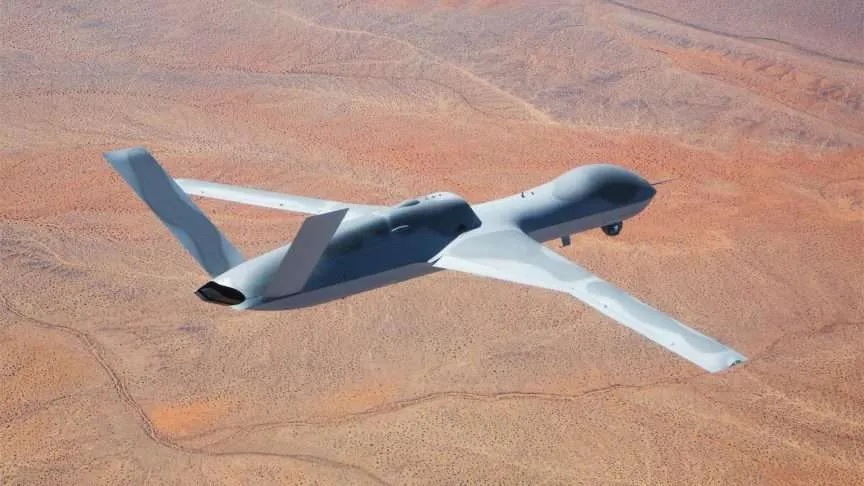
SAN DIEGO / WASHINGTON : In a milestone that underscores how rapidly artificial intelligence is reshaping air combat, General Atomics Aeronautical Systems, Inc. has confirmed that its MQ-20 Avenger unmanned aircraft successfully carried out a live, autonomous aerial intercept of a crewed aggressor aircraft during a January flight from California. The demonstration, completed with minimal human input, is being described by defense officials and industry observers as one of the clearest signs yet that Collaborative Combat Aircraft (CCA) are moving from concept to operational reality.
Autonomous Intercept Marks New Phase in Unmanned Air Combat
According to the company, the flight took place on 18 January 2026 and was fully funded by General Atomics. During the mission, the MQ-20 Avenger relied on a U.S. government-provided reference autonomy stack to plan, execute and adapt its actions in real time while manoeuvring against a live, crewed aircraft acting as an adversary. Unlike earlier autonomy trials that were limited to simulations or scripted manoeuvres, this test involved dynamic decision-making, sensor-driven target tracking and compliance with operational airspace constraints.
Company officials said the aircraft autonomously adjusted heading, speed and altitude, respected predefined keep-in and keep-out geofences, and managed the intercept profile with only supervisory oversight from a ground control team. The aggressor aircraft remained crewed throughout the engagement, highlighting the growing confidence in safely operating AI-enabled systems alongside human pilots.
Avenger’s Evolution from Strike Drone to Autonomy Testbed
The MQ-20 Avenger is a jet-powered unmanned combat air vehicle (UCAV) developed as a higher-speed, lower-observable evolution of the MQ-9 Reaper family. Measuring roughly 13 metres in length with a wingspan of about 20 metres, the aircraft is powered by a Pratt & Whitney PW545B turbofan engine, enabling cruise speeds approaching 740 kilometres per hour and routine operations above 15,000 metres.
Designed with an internal weapons bay to reduce radar and infrared signatures, the Avenger can also carry sensors or stores on external hardpoints when low observability is less critical. With endurance exceeding 20 hours and payload capacity well over a tonne, it sits firmly in the U.S. military’s Group 5 category of large, long-endurance unmanned aircraft. Although produced only in limited numbers, the type has logged thousands of flight hours since its first flight in 2009.
In recent years, GA-ASI has increasingly used the Avenger as a flying laboratory for mission autonomy. As the United States Air Force accelerates its push toward Collaborative Combat Aircraft under its Next-Generation Air Dominance (NGAD) vision, the MQ-20 has emerged as a surrogate platform for testing open-architecture autonomy, sensor fusion, and manned-unmanned teaming concepts.
Building on Earlier Autonomy Demonstrations
The January 2026 intercept builds on a series of increasingly complex trials conducted over the past two years. In early 2025, the Avenger flew in the Orange Flag 25-1 exercise using a government autonomy stack before transitioning control in flight to Shield AI’s Hivemind autonomy software. Later that year, GA-ASI demonstrated mixed live-virtual operations in which a real MQ-20 and its digital twin coordinated combat air patrol patterns, executed autonomous formation manoeuvres, and maintained station keeping without continuous human direction.
A separate company-led test in mid-2025 had already included simulated autonomous shoot-downs of live aircraft, but the January 2026 event marks the first publicly acknowledged instance of a live intercept profile being flown end-to-end using the same class of government reference software. Defense analysts note that this continuity suggests the autonomy stack is maturing into a repeatable, certifiable capability, rather than a one-off experiment.
Tactical Implications for Future Air Campaigns
From an operational perspective, the intercept highlights several advantages that mission-autonomous UCAVs could offer in high-end conflicts. By relying on passive sensors such as infrared search and track (IRST), the Avenger can detect and close with airborne targets without emitting radar energy, reducing its electronic signature and complicating enemy countermeasures. Autonomous compliance with airspace control measures demonstrates that such aircraft can operate aggressively while still adhering to commander-imposed safety and deconfliction rules.
Equally important is the reduction in cognitive burden on human operators. Autonomy that can handle routine manoeuvring, instrument navigation, and rapid response to new tasking allows a single ground crew to supervise multiple aircraft simultaneously. In combat, this could enable persistent patrols, faster intercept timelines, and the massing of uncrewed, potentially attritable shooters, while reserving crewed fighters for missions that demand human judgment.
Strategic and Political Context
The test further strengthens the MQ-20 Avenger’s role as a stepping-stone toward operational CCA fleets. By basing its work on open, government-defined reference architectures and demonstrating interoperability with third-party autonomy software, GA-ASI is aligning closely with U.S. Air Force objectives of avoiding vendor lock-in and fostering industrial competition.
For Washington and allied air forces, this approach promises faster capability insertion and easier coalition interoperability. At the same time, the emphasis on simulated weapons effects and human oversight reflects an awareness that political, legal and ethical debates over lethal autonomy are intensifying. Defense officials continue to stress that humans will remain responsible for authorizing the use of force, even as AI systems take on greater roles in sensing, manoeuvre and decision support.
Software as the New Centre of Gravity
As air forces prepare for potential conflicts against technologically sophisticated adversaries, the January 2026 intercept flight stands out as a marker of how quickly mission autonomy is advancing from theory to practice. The MQ-20 Avenger’s performance suggests that future breakthroughs in air combat may hinge less on airframe performance and more on the quality, adaptability and trustworthiness of software.
By pairing a survivable, long-endurance unmanned platform with modular autonomy stacks and advanced sensors, General Atomics and its partners are laying the groundwork for human-machine air combat teams that could redefine how air superiority is achieved in the decades ahead.
About the Author
Aditya Kumar:
Defense & Geopolitics Analyst
Aditya Kumar tracks military developments in South Asia, specializing in Indian missile technology and naval strategy.