MKE Unveils New Canister-Launched Loitering Munitions Family at IDEF 2025

Turkey's state-owned MKE (Mechanical and Chemical Industry Corporation) made headlines at IDEF 2025 by revealing a brand-new family of canister-launched loitering munitions, signaling a major step forward in the country’s indigenous weapons development. These munitions—often called “kamikaze drones”—have become a critical tool in modern warfare due to their ability to loiter over a battlefield before striking with precision.
The new systems, showcased in the R&D section of MKE’s pavilion, include three distinct loitering munitions, all designed to be launched from a common platform. At the show, MKE presented an eight-cell trailer-mounted launcher, although the modular system can be reconfigured for land or naval use. The munitions are ejected from the tubes using a pneumatic launch system, after which their respective propulsion systems take over.
Key Design Features
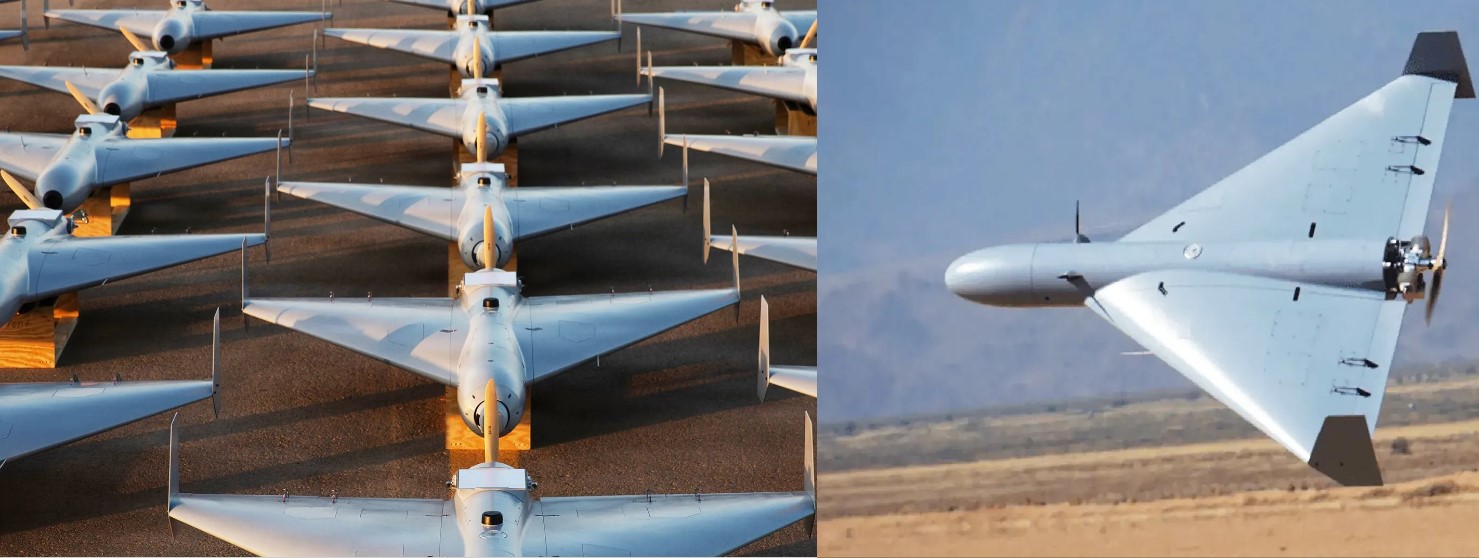
All three versions share a similar airframe, constructed mainly from carbon fiber to minimize weight. They feature a near-square fuselage, foldable straight wings, and rear vertical stabilizers, allowing them to fit inside the launch tubes. Upon launch, the tail fins deploy first, followed by wing extension.
Navigation is guided by GNSS with anti-jamming capability provided by four CRPA antennas. The munitions are optimized for low-altitude flight, helping avoid radar detection, and claim a targeting accuracy within 10 meters (CEP).
Electric Version 1: Anti-Tank Munition
This first electric variant has its motor mounted at the rear, spinning a two-blade folding propeller. It weighs 20 kg, with a 5 kg warhead. It reaches speeds of 140 km/h and has an operational range of 40 km. Two warhead types are planned:
-
High-explosive fragmentation (with steel balls), or
-
Shaped-charge anti-armor (for penetrating heavily protected targets).
The shaped charge variant has a wider fuselage nose, though how it maintains the promised 10m accuracy is unclear—perhaps requiring an alternate seeker system.
Electric Version 2: Fibre-Optic Guided Munition
This jamming-resistant variant uses fibre-optic guidance, which provides real-time control via First-Person View (FPV). Since the fibre reel is placed at the rear, the electric motor is moved to the front to make space.
-
Speed: 125 km/h (slightly reduced for cable management)
-
Warhead: 2 kg high-explosive fragmentation, optimized for controlled strikes
-
Control: Full manual control until impact via fibre-optic link
The system is at Technology Readiness Level (TRL) 6/7, with airframe flight tests already done and full system tests upcoming.
Turbine-Powered Jet Version
The third and most powerful variant is powered by a small turbine engine (imported from Thailand) that runs on diesel, kerosene, or Jet A1 fuel. It uses the same general airframe structure with a rear-mounted engine.
-
Speed: Over 300 km/h
-
Range: 65 km
-
Take-off weight: 60 kg, including a 20 kg high-explosive fragmentation warhead
-
Lethal radius: 25 meters
This version is also at TRL 6, with flight tests (minus warhead) completed and full-system trials scheduled next.
MKE’s loitering munitions program shows how Turkey is pushing aggressively into next-generation guided weapons, joining a growing global trend toward modular, precision-strike drone systems. While these new drones remain unnamed for now, the unveiling at IDEF suggests they are nearing operational maturity.
With flexible launcher platforms and varied mission-specific payloads, MKE’s loitering drones are poised to become a strategic asset for Turkish armed forces, and potentially for export to allied nations.
✍️ This article is written by the team of The Defense News.