MBDA Secures First Export Deal for Sky Warden Counter-UAV System in Middle East
MBDA has signed its first international export contract for the Sky Warden counter-UAV system with an undisclosed Middle Eastern country, marking a major milestone for the company’s rapidly evolving anti-drone portfolio. The deal follows Frontex’s recent recognition of Sky Warden as the “best system to protect the EU’s borders”, significantly boosting its global credibility.
Lorenzo Mariani, MBDA Executive Group Sales and Business Development, said the agreement represents “a crucial step in our commitment to ensuring the security and sovereignty of our partners around the world.” He described Sky Warden as an innovative and adaptable solution designed to counter the growing threat of asymmetric air attacks, especially from drones of varying sizes and capabilities.
What Is Sky Warden?
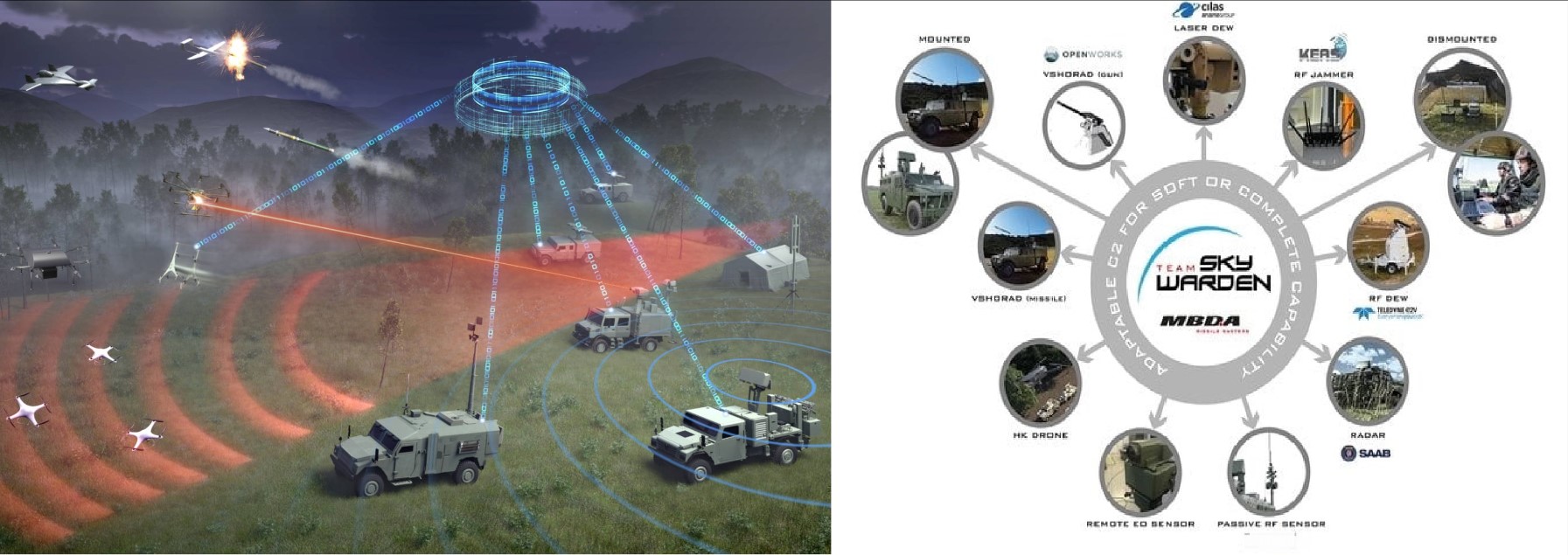
Sky Warden is a multi-layered counter-UAV (C-UAS) defence system developed by MBDA to protect military bases, critical infrastructure, borders, and high-value assets from modern drone threats. Unlike many single-sensor or single-weapon systems, Sky Warden brings together multiple sensors, multiple effectors, and an AI-driven command-and-control network, giving operators a complete and automated counter-drone solution.
It is designed to defend against a spectrum of drone threats—from micro-drones flown by individuals to tactical UAVs used by armed forces—at distances of up to 8 km.
How Sky Warden Works
Sky Warden uses a layered detection and engagement process, allowing it to stop drones in several different ways:
1. Detection & Tracking
-
Uses multi-sensor fusion, including radars, RF detectors, electro-optical/infrared cameras, and acoustic sensors.
-
Artificial intelligence identifies and classifies incoming drones, reducing false alarms.
-
The command-and-control core merges all data and provides operators with a real-time threat picture.
2. Soft-Kill (Non-Kinetic) Neutralisation
Sky Warden integrates:
-
Omni-directional jammers to disrupt drone communications and GPS links.
-
Directional jammers for precision disruption without affecting surrounding systems.
Soft-kill methods are preferred when operators want to neutralise a drone without causing debris or collateral damage.
3. Hard-Kill (Kinetic) Neutralisation
For dangerous or hardened drones, the system can employ:
-
CILAS Helma-P laser weapon, capable of burning through drone structures at close to medium range.
-
MBDA HTK (Hard-Kill) interceptors, small anti-drone munitions.
-
Mistral 3 missile, with a success rate above 96%, for larger or high-speed UAVs.
The laser weapon gives Sky Warden a near-unlimited number of shots, while the Mistral 3 extends its engagement envelope significantly.
Sky Warden Specifications (Key Features)
-
Engagement Range: Up to 8 km
-
Target Types: Micro-drones to tactical UAVs
-
Architecture: Modular, scalable, multi-sensor, multi-effector
-
Sensors: Radars, EO/IR cameras, RF detectors, acoustic arrays
-
AI Integration: Automated drone classification & threat prioritisation
-
Effectors:
-
Helma-P high-energy laser
-
Omni & directional jammers
-
HTK interceptors
-
Mistral 3 missile
-
-
Deployment Options: Mobile vehicles, fixed sites, or semi-static installations
-
Integration: Can work with VL MICA, CAMM-ER, or other air defence networks
-
Command Architecture: MBDA’s advanced C2 (command-and-control) framework
Why the System Is Gaining Demand
The global demand for advanced counter-drone systems is rising sharply, especially as drone warfare intensifies across Ukraine, the Middle East, and Africa. In this environment, Sky Warden has begun to stand out as one of the more capable and versatile solutions available. What makes it appealing is not just one specialty, but the fact that it brings lasers, electronic jammers, missile interceptors, and hard-kill munitions together in one integrated system. Its ability to deal with drone swarms—not just single UAVs—places it in a different league compared to older technologies. Another major advantage is its modular design, which allows countries to tailor the system according to budget and threat level. With artificial intelligence assisting in detection and engagement, Sky Warden reduces operator workload while improving accuracy and response speed.
Other Customers or Operators
Even though this Middle Eastern deal is the first full export contract for Sky Warden, the system is not new to international users. Frontex, the European Border and Coast Guard Agency, has already tested it extensively and rated it as the most effective counter-UAV system for EU border protection. Several European militaries have evaluated individual components—such as the Mistral 3 missile and the Helma-P laser—and expressed strong interest in its capabilities. Parts of the Sky Warden architecture, especially its sensors and jamming modules, are already in service with multiple NATO members. The new agreement is significant because it marks the first time the complete Sky Warden system—with all its layered effectors—is being exported outside Europe.
Integration and Future Growth
MBDA confirms that Sky Warden can be linked with larger air defence systems like VL MICA or CAMM-ER, allowing militaries to create a complete air defence network from short to medium range.
The system’s capability continues to evolve, especially after MBDA acquired the Helma-P laser, giving it greater control over roadmap development and improving energy-based counter-drone options.
A Growing Market for Counter-Drone Capability
With drones now used for surveillance, smuggling, terrorism, and precision strikes, countries worldwide are investing in C-UAS technology. Sky Warden’s entry into the export market is expected to boost MBDA’s position in this rapidly expanding sector.
As drone threats grow in complexity and frequency, systems like Sky Warden will form a critical part of future battlefield and homeland security architectures.
About the Author
Aditya Kumar:
Defense & Geopolitics Analyst
Aditya Kumar tracks military developments in South Asia, specializing in Indian missile technology and naval strategy.