Lockheed Martin Conducts First 90-Degree Vertical Launch of JAGM, Enhancing 360-Degree Maritime Defense
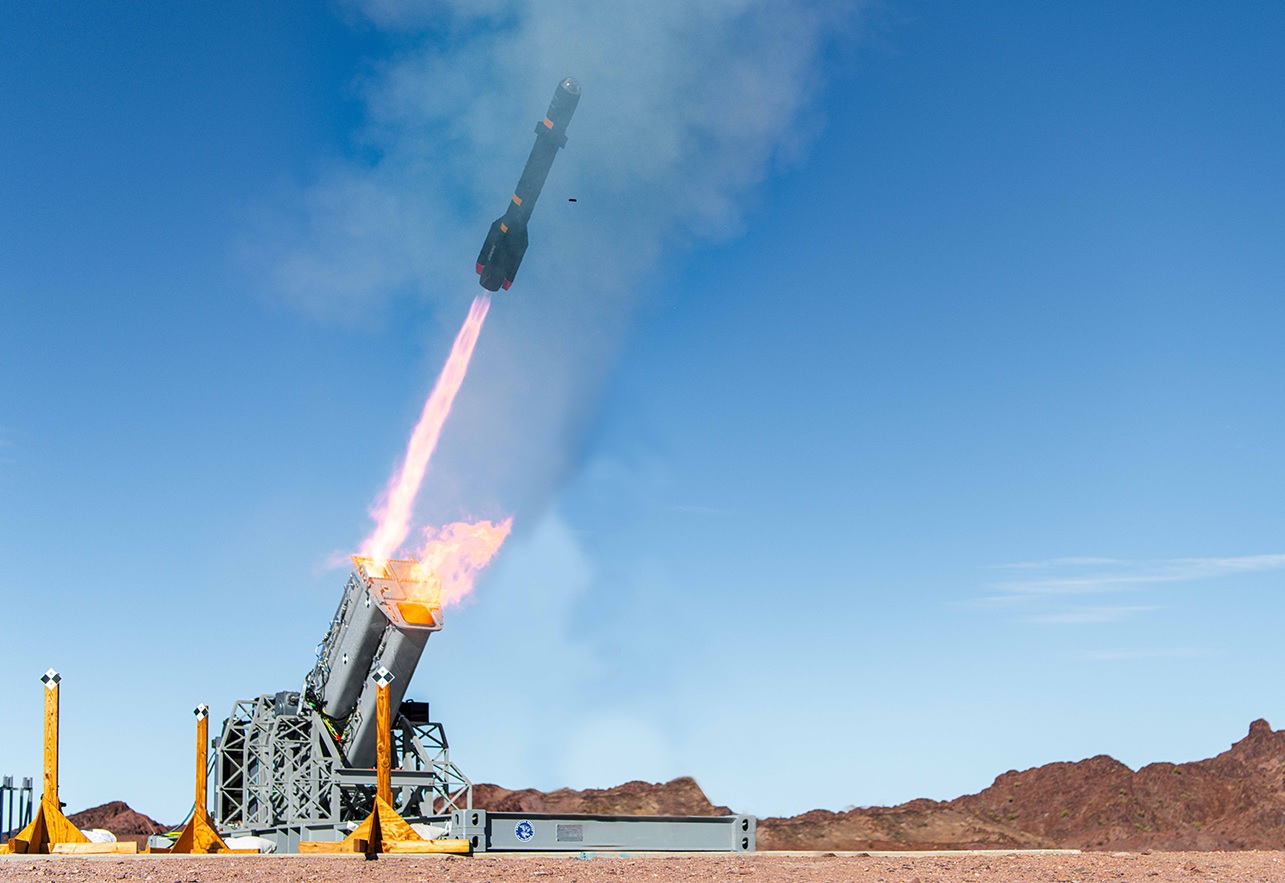
China Lake, California : Lockheed Martin has successfully conducted the first-ever 90-degree vertical launch of its Joint Air-to-Ground Missile (JAGM) from the newly developed JAGM Quad Launcher (JQL), marking a major advancement in multi-domain missile deployment and modern naval defense.
The demonstration, carried out at the Naval Air Weapons Station China Lake, validated JAGM’s ability to launch vertically and engage threats across air, land, and sea environments. Defense officials say the test confirms the missile’s suitability for providing a full 360-degree defensive envelope, particularly for naval forces facing increasingly complex and fast-emerging threats.
Vertical Launch Breakthrough for a Proven Missile
Traditionally employed as an air-launched precision weapon, JAGM’s successful vertical launch represents a significant shift in deployment capability. Fired straight up from the JQL before maneuvering toward its target, the missile demonstrated controlled post-launch orientation and rapid target acquisition.
This capability enables JAGM to be deployed from confined or space-limited platforms such as ship decks, mobile ground vehicles, and expeditionary installations, without requiring angled launchers. For naval forces, vertical launch means threats approaching from any direction can be engaged instantly, a critical advantage in high-tempo maritime operations.
Counter-UAS Success Highlights Emerging Mission Role
During the test event, JAGM successfully engaged an unmanned aerial system (UAS) simulating a hostile drone. The missile detected, tracked, and neutralized the target, underscoring its effectiveness against unmanned and asymmetric threats.
Lockheed Martin officials emphasized that this capability extends beyond aerial drones. JAGM is designed to counter unmanned surface vehicles (USVs), small fast-attack craft, and other low-altitude air threats. As adversaries increasingly rely on drones and autonomous systems to overwhelm defenses, this capability is becoming essential for modern navies.
Multi-Domain Mission Integration Across Air, Land and Sea
The integration of JAGM with the JAGM Quad Launcher demonstrates Lockheed Martin’s focus on flexible, mission-tailored deployment. The system allows operators to select different engagement envelopes depending on mission requirements, platform constraints, and threat profiles.
JAGM can now be employed from helicopters, fixed-wing aircraft, ground platforms, and vertical launch systems, providing a single missile solution across multiple operational domains. This commonality reduces logistical complexity, lowers training requirements, and improves interoperability among joint and allied forces.
Guidance, Propulsion and Warhead Capabilities
JAGM incorporates a multi-mode guidance system combining semi-active laser (SAL) guidance with millimeter-wave (MMW) radar. This dual-mode seeker allows the missile to operate effectively in poor weather, smoke, dust, and contested electronic environments, while also enabling fire-and-forget capability when required.
The missile is powered by a solid rocket motor derived from the Hellfire family, ensuring reliability and a well-understood performance profile. Its multi-purpose warhead combines shaped-charge and fragmentation effects, enabling it to defeat a wide range of targets, from lightly armored vehicles to unmanned systems and small maritime threats.
Full Baseline JAGM Specifications
The baseline Joint Air-to-Ground Missile measures approximately 70 inches (178 centimeters) in length, with a diameter of about 7 inches (17.8 centimeters). The missile weighs roughly 115 pounds (51.5 kilograms).
For helicopter operations, JAGM has an effective range of approximately 0.3 to more than 4.9 miles (0.5 to over 8 kilometers), with extended range achievable from fixed-wing aircraft. These characteristics allow the missile to support both close-in defense and stand-off engagement roles.
Strategic Benefits for Naval and Joint Forces
The vertical launch demonstration highlights several operational benefits. JAGM offers navies a compact, cost-effective interceptor capable of addressing drone and small surface threats without expending larger, more expensive air-defense missiles. It supports layered defense strategies and improves response times against sudden, low-signature threats.
By combining precision, flexibility, and cross-domain compatibility, JAGM enhances force survivability and expands commanders’ operational options in contested environments. Analysts say such adaptable systems are increasingly vital as modern warfare shifts toward distributed operations and unmanned threats.
A Step Toward Future Integrated Defense
Lockheed Martin’s successful test at China Lake positions JAGM and the JAGM Quad Launcher as a key component of future multi-domain defense architectures. As unmanned and asymmetric threats continue to proliferate, systems capable of rapid deployment, precise engagement, and seamless integration across platforms are expected to play a decisive role in shaping next-generation military operations.
The demonstration signals JAGM’s evolution from a traditional air-launched missile into a versatile, all-domain weapon system, reflecting broader changes in how modern forces approach integrated defense and precision strike in an increasingly complex battlespace.
About the Author
Aditya Kumar:
Defense & Geopolitics Analyst
Aditya Kumar tracks military developments in South Asia, specializing in Indian missile technology and naval strategy.