Latvia Confirms First ASCOD Hunter Infantry Fighting Vehicles to Arrive in H1 2026, Full Fleet by 2027
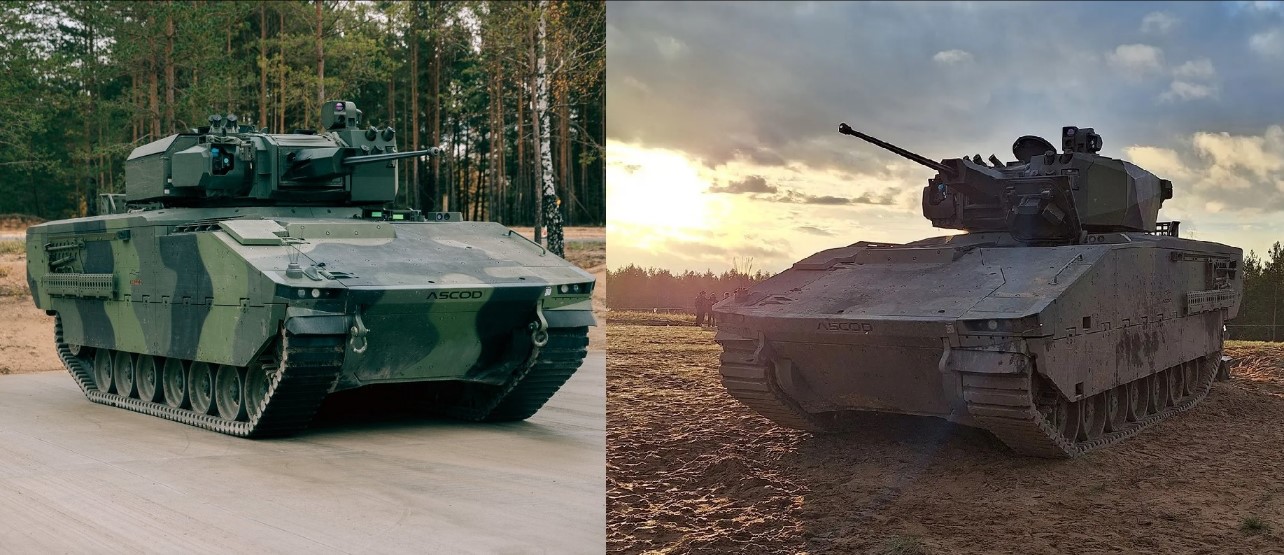
On 27 November 2025, Latvian Ministry of Defence (MoD) announced that the first ASCOD Hunter infantry fighting vehicles (IFVs) will be delivered in the first half of 2026. The disclosure by Defence Minister Andris Sprūds came during a meeting held at the Ādaži military base, where a letter of intent was signed with allies GDELS-Santa Bárbara Sistemas (Spain) and Patria Latvia / Defence Partnership Latvia (DPL) — which formalizes cooperation within the ASCOD programme and establishes a shared user group for upgrades, sustainment, and interoperability.
The acquisition marks a major step in the modernisation of Latvia’s land forces. Under the procurement plan, a total of 84 Hunter IFVs will be acquired — split between two mechanised infantry battalions — with full fleet deliveries expected by 2027.
Deal Background and Industrial Participation
The procurement process began with an initial contract signed in January 2025 for 42 vehicles, valued at around €373 million (including a logistics-support package). In June 2025, the Latvian government approved a second order for an additional 42 IFVs, costing approximately €387 million, bringing the total investment close to €760 million for 84 vehicles.
As part of the agreement, at least 30 percent of the procurement programme is designated for Latvian industry: local companies are to be involved in component production, final assembly, and long-term sustainment. The assembly and maintenance work will take place at the DPL facility in Valmiera operated by Patria Latvia.
The meeting on 27 November formalized cooperation between Latvia, Spain and Austria under the ASCOD programme and created a shared user group to manage future upgrades, sustainment, and interoperability — strengthening European cooperation in ground defence systems.
What Is the ASCOD Hunter — Specifications & Capabilities
The Hunter version is the Latvian-customised variant of the latest generation ASCOD 2 tracked platform. The vehicle features a high-output diesel engine, RENK HSWL-256B automatic transmission, and hydropneumatic suspension, delivering excellent cross-country mobility and a top road speed up to about 70 km/h.
Armour protection meets NATO STANAG 4569 Level 4, furnishing defence against kinetic and mine-blast threats. The IFV is operated by a crew of three and can carry up to six fully-equipped infantry soldiers, enabling rapid deployment in combat.
In terms of firepower, Hunter is equipped with the unmanned turret Elbit UT30 Mk2, armed with a 30 mm Mk44 Bushmaster II autocannon, capable of integrating Spike LR2 anti-tank guided missiles, a machine gun, and advanced C4I systems for situational awareness and networked operations.
The digital electronic architecture, modular design and NATO-compatible communication systems make Hunter a versatile next-generation IFV suited for Europe’s defence environment.
Replacement of Old Fleet: From CVR(T) to Modern IFVs
The acquisition of Hunter IFVs comes as part of a broader effort to replace Latvia’s ageing CVR(T) armoured vehicle fleet. Latvia has operated around 184–200 CVR(T) vehicles, though many have been donated to allied nations in recent years.
The new IFV fleet promises significantly enhanced capability: superior protection, greater firepower, better mobility, and full NATO interoperability — crucial for Latvia’s position on NATO’s eastern flank.
Strategic Implications & Significance
The deal reinforces Latvia’s commitment to modernising its land forces amid heightened regional tensions. By selecting a proven, modern platform and involving local industry, Riga aims to strengthen its national defence and contribute to NATO collective security.
The shared ASCOD user-group with Spain and Austria may lead to coordinated upgrades and maintenance, potentially establishing ASCOD Hunter as a multi-national NATO armoured platform.
With deliveries beginning in mid-2026 and completion by 2027, the first Hunter vehicles will soon be ready for unit integration, training, and initial deployment — significantly boosting Latvia’s mechanised infantry capability.
About the Author
Aditya Kumar:
Defense & Geopolitics Analyst
Aditya Kumar tracks military developments in South Asia, specializing in Indian missile technology and naval strategy.