Kurdish-Led Syrian Democratic Forces Set to Merge Into Syrian Army After Military Defeat
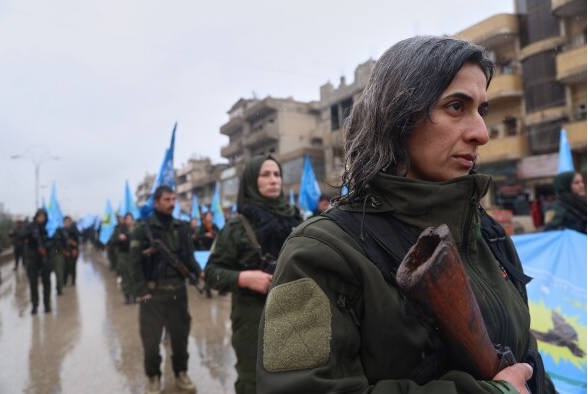
BEIRUT : The collapse of the Syrian Democratic Forces (SDF) as an independent military power appears imminent after a sweeping government offensive and a far-reaching agreement that will see the Kurdish-led force absorbed into Syria’s national institutions, effectively ending a decade-long experiment in Kurdish self-rule in the country’s northeast.
Once the most effective ground force against the Islamic State group, the SDF has been pushed back to a shrinking pocket in Hassakeh after Syrian government troops captured large swaths of territory following days of deadly clashes. The rapid advance marks one of the most significant military and political turning points since the fall of former President Bashar Assad in December 2024.
From U.S.-Backed Ally to Strategic Defeat
Formed in 2015 with U.S. backing, the SDF united Kurdish, Arab, Turkmen and Christian militias to combat the rise of the Islamic State in Syria. At its height, the force controlled nearly a quarter of Syrian territory, including much of the oil-rich east and key population centers along the Turkish and Iraqi borders.
Although ethnically diverse on paper, the alliance was dominated by the Kurdish People’s Protection Units (YPG), a fact that fueled tensions with Arab factions and alarmed neighboring Turkey, which considers the YPG an extension of the PKK insurgency it has fought for decades.
The SDF’s military success culminated in March 2019, when it captured the last Islamic State stronghold in eastern Syria. That victory, however, left the group governing vast territory, running detention camps and prisons, and navigating a fragile relationship with Damascus that would eventually unravel.
Damascus Moves to Reassert Control
Relations between Syria’s new leadership and the SDF remained strained after Assad’s ouster, even as interim President Ahmad al-Sharaa consolidated power in Damascus. A surprise thaw appeared in March, when SDF commander Mazloum Abdi visited the capital and signed a preliminary agreement to integrate the force into the national army by the end of 2025.
But talks stalled over how that integration would occur. Abdi publicly favored merging the SDF as a cohesive unit, preserving its internal command structure. Damascus rejected that approach.
In early January, Abdi returned to Damascus for further negotiations. State media reported that no tangible progress was made. Within days, fighting erupted in northern Aleppo, forcing the SDF to evacuate long-held neighborhoods. The clashes quickly escalated into a broader offensive.
Government troops pushed eastward, seizing towns outside Aleppo before driving deeper into the heart of SDF-held territory. By Sunday, Syrian forces had taken control of much of Raqqa — the former de facto capital of the Islamic State — and the oil-rich province of Deir el-Zour along the Iraqi border.
A Ceasefire That Redefines Power
Late Sunday, Damascus announced a ceasefire, formally ending the latest round of fighting. Shortly afterward, state-run media broadcast images of al-Sharaa signing a new agreement. Abdi’s signature appeared on the document, though he was absent from the ceremony, with officials citing bad weather.
Under the terms of the deal, SDF fighters will be absorbed into Syria’s army and police as individuals, not as an organized force — a provision widely seen as a decisive blow to Kurdish leverage. Senior SDF commanders will submit names to Damascus, with select figures expected to receive military or administrative posts.
In a symbolic move aimed at easing Kurdish anger, al-Sharaa issued a decree recognizing Kurdish as an official language alongside Arabic and declaring the Kurdish New Year a national holiday. The ceasefire was announced two days later.
The End of Rojava
The agreement effectively dismantles the autonomous region known as Rojava, or Western Kurdistan, which had emerged during Syria’s civil war. Kurds made up roughly 10 percent of Syria’s pre-war population of 23 million, but their political influence far exceeded their demographic weight during the height of SDF control.
With Raqqa and Deir el-Zour lost, the SDF has been stripped of key economic assets, including oil fields, wheat supplies, dams and border crossings. Analysts say the loss of revenue and territory left the group little choice but to accept harsher terms than those it had previously rejected.
Turkey stands to gain the most from the outcome. Ankara has long demanded the dismantling of Kurdish armed structures along its southern border and now sees its primary objective achieved without direct military intervention.
Islamic State Prisons: A Looming Test
One of the most sensitive issues now confronting Damascus is control of detention facilities holding thousands of Islamic State suspects. The SDF has for years guarded prisons housing an estimated 9,000 IS fighters, as well as the sprawling al-Hol and Roj camps, home to tens of thousands of women and children linked to the group.
On Monday, the SDF reported an attack on the Shaddadeh prison, saying its fighters repelled multiple assaults. Under the new 14-point ceasefire agreement, responsibility for prisons and camps will gradually transfer to the Syrian government, which will assume full legal and security control. No timeline has been announced.
The deal commits Damascus to continuing the fight against Islamic State, noting Syria’s participation in the U.S.-led coalition. Security experts warn that any lapse in oversight could trigger prison breaks or renewed insurgent activity.
A Shift in U.S. Posture
Washington has described the agreement as an “inflection point,” language widely interpreted as signaling the end of direct U.S. backing for the SDF. Kurdish commanders had publicly urged American officials to intervene as negotiations faltered, but those appeals went unanswered.
For many Kurds, the outcome confirms long-standing fears of abandonment. After serving as the West’s primary partner in the war against Islamic State, the SDF now faces dissolution, its fighters absorbed into a state that once denied Kurdish identity altogether.
As al-Sharaa tightens his grip on the country — following deadly clashes that subdued Assad-era Alawite strongholds — Syria enters a new phase of postwar consolidation. Whether that stability holds, particularly with Islamic State detainees now under central control, may determine whether the conflict is truly ending or merely entering another, more volatile chapter.
About the Author
Aditya Kumar:
Defense & Geopolitics Analyst
Aditya Kumar tracks military developments in South Asia, specializing in Indian missile technology and naval strategy.