Kaveri derivative engine completes UCAV mission-cycle tests with Accelerated Simulated Endurance Mission Test (ASEMT)
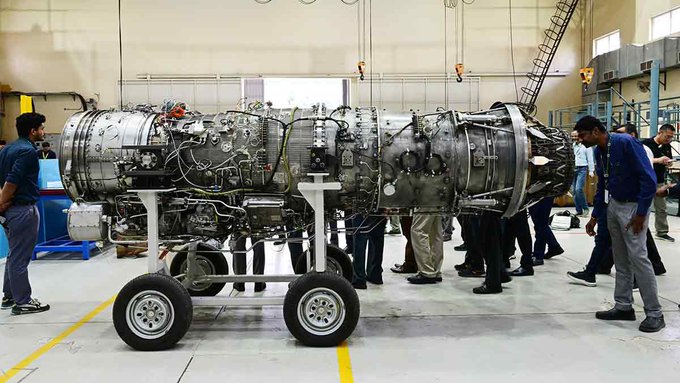
Bengaluru — India’s Kaveri derivative engine has successfully completed an intensive Accelerated Simulated Endurance Mission Test (ASEMT) designed to replicate the full operational cycle of a modern Unmanned Combat Aerial Vehicle (UCAV) — from long loiters to high-power attack bursts and back to loiter. The milestone advances the engine closer to final certification and integration into the indigenous Ghatak UCAV program.
The ASEMT was built to stress the engine exactly as a UCAV would use it in contested operations. Engineers ran repeated rapid throttle cycling sequences to mimic real mission profiles — loiter → strike → loiter — ensuring the engine can tolerate frequent and abrupt changes in thrust demand without performance degradation. The program also executed aggressive thermal cycling (repeated heating and cooling of the hot section after thrust bursts) to check structural and material resilience. In addition, long high-endurance cruise runs were performed to validate fuel consumption and thermal stability at sustained cruise power, explicitly testing TSFC (thrust specific fuel consumption) and cruise efficiency for long-range missions. An IR-suppression evaluation was included as well, examining nozzle geometry and hot-section coatings to reduce the engine’s infrared signature.
Technical teams report no catastrophic issues during the ASEMT; instead the trials provided key data on durability margins, hot-section life, and coating performance under real-world-like cycling. Those results will feed directly into component life predictions and maintenance-interval planning required for formal certification.
The Kaveri derivative — a non-afterburning, dry variant developed from the long-running Kaveri program — is being tailored specifically for stealthy, medium-thrust unmanned platforms. Public reporting and project briefings place the engine’s dry thrust in the roughly 49–55 kN class, making it well suited for the Ghatak UCAV’s requirements for endurance, stealth and cruise efficiency rather than the much higher thrust levels needed for manned fighters. Production partners in the private sector have already started delivering modules and engines as the program transitions from lab development to qualification and certification testing.
Recent in-flight and ground test activity, including final multi-hour trials, have been reported as the program moves toward certification and integration with the Ghatak demonstrator. The successful ASEMT is an important step in that sequence because it compresses a variety of mission stresses into a measurable, repeatable test that shortens the time needed to validate life-cycle and operational characteristics.
If the recent engine image circulating is indeed authentic and up to date, it warrants close attention. The frontal section appears to show a reworked fan architecture, while the visible afterburner section suggests either experimental integration of an AB unit on the dry Kaveri derivative, or more likely, reference to the earlier Kaveri Aero variant, which had undergone modifications including afterburning capability. If validated, these indicators would represent a positive development, though their real significance hinges entirely on the image’s recency and official confirmation.
Program managers and defence experts say the implications extend beyond a single engine: a qualified indigenous engine for UCAVs would strengthen India’s self-reliance in air-launched systems, reduce dependence on foreign powerplants for unmanned strike platforms, and enable more flexible mission planning for deep-strike and contested-airspace operations. Engineers also noted that the ASEMT’s IR-suppression findings will be important for shaping nozzle design and thermal-coating specifications on future production engines.
✍️ This article is written by the team of The Defense News.