Japan’s New Lithium-Ion Submarines Outclass Nuclear Submarines in Stealth
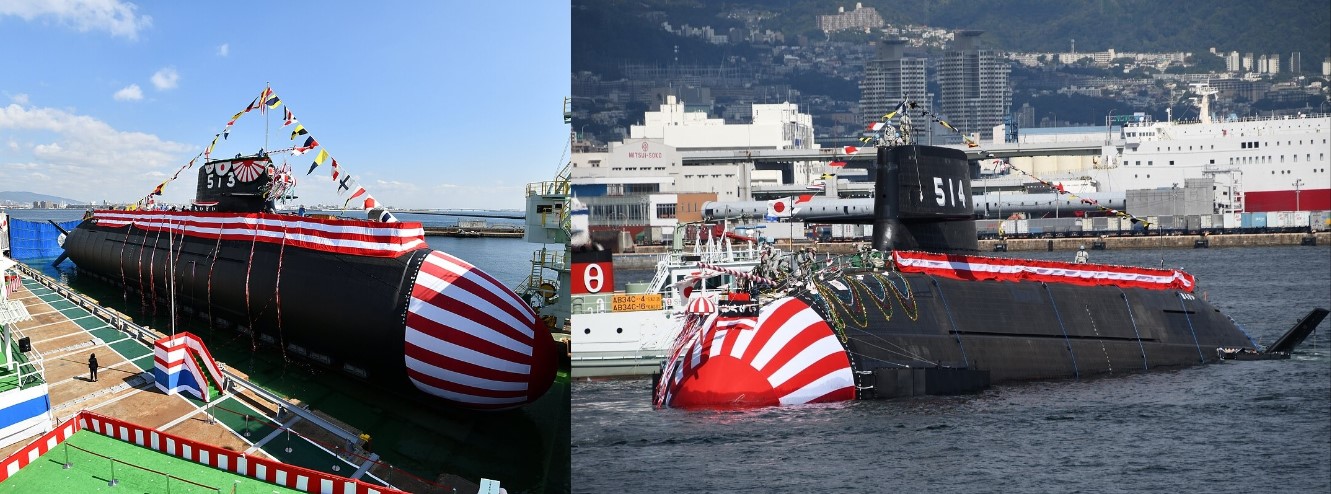
Japan has taken a decisive lead in submarine technology with its late-batch Sōryū-class and the next-generation Taigei-class, the world’s first operational combat submarines powered entirely by lithium-ion batteries. This propulsion revolution has reshaped everything from acoustic stealth to underwater endurance, placing these Japanese boats in a unique category where they can match — and under certain tactical conditions surpass — the quietness of nuclear-powered submarines. The achievement represents a milestone not only for Japan’s maritime forces but for submarine warfare as a whole.
Lithium-Ion Propulsion as the Foundation of Silence
The shift from lead-acid to lithium-ion power transformed Japan’s underwater operations. A lithium-ion battery can store several times more energy per unit weight than legacy cells, allowing the submarine to cruise underwater for far longer without surfacing. When operating in full battery mode, every major noise source inside the hull disappears. The diesel engines remain shut down. There is no need for a mechanical AIP engine, no rotating pistons, no fuel-cell compressors, and no intake or exhaust noises from frequent snorkel cycles.
This creates a submarine that moves with only the soft electrical hum of a permanent-magnet propulsion motor, producing an acoustic signature so faint that it dissolves into the background noise of the sea. Unlike lead-acid batteries, lithium-ion cells maintain a high voltage throughout their discharge cycle, allowing the submarine to operate at higher speed without becoming louder.
Why Lithium-Ion Silence Surpasses Nuclear Stealth
Nuclear-powered submarines dominate long-range warfare, but they are permanently burdened by the machinery of atomic propulsion. A reactor must always run. Pumps circulate coolant. Steam systems drive turbines. Even when running at their quietest setting, nuclear submarines generate a detectable mechanical heartbeat.
Japan’s lithium-ion boats do not have this problem. In low-speed patrols, ambush positions, or seabed listening missions, the submarine radiates almost no mechanical signature. The absence of reactor noise removes the constant low-frequency hum that nuclear boats cannot eliminate. This is why, in the tight waters of the East China Sea, Okinawa chain, and Luzon Strait, Japanese submarines can be harder to hear than nuclear fast-attack vessels from major powers.
The Sōryū-Class Lithium-Ion Variants
The breakthrough began with the final pair of Sōryū-class submarines, JS Ōryū and JS Tōryū. These 84-meter-long boats displace about 4,200 tons submerged, can exceed 20 knots underwater, and are equipped with a full array of flank, bow, and towed-array sonars. Their lithium-ion system replaced the earlier Stirling AIP engines, eliminating mechanical vibration and simplifying the submarine’s internal layout. The power density of the new batteries allowed longer silent running and reduced snorkel frequency, giving the submarine extended periods of near-complete invisibility.
These submarines served as the operational testbed that validated Japan’s safety systems, including advanced thermal management, multi-layer fire isolation zones, and an unusually sophisticated battery management system derived from Japan’s consumer and automotive battery sectors. No other navy had attempted such a transition in an operational fleet before Japan did.
The Taigei-Class: Japan’s First Purpose-Built Lithium-Ion Submarine
The Taigei-class represents Japan’s full expression of lithium-ion submarine engineering. Also about 84 meters in length and displacing approximately 3,000 tons surfaced and 4,500 tons submerged, the Taigei features a hull sculpted specifically for quiet hydrodynamics. Its new permanent-magnet synchronous motor is even smoother and quieter than the Sōryū’s induction motor, producing remarkably low acoustic output at creeping speeds.
Japanese engineers redesigned Taigei from the keel up to take advantage of lithium-ion power. The batteries are larger, arranged in more efficient blocks, and managed by a next-generation thermal system. The submarine dives beyond 300 meters and uses a full suite of Japanese-developed sensors with improved signal processing to detect low-frequency contacts at extended ranges. The interior machinery is raft-mounted on multi-layer dampers, while floating decks isolate vibrations. Even the coolant flows and pipe routing were reshaped to eliminate micro-vibrations that sonar arrays could detect.
Why Japan’s Lithium-Ion Submarines Are More Advanced Than Other Nations’ Li-Ion Efforts
Several countries now plan to adopt lithium-ion batteries, including South Korea and France. But Japan’s system is considered more advanced for three key reasons.
Japan has far more operational experience. Its lithium-ion submarines have been deployed on real patrols for years, giving Japan data that no other navy possesses. This includes long-term battery degradation behavior under deep diving, high-speed discharge patterns, and the thermal characteristics of megawatt-hour battery packs under combat conditions.
Japan also enjoys the world’s strongest industrial ecosystem for battery technology. Companies such as Panasonic and GS Yuasa have decades of experience in safe high-density cells, a capability absent in most other submarine builders. This depth allowed Japan to develop a battery chemistry with extremely high stability and a battery management system capable of monitoring thousands of cells simultaneously with millisecond reaction times.
Finally, Japan designs the submarine as a complete acoustic system, not a platform with a new battery. Every part — from the propeller shape to the arrangement of cable ducts — is tuned for stealth. Other nations may adopt lithium-ion packs, but without Japan’s holistic quieting philosophy, their acoustic results will not reach the same level.
What Makes Them Technically Special Even Compared to Nuclear Submarines
Japan’s lithium-ion submarines are not nuclear boats, yet in certain missions, they outperform them in stealth because they remove the reactor as a noise source. Nuclear submarines cannot glide in total silence; their reactors and pumps generate a continuous, low-frequency signature that modern sonar arrays can detect at range. Japan’s lithium-ion boats do not suffer from this mechanical baseline. At slow speeds they produce almost no detectable emissions and can remain acoustically neutral for long periods.
Their lithium-ion packs also allow high-speed dashes in near silence, something lead-acid batteries cannot support. Nuclear submarines can sprint indefinitely, but not quietly. Japan’s boats can sprint silently for tactical bursts without revealing their location, a unique advantage in shallow strategic waters.
Strategic Significance in the First Island Chain
The First Island Chain is defined by straits, shallow basins, and complex seabed acoustics. In these environments, silence is more valuable than unlimited endurance. Japan’s lithium-ion submarines can wait in near-motionless ambush, observe enemy movement with powerful passive sonar, and then reposition without revealing themselves. Their presence complicates Chinese naval operations and strengthens Japan’s deterrent posture without the political burden of acquiring nuclear submarines.
As more Taigei-class submarines enter service, Japan is constructing one of the world’s most technologically advanced non-nuclear submarine fleets. It is a fleet that challenges long-held assumptions about what conventional submarines can do, and one that proves that silence — not size — remains the most decisive weapon beneath the waves.
✍️ This article is written by the team of The Defense News.