Japan's Maritime Self-Defense Force Successfully Completes Firing Trials of Ship Based Railgun
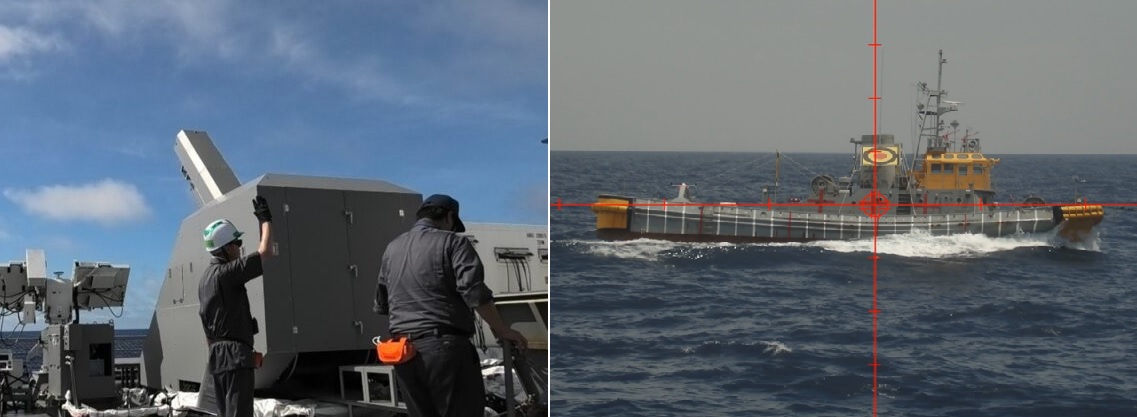
Japan's Acquisition, Technology & Logistics Agency (ATLA) has announced the successful completion of offshore firing trials of an electromagnetic railgun aboard the Maritime Self-Defense Force's test vessel, JS Asuka. The trials, conducted between June and early July 2025, marked a significant advancement in Japan's defense capabilities.
ATLA confirmed that the railgun, mounted on the ship, successfully carried out long-range firings and accurately engaged a target vessel during the trial.
The agency released four images taken during the tests, showing the railgun in action, including a moment when the weapon was aimed at a surface target. The railgun, powered entirely by electrical energy, fires projectiles at extreme velocity. Traditional tank guns typically fire at an initial speed of 1,750 meters per second. In contrast, ATLA stated the railgun used in this test achieved muzzle velocities exceeding 2,500 meters per second. The weapon’s design allows for adjustments in projectile velocity, range, and destructive power—all without the need for chemical propellants.
Because the railgun uses smaller projectiles and does not rely on explosive warheads, it is harder to detect and intercept. This could offer a distinct advantage in contested environments where counter-battery fire or missile interception is a concern. ATLA previously highlighted this system during a 2023 demonstration, which it described as the first successful ship-based firing of a railgun anywhere in the world. This summer’s test builds on that milestone and is expected to be featured in greater detail at the upcoming ATLA Symposium, scheduled for November 11–12.
In the broader context of Japan’s defense posture, the railgun is seen as part of a layered response to regional threats, including ballistic missile defense. ATLA has framed the system as a future solution to intercept high-speed airborne or naval targets and to serve as a long-range precision strike capability at sea.
Japan’s focus on electromagnetic weaponry is aligned with its wider effort to modernize the capabilities of the Self-Defense Forces. While the U.S. Navy previously shelved its own railgun program, Japan’s continued work in this field may help revive international interest in weapon systems that rely on electricity rather than explosives.
The successful completion of these offshore firing trials represents a significant milestone in Japan's defense technology development and underscores the nation's commitment to enhancing its maritime defense capabilities.
✍️ This article is written by the team of The Defense News.