Japan Launches Fifth Awaji-Class Mine Countermeasures Vessel JS Kerama
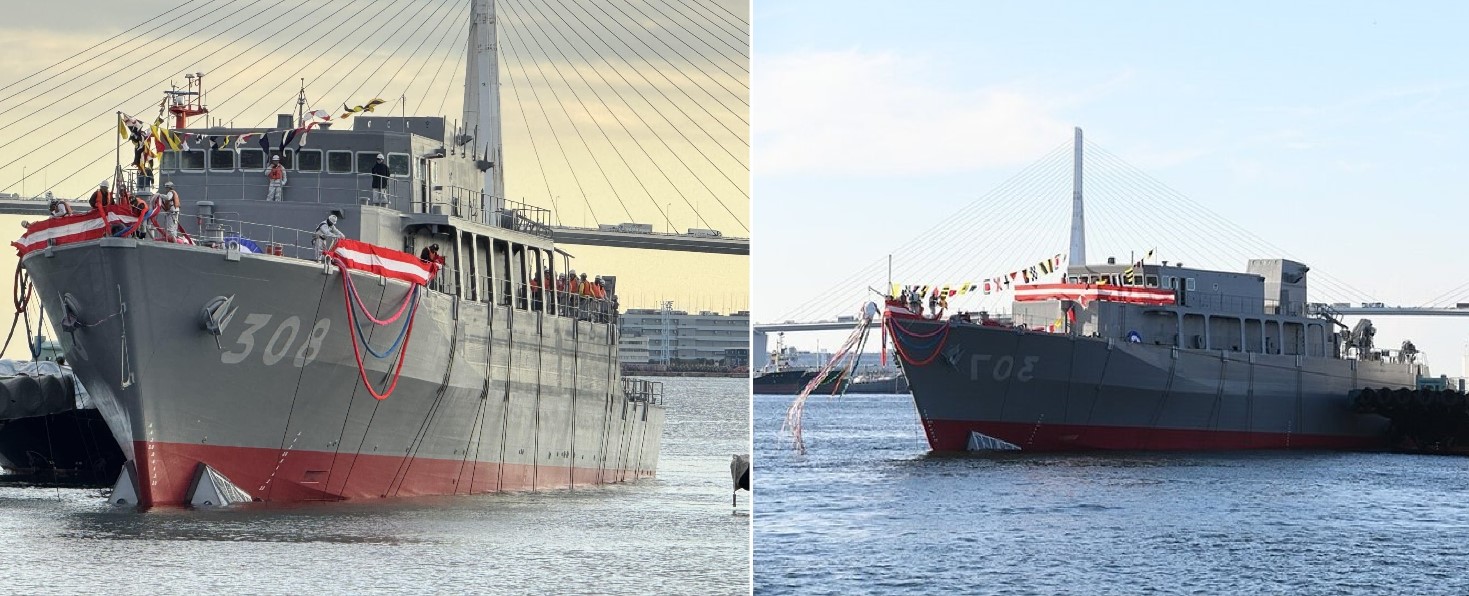
Japan Marine United (JMU) Corporation has launched the fifth Awaji-class mine countermeasures vessel (MCMV) built for the Japan Maritime Self-Defense Force (JMSDF), underscoring Tokyo’s continued investment in modern naval mine warfare capabilities and maritime security.
The vessel, named JS Kerama (MSO-308), was launched on December 18 during a ceremony at JMU’s Yokohama shipyard. Measuring 67 meters in length, the ship has entered the outfitting and sea trials phase and is scheduled to be commissioned by March 2027, according to JMSDF officials.
Naming and Construction Cost
The name Kerama is derived from Kerama Island in Okinawa Prefecture, a strategically significant area in Japan’s southwestern island chain. This marks the first time the JMSDF has used the name “Kerama,” with no historical precedent in the former Imperial Japanese Navy.
In accordance with JMSDF naming conventions, minesweepers and mine countermeasures vessels are named after islands, straits, waterways, or channels. A JMSDF spokesperson confirmed that JS Kerama was constructed at a cost of approximately 13.4 billion yen (about USD 86 million).
Status of the Awaji-Class Program
Japan Marine United has built all Awaji-class vessels launched so far, highlighting its central role in Japan’s naval shipbuilding industry. The fourth ship, JS Nomi, was commissioned in March 2025.
The JMSDF plans to operate a total of nine Awaji-class vessels. To support this, the Ministry of Defense (MoD) allocated 26.3 billion yen (USD 169 million) in fiscal year 2024 for construction of the sixth ship, and requested 34.2 billion yen (USD 219.4 million) in the proposed fiscal year 2026 budget for the seventh vessel, announced in August.
Design, Hull and Performance
According to JMSDF data, the Awaji-class has a standard displacement of about 690 tons, a beam of 11 meters, and a draught of 5.2 meters, with a crew complement of around 50 personnel. Propulsion is provided by two 2,200-horsepower diesel engines, giving the vessels a maximum speed of 14 knots.
A defining feature of the class is its fiber-reinforced plastic (FRP) composite hull, which significantly reduces the ship’s magnetic signature—a critical factor during mine countermeasures operations. The JMSDF also notes that the material offers high corrosion resistance, extending the ships’ expected service life to about 30 years, compared with approximately 20 years for older wooden-hulled minesweepers.
Sensors and Mine Countermeasures Systems
JS Kerama is equipped with a comprehensive suite of advanced mine warfare systems. These include light detection and ranging (LIDAR) surveillance equipment capable of detecting underwater objects at long range during day and night operations.
For mine detection and classification, the ship carries Hitachi-made variable depth sonar (VDS) and Mitsui E&S Holdings’ expendable mine disposal system (EMDS) for mine identification and neutralization. The vessel is also equipped with the REMUS 600 autonomous underwater vehicle (AUV)—known in JMSDF service as OZZ-4—developed by the Woods Hole Oceanographic Institution, enabling operations against deep-water mines.
For self-defense and the destruction of surfaced mines, JS Kerama mounts a remote-controlled weapon station armed with a JM61R-MS 20 mm cannon, allowing engagement while minimizing risk to the crew.
Operational Assignment and New Force Structure
Following commissioning, JS Kerama is expected to be assigned to a newly established unit tentatively named the Amphibious Warfare and Mine Countermeasures Group. This group will fall under a proposed new JMSDF command structure known as the Fleet Surface Force, which is scheduled to be created by the end of fiscal year 2025 as part of broader organizational reforms.
Replacing Aging Minesweepers
The Awaji-class was developed to replace the JMSDF’s Yaeyama-class wooden-hulled minesweepers, the first of which entered service in 1993. All three Yaeyama-class vessels were decommissioned by 2017, creating the requirement for modern, low-signature platforms with enhanced detection and endurance.
Japan’s Longstanding Minesweeping Tradition
Mine countermeasures have long been a core specialty of Japan’s maritime forces. Even before the establishment of the Maritime Self-Defense Force in 1954, Japanese minesweeping units played a critical role in clearing World War II naval mines, helping restore Japan’s postwar maritime trade routes.
During the Korean War, Japanese minesweepers were dispatched at the request of the United States to clear waters around the Korean Peninsula. In October 1950, one vessel struck a mine off Wonsan, North Korea, resulting in the loss of the ship and the death of one crew member. More recently, JMSDF minesweepers were deployed to the Persian Gulf following the 1991 Gulf War.
With the launch of JS Kerama, Japan continues to build on this legacy, strengthening its mine countermeasures capability to protect critical sea lanes amid an increasingly complex regional security environment.
About the Author
Aditya Kumar:
Defense & Geopolitics Analyst
Aditya Kumar tracks military developments in South Asia, specializing in Indian missile technology and naval strategy.