Japan Deploys Osprey Aircraft at New Base to Counter China’s Growing Influence
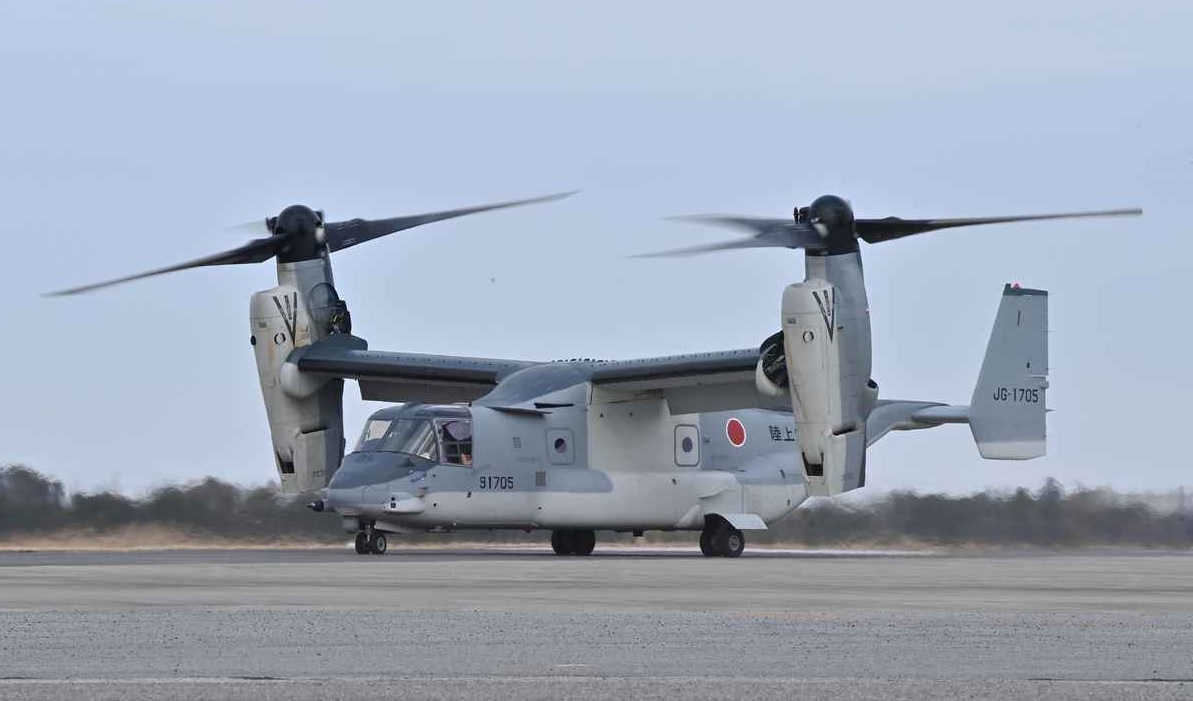
Japan has officially begun deploying its fleet of V-22 Osprey aircraft to a new permanent military base in Saga Prefecture, a strategic move aimed at bolstering the country's defense posture amid rising tensions with China in the Indo-Pacific region. The deployment comes as Tokyo continues its most significant military expansion since World War II, with a sharp focus on protecting its remote southwestern islands.
On Wednesday, the first of 17 Osprey tiltrotor aircraft arrived at Camp Saga, located in the southern part of Japan's Kyushu Island. The remaining aircraft are expected to be transferred to the base by mid-August. This marks the first time the Japanese Ground Self-Defense Force (GSDF) is permanently stationing its Osprey fleet, highlighting the aircraft’s critical role in enhancing rapid-response capabilities.
The V-22 Osprey, developed by the U.S., is a unique aircraft that combines the vertical takeoff and landing capabilities of a helicopter with the speed and range of a fixed-wing plane. It is seen as particularly valuable for transporting troops and equipment swiftly across Japan’s numerous remote islands, especially in the East China Sea, where China has become increasingly assertive.
Japan’s Defense Ministry plans to integrate the Ospreys with its Amphibious Rapid Deployment Brigade (ARDB), based in nearby Sasebo. The ARDB is a specialized force modeled after the U.S. Marine Corps and is trained to conduct island recapture and rapid deployment operations. With China stepping up its military activities near the Senkaku Islands—which Japan administers but China also claims—this coordination between air and amphibious assets is expected to be a critical part of Japan’s deterrence strategy.
Defense Minister Gen Nakatani underscored the urgency of the move, saying, “The security environment surrounding Japan has been increasingly severe, and it is our pressing task to strengthen our island defense capabilities.”
However, not everyone supports the Osprey deployment. Public opposition remains strong, especially in southern Japan, where past accidents involving the aircraft—both American and Japanese—have fueled safety concerns. Outside Camp Saga, protesters gathered holding signs and shouting slogans like “Get out Osprey!” One protester, Osamu Rikihisa, expressed fears over safety, noting the aircraft's troubled history.
Indeed, concerns are not unfounded. In November 2023, a U.S. Air Force Osprey crashed off Japan’s southern coast, killing eight personnel. Just a year later, in October 2024, a Japanese GSDF Osprey suffered a mishap during a joint training exercise with the U.S., tipping on takeoff. Though that incident was later attributed to human error, it has added to public unease.
Despite this, Prime Minister Shigeru Ishiba defended the deployment during a campaign speech in Saga. He emphasized the Osprey’s superior capabilities over traditional helicopters, not just for military purposes, but also for humanitarian aid and disaster relief missions across Japan’s rugged terrain.
The base at Saga Airport, where the Ospreys are now stationed, is part of a broader plan by Japan to shift its military focus southward, closer to potential flashpoints like Taiwan and the disputed East China Sea islands. This shift reflects growing alignment with U.S. strategic interests in the region and a more proactive stance in collective defense under Japan’s evolving national security strategy.
As the full fleet settles in over the next few months, Japan’s ability to quickly respond to emergencies, whether natural or geopolitical, is set to grow—but so too may the debate over the balance between national security and public safety.
✍️ This article is written by the team of The Defense News.