Japan Approves $5.4 billion Supplementary Defense Budget For Accelerate Frigate and Submarine Construction
On November 28, the cabinet of Japanese Prime Minister Sanae Takaichi approved a supplementary defense budget of ¥847.2 billion (US$ 5.4 billion) for fiscal 2025, in response to mounting security challenges posed by increased military activity from neighbouring powers.
The package includes a major allocation of ¥122.2 billion (US$ 782 million) aimed at “enhancing capabilities by securing the early operational readiness of aircraft and vessels.”
Officials said the funds represent an “advance allocation” of future-year payments — effectively front-loading construction costs already approved under earlier defence budgets — to enable shipbuilders to begin manufacturing earlier and deliver vessels ahead of schedule.
This move is part of Japan’s broader strategy to bolster its deterrence posture as a maritime nation facing a rapidly deteriorating regional security environment.
What the Funding Will Build: Frigates and Submarines
A breakdown of the major construction investments shows a focus on expanding and accelerating the fleet of surface vessels and submarines for the Japan Maritime Self-Defense Force (JMSDF).
Included in the supplementary budget:
-
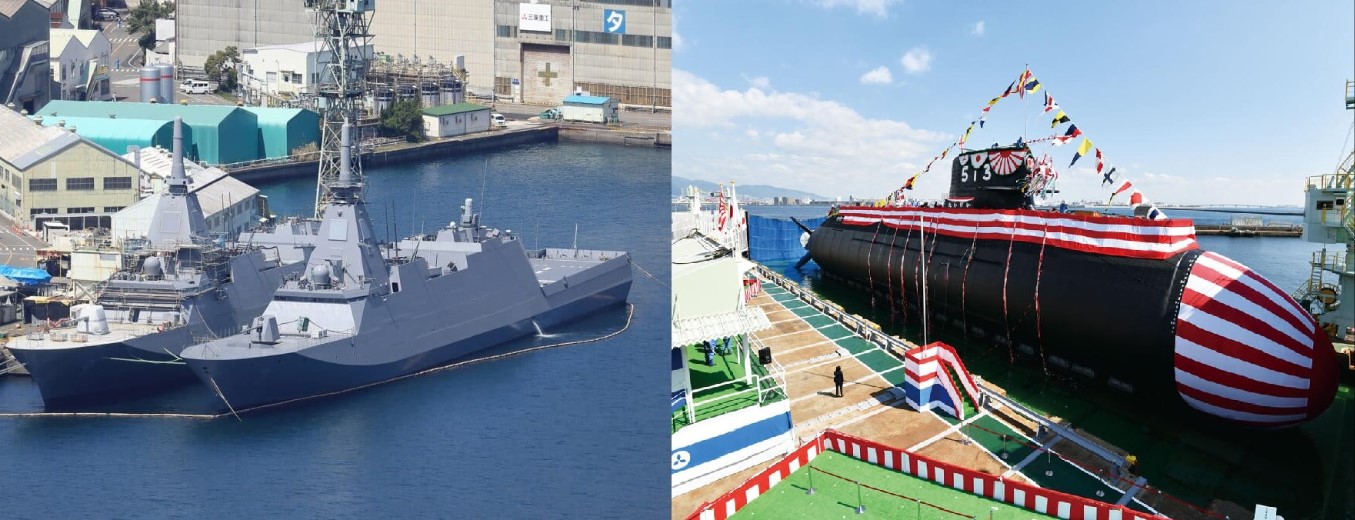
Around ¥11.5 billion (US$ 73.6 million) designated for two Mogami-class frigate vessels
-
Approximately ¥2.9 billion to fund two upgraded Mogami-class vessels — the New FFM (06FFM)
-
About ¥39.3 billion for four Taigei-class submarines
The focus on frigates and submarines underscores Tokyo’s emphasis on both surface and undersea capabilities for deterrence, coastal defense, and maritime domain operations.
The Strategic Rationale Behind Accelerated Procurement
According to a spokesperson from the Ministry of Defense (Japan), this accelerated procurement is intended to give shipbuilders early access to necessary funds so they can begin manufacturing sooner, which in turn helps — in their words — “bring forward the delivery schedule.”
The supplementary budget covers only the construction costs. It does not include related expenses such as those for the Vertical Launching System (VLS).
By committing the money now, Japan aims to speed up readiness of its naval forces, enabling the JMSDF to respond more quickly to evolving regional threats.
JMSDF Fleet Plans and the Role of Mogami & Taigei Vessels
The JMSDF, as of 2025, operates a fleet of over 150 vessels along with many aircraft — but under its modernization roadmap, it is progressively replacing older ships with more advanced, stealthier, and automated vessels.
The Mogami-class frigate was conceived as a “compact-hull but multi-mission” stealth frigate, designed to deliver destroyer-level capabilities with fewer crew and lower operating cost.
Originally, plans had envisaged up to 22 Mogami-class frigates. However, in a shift of strategy, Japan later decided to build 12 such ships and then transition to 12 New FFMs between fiscal 2024 and 2028.
The New FFM (06FFM) upgrade brings enhancements such as a redesigned main mast, updated radar capabilities, and on some versions, a Mk 41 VLS with up to 32 cells.
On the submarine side, the Taigei-class is the JMSDF’s newest diesel-electric attack submarine equipped with advanced sonar, snorkel-based power generation, and lithium-ion battery technology — improving underwater endurance and performance.
Japan has not officially decided how many Taigei-class submarines will be built, though officials indicate the total will likely be about 12.
Regional and Geopolitical Implications
Japan’s decision to fast-track frigate and submarine procurement reflects broader regional security anxieties, especially with regard to growing military activity by neighboring powers. The accelerated time-frame sends a clear signal that Tokyo intends to bolster maritime deterrence and readiness.
Moreover, the push dovetails with Japan’s broader defense buildup. Earlier in 2025, the government proposed its largest–ever standard defence budget, signaling a long-term shift in Japan’s postwar security posture.
The investment in rapidly deployable surface combatants and advanced submarines also enhances Japan’s ability to project power, secure sea-lanes, and reinforce its role as a deterrent force in the Indo-Pacific region.
What Comes Next: Delivery Timelines and Broader Military Modernization
Under current plans, the first of the New FFM frigates is scheduled for commissioning in fiscal year 2028. If all goes smoothly, the full suite of 12 New FFMs could be in service by fiscal 2032.
On the submarine front, the increasing number of Taigei-class boats indicates continued expansion. But the exact total remains unconfirmed, though some Japanese officials cited 12 as likely.
The broader defense build-up will likely also include additional investments in unmanned systems, long-range missiles, and upgrades to existing fleets — part of a new comprehensive security framework adapting to 21st-century threats.
The November 28 approval of the ¥847.2 billion supplementary budget marks a decisive acceleration in Japan’s naval modernization — underscoring Tokyo’s determination to strengthen maritime deterrence amid shifting strategic dynamics in the region. The investment in both the advanced Mogami-class frigates, New FFMs, and Taigei-class submarines signals a shift toward a more capable, nimble, and future-oriented fleet for the JMSDF.
Given the compressed procurement timeline, the next few years will be critical: as the first of the new vessels roll out, Japan’s maritime security posture may evolve sharply — carrying consequences not only for its own defense, but for the broader balance of power in the Indo-Pacific.
✍️ This article is written by the team of The Defense News.