Jaishankar Slams Pakistan as ‘Serial IMF Borrower’, Rejects Trump’s Mediation Claim, and Recalls UPA's China Policy
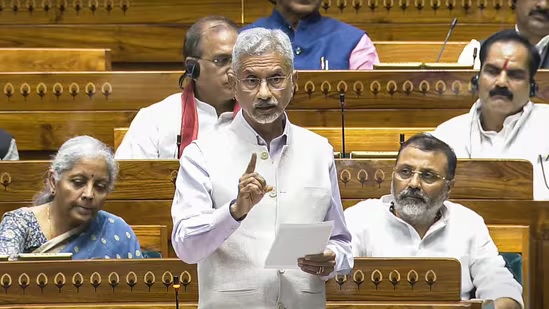
In a forceful speech in Parliament during a special discussion on Operation Sindoor, External Affairs Minister Dr. S. Jaishankar launched a scathing attack on Pakistan’s economic credibility, firmly rejected U.S. President Donald Trump’s claims of mediating a ceasefire between India and Pakistan, and highlighted the Congress-era move to name China a “strategic partner.”
“Pakistan a Serial Borrower”
Jaishankar described Pakistan as a “serial borrower from the IMF,” pointing out that Islamabad has turned to the International Monetary Fund 16 or 17 times over the last few decades. He cited the most recent $7 billion bailout approved in 2024 and referenced earlier IMF support packages in 2008 and 2013. The Minister said this borrowing pattern reflects the lack of financial discipline in Pakistan’s governance, compounded by its continued association with terrorism and religious fanaticism.
He emphasized that India’s diplomacy at the United Nations exposed Pakistan’s dual failures — economic instability and state-backed terrorism — a narrative that received widespread international backing.
Operation Sindoor: India’s Calibrated Response
Speaking on Operation Sindoor, Jaishankar detailed how the Indian government launched precise strikes on May 7, targeting nine terror infrastructure sites in Pakistan and Pakistan-occupied Kashmir. These actions followed the Pahalgam terror attack on April 22, which claimed 26 lives.
Jaishankar stressed that the operation was “focused, measured, and non-escalatory,” executed with restraint but firm intent. He added that India's decision to halt the operation on May 10 came only after Pakistan formally requested a ceasefire through a DGMO (Director General of Military Operations)-level military communication — not under any international pressure.
According to the Minister, 27 countries were directly briefed by him during the diplomatic effort, while 20 more were contacted at the Prime Ministerial level, and over 35 letters were dispatched seeking international support. Out of 190 member nations at the UN, only three opposed the Indian military action, indicating strong global alignment with New Delhi's stance.
Trump's Mediation and Trade Link Claim Dismissed
Addressing the controversy surrounding Donald Trump’s repeated assertions that he helped broker peace between India and Pakistan in exchange for trade agreements, Jaishankar categorically denied any such interaction.
He stated unequivocally that no phone calls took place between Prime Minister Modi and President Trump between April 22 and June 17. “There was no mediation, no negotiation, and certainly no linkage with trade,” Jaishankar told the Lok Sabha, calling the former U.S. president’s claims misleading.
Defence Minister Rajnath Singh also weighed in, stating that India’s decision to end the operation came after its objectives were met — not due to outside influence. He added that such insinuations disrespected the capability and autonomy of India’s armed forces.
On China: UPA’s Strategic Partnership Legacy
Turning to India-China relations, Jaishankar reminded the House that it was under the Congress-led UPA government in 2005 that China was designated as India’s “strategic partner.” At that time, the phrase “Chindia” was coined to reflect growing optimism about bilateral ties. However, Jaishankar argued that the current geopolitical reality is different and more challenging.
Clarifying his recent visit to China, the External Affairs Minister said, “I did not go to China for the Olympics. I did not go to strike secret deals. I went to make our position clear on de-escalation, trade restrictions, and terrorism.” He contrasted this principled approach with previous governments that, according to him, hesitated to confront China even during episodes like the Beijing Olympics, when China was issuing stapled visas to Indian citizens from Jammu & Kashmir and Arunachal Pradesh.
Opposition Under Fire
The debate saw heated exchanges between Treasury and Opposition benches. Home Minister Amit Shah took aim at the Congress party, accusing it of trusting foreign narratives over statements from the Indian government. “Why do they believe others over our own External Affairs Minister?” Shah questioned during the session.
Jaishankar further recalled that during the Doklam crisis, some leaders from the opposition reportedly sought briefings from the Chinese ambassador rather than from Indian officials, implying misplaced loyalties.
Jaishankar’s statements reflected a broader effort by the government to assert India's sovereign decision-making in foreign affairs, reject outside interference, and draw sharp contrasts with past diplomatic postures. In doing so, he not only defended India’s handling of Operation Sindoor but also sent strong messages to both Pakistan and China, while forcefully debunking Trump’s claim of brokering peace.
The Minister's address marked one of the most comprehensive foreign policy briefings in Parliament in recent years, combining historical clarity with present-day assertiveness.
✍️ This article is written by the team of The Defense News.