JAXA Explores Partnership With ISRO On Robotic Arms As India Emerges As A New Leader In Space Robotics
The Japan Aerospace Exploration Agency (JAXA) is exploring new opportunities to work with the Indian Space Research Organisation (ISRO) in the field of space robotic arms, a cutting-edge area that is rapidly becoming crucial for satellite servicing, space stations and deep-space exploration. The interest comes at a time when India has quietly joined an elite group of nations that have actually deployed operational robotic arms in orbit, thanks to ISRO’s recent SpaDeX and POEM-4 experiments.
India’s First Space Robotic Arm Changes The Game
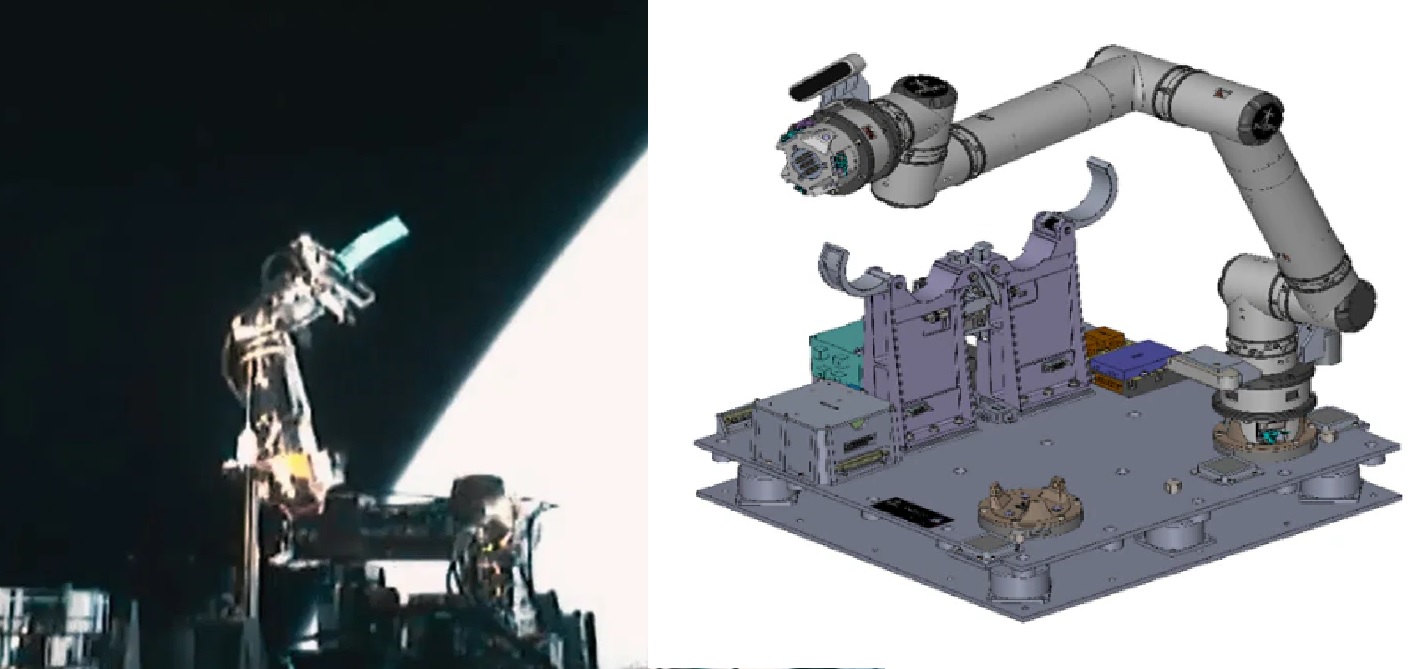
ISRO’s Space Docking Experiment (SpaDeX), launched aboard PSLV-C60 on 30 December 2024, was primarily designed to demonstrate autonomous rendezvous and docking between two 220-kg satellites in low Earth orbit. But tucked into the same mission was another breakthrough: India’s first space-qualified robotic manipulators, flown on the POEM-4 (PSLV Orbital Experimental Module) platform.
The centrepiece was the Relocatable Robotic Manipulator – Technology Demonstrator (RRM-TD), often described as a “walking robotic arm”. Developed by ISRO’s Inertial Systems Unit (IISU), the arm features seven degrees of freedom, indigenous robotic joints and controllers, a grappling mechanism, and standardised power/data interfaces. It can “inch-worm” its way between fixtures on POEM-4, demonstrating end-on-end walking, microgravity operations, visual inspection, vision-based pose estimation, and teleoperation, all backed by a high-compute onboard processor and advanced safety software.
A second payload, the Debris Capture Robotic Manipulator built by the Vikram Sarabhai Space Centre (VSSC), is designed to capture tethered space debris using visual servoing and object-motion prediction, and is intended as a pathfinder for future capability to grasp freely tumbling objects and even refuel spacecraft in orbit.
Together, these experiments have made India one of only a few countries—alongside the US, Russia and China—with real in-orbit experience of sophisticated space robotic arms and docking operations.
Why JAXA Is Interested In Indian Space Robotics
JAXA has long experience with robotic systems in space, including the Kibo module’s robotic arm on the International Space Station, which can manipulate payloads outside the module and deploy small satellites.
Now, as Japan and India deepen their cooperation through the Chandrayaan-5 / LUPEX lunar polar mission—where ISRO provides the lander and JAXA the rover—official delegations have begun discussing new areas of collaboration, including robotic arms for India’s future Bharatiya Antariksh Station (BAS) and for on-orbit servicing.
According to a recent statement amplified on social media, JAXA is now “exploring opportunities to work with ISRO in the field of robotic arms,” explicitly citing India’s SpaDeX robotic-arm achievements as a reference point.
For JAXA, India offers:
-
A partner that has demonstrated low-cost but high-end robotics and docking technologies in orbit.
-
Growing ambitions for a national space station (BAS), which will require multiple external and internal robotic arms for assembly, maintenance and cargo handling.
-
A rapidly expanding ecosystem of Indian and Japanese private space companies already collaborating in areas like debris removal and orbital servicing, creating a natural industry bridge for joint robotic-arm applications.
SpaDeX: The Technology Backbone For Future Robotic Partnerships
The SpaDeX mission itself has evolved into a broad technology testbed that directly supports any future ISRO–JAXA robotic-arm projects.
ISRO’s twin SpaDeX satellites—SDX01 (Chaser) and SDX02 (Target)—have successfully demonstrated:
-
Autonomous rendezvous and docking in low-Earth orbit, including a second fully autonomous docking run starting from 15 metres separation.
-
Complex formation-flying and “rolling” manoeuvres, where one satellite circled the other, validating sensors, software and ground control techniques for multi-vehicle coordination.
-
Bidirectional power transfer between the docked satellites, proving concepts vital for space stations and servicing missions.
These capabilities are directly relevant to robotic arms used for berthing, servicing and assembly, where precise relative navigation, stable docking and safe proximity operations are essential. International briefings on docking often distinguish between “docking” (spacecraft attaching themselves) and “berthing” (a robotic arm captures and positions a visiting vehicle)—meaning SpaDeX’s software, sensors and guidance are natural foundations for future ISRO–JAXA berthing systems as well.
From Lunar Poles To Space Stations: Where Joint Robotic Arms Could Be Used
Officials and analysts see several likely applications where JAXA–ISRO robotic-arm cooperation could materialise in the coming years:
1. Bharatiya Antariksh Station (BAS)
ISRO has already said that the POEM-4 robotic arm experiments are precursors for technologies needed on the Bharatiya Antariksh Station, planned for the 2030s.
A mobile external arm, similar in spirit to JAXA’s Kibo arm or the Canadian-built Canadarm2 on the ISS, would be vital for:
-
Handling visiting cargo vehicles
-
Supporting astronauts during spacewalks
-
Installing new modules and experiments
-
Inspecting and repairing external systems in orbit
JAXA’s long operational experience with ISS robotics and ISRO’s new indigenous arms create a complementary technology fit for such a system.
2. Lunar Surface Operations Under LUPEX / Chandrayaan-5
The joint LUPEX / Chandrayaan-5 mission, now formally approved on both sides, aims to drill for and study water ice in permanently shadowed regions near the Moon’s south pole.
While the current baseline focuses on a lander and rover, future follow-on missions could:
-
Use robotic arms on landers or rovers to manipulate drilling tools, collect core samples and move instruments into shadowed craters.
-
Conduct sample transfer operations between rovers, landers or ascent vehicles.
Here JAXA’s expertise with lunar rovers and precision mechanisms and ISRO’s new experience with space manipulators and vision-based control could converge into jointly designed lunar robotic arms.
3. Space Debris Removal And On-Orbit Servicing
Both countries are increasingly vocal about the risks posed by space debris. JAXA already works with Japanese firm Astroscale on debris removal, while Indian startups and ISRO are exploring similar technologies, including laser-based and robotic de-orbiting concepts.
ISRO’s Debris Capture Robotic Manipulator on POEM-4 is a natural demonstration towards this goal. Robotic arms jointly developed by Indian and Japanese engineers could one day:
-
Capture and de-orbit defunct satellites
-
Re-fuel and extend the life of high-value spacecraft
-
Replace failed components on orbiting platforms
Strategic Significance For India, Japan And The Indo-Pacific
At a strategic level, deeper cooperation on space robotic arms fits squarely into the broader India–Japan Indo-Pacific partnership:
-
It reinforces the two democracies’ ambition to be rule-shapers in space, particularly on responsible operations like debris removal and cooperative servicing.
-
It reduces dependence on any single Western or Russian provider for advanced space robotics, diversifying the global supply chain in an area that has strong dual-use implications.
-
It showcases a model of transparent, peaceful use of advanced orbital technologies at a time when concerns about the militarisation of space are growing.
For India, JAXA’s interest is a signal that SpaDeX and POEM-4 have elevated ISRO into the top tier of global players in space robotics. For Japan, partnering with a fast-moving, cost-efficient space power like India offers a way to accelerate its own ambitions in lunar exploration, orbital servicing and next-generation space stations.
What Comes Next
Neither ISRO nor JAXA has yet announced a dedicated joint robotic-arm mission, but recent technical meetings on Chandrayaan-5/LUPEX and public statements about exploring cooperation in this field suggest that concrete projects could emerge over the rest of this decade.
In the meantime, ISRO is already planning SpaDeX-2, a follow-on docking and robotics mission intended to further mature the technologies needed for India’s space station plans. Each new demonstration will only make ISRO a more attractive partner for JAXA as both agencies look beyond Earth orbit—to the Moon, to on-orbit servicing, and eventually to human habitats in deep space.
About the Author
Aditya Kumar:
Defense & Geopolitics Analyst
Aditya Kumar tracks military developments in South Asia, specializing in Indian missile technology and naval strategy.