Italy PM Responds to Trump’s NATO Remark: ‘Should We Shut Down U.S. Bases in Europe?’
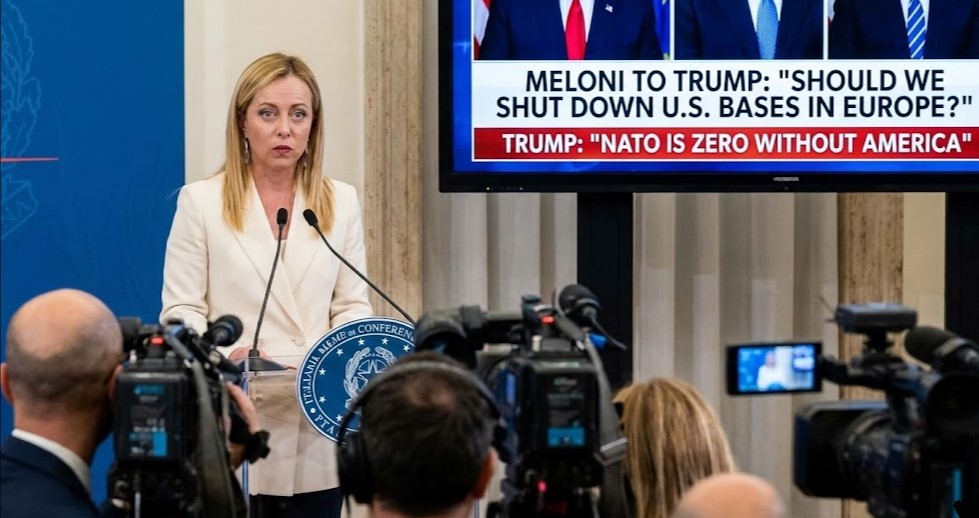
EUROPE / U.S : Recent attention has focused on remarks attributed to former U.S. president Donald Trump, who was quoted as saying “NATO is zero without America.” The comment was followed by a purported response attributed to Italian Prime Minister Giorgia Meloni, suggesting that Europe could respond by closing U.S. military bases, restricting transatlantic trade, or targeting American commercial interests. The exchange has been widely presented as a direct political confrontation between the two leaders.
A closer examination, however, reveals an important distinction between verified statements and fabricated attributions. While Trump’s remarks align with his longstanding criticism of the North Atlantic Treaty Organization (NATO), the statement attributed to Meloni does not appear in any verified speech, interview, parliamentary record, or official government communication. Instead, the wording reflects an unattributed commentary rather than a confirmed position expressed by the Italian prime minister.
Despite the lack of confirmation, the episode has drawn attention because it underscores a substantive strategic debate. At its core lies the balance of power within NATO, Europe’s reliance on American military capabilities, and the degree of leverage European states theoretically hold by hosting a significant portion of the U.S. military’s forward-deployed infrastructure. These factors remain central to transatlantic security relations, regardless of how the debate is framed or attributed.
Trump’s NATO Message, And The Pressure Campaign Behind It
Trump has repeatedly framed NATO as an imbalanced deal in which the United States carries the burden. That posture has sharpened European anxiety about whether Washington could reduce its force presence, especially as U.S. officials have publicly signaled that troop levels in Europe are ultimately a presidential decision.
Those nerves have not been abstract. Reporting over the past year has focused on adjustments to deployments on NATO’s eastern flank, including reductions in Romania that allies and analysts read as politically significant, even when the Pentagon emphasizes that the broader U.S. presence remains above pre-2022 levels.
How Big is The U.S Basing Footprint in Europe?
Assessing the size of the U.S. military basing footprint in Europe depends heavily on how a “base” is defined. Analysts and governments distinguish between major permanent installations, persistent access sites, and a wider network of smaller facilities used for storage, communications, training, and contingency operations.
As of early 2025, the United States maintains a broad and layered military infrastructure across Europe, designed to support NATO operations, deterrence on the eastern flank, and power projection into the Middle East and Africa.
Publicly available assessments indicate that the U.S. operates 31 persistent bases and 18 additional significant access sites across Europe. When smaller facilities — including logistics depots, “lily pad” contingency locations, and communications and intelligence stations — are included, the overall network exceeds 80 separate military sites across the continent.
This discrepancy reflects the Pentagon’s accounting method. The Congressional Research Service (CRS) explains that the Department of Defense’s Base Structure Report (BSR) counts individual parcels of infrastructure as separate “sites,” even when they belong to a single base complex. As a result, one installation can appear multiple times in official tallies — a method that significantly inflates site numbers without changing the underlying footprint.
What is not disputed is the scale of personnel supported by this infrastructure. As of early 2025, approximately 84,000 U.S. service members are stationed in Europe. This figure includes around 20,000 additional troops deployed after Russia’s 2022 invasion of Ukraine, reinforcing NATO’s eastern flank and expanding rotational forces in Central and Eastern Europe.
While troop numbers fluctuate due to rotations, exercises, and temporary deployments, U.S. force levels remain well above pre-2022 baselines, underscoring Europe’s continued role as the primary forward operating theater for American forces outside the Indo-Pacific.
The U.S. military presence in Europe is heavily concentrated in a small number of allied countries, with Germany, Italy, and the United Kingdom forming the core of America’s regional posture.
Germany, hosting roughly 35,000 U.S. personnel, functions as the primary logistics and command hub. It contains the largest concentration of U.S. facilities in Europe — estimates range from 40 to more than 100 sites, depending on classification. Major installations include Ramstein Air Base, the largest U.S. air base overseas; USAG Stuttgart, home to U.S. European Command (EUCOM); USAG Bavaria; and Spangdahlem Air Base.
Italy, with approximately 13,000 U.S. personnel, serves as the Mediterranean hub for American operations. The country hosts between 7 and 12 major installations, including Aviano Air Base, Naval Air Station Sigonella, and Naval Support Activity Naples, which supports the U.S. Sixth Fleet.
The United Kingdom, with around 10,000 U.S. troops, is primarily an air power hub. Facilities such as RAF Lakenheath, home to U.S. F-35 fighter squadrons, and RAF Mildenhall support long-range strike, refueling, and intelligence missions.
Spain hosts 3,200 to 4,000 U.S. personnel, centered on Naval Station Rota, a critical naval logistics hub that supports U.S. Aegis-equipped destroyers operating in both the Mediterranean and Atlantic.
On NATO’s eastern flank, Poland has emerged as a growing focal point. While most forces remain rotational, the U.S. recently established its first permanent Army base in the country at Camp Kościuszko in Poznań, reflecting Poland’s expanding role in regional defense planning.
Turkey, hosting roughly 1,700 U.S. personnel, retains strategic importance through Incirlik Air Base, which provides access to the Middle East despite periodic political friction.
Other countries hosting smaller but strategically significant U.S. sites include Belgium, The Netherlands, Greece (notably Souda Bay), and Romania, which hosts an Aegis Ashore missile defense site.
Taken together, the U.S. basing network in Europe represents not a single monolithic structure, but a distributed system designed for rapid reinforcement, deterrence, and flexible response. While debates continue over burden-sharing and future troop levels, the physical scale of America’s European footprint remains one of the most consequential — and irreplaceable — pillars of transatlantic security.
Italy’s Role: Why U.S Bases There Matter
Italy sits at the center of the U.S. Mediterranean map: close to the Balkans, North Africa, the Levant, and Black Sea approaches. CRS describes key functions hosted in Italy, including U.S. Army headquarters elements in Vicenza and combat air assets at Aviano.
Among the best-known U.S. facilities in Italy are Aviano Air Base, Naval Air Station Sigonella, and U.S. Navy hubs around Naples (including support sites), all of which appear in congressional basing discussions and compilations of U.S. overseas posture.
Even when the viral “Meloni” line is treated as fiction, it lands because it points at a real vulnerability: host nations can impose political and legal constraints, slow-roll permissions, or in extreme scenarios demand closures — and the U.S. cannot fully substitute Europe’s geography with a memo from Washington.
The “Shut Down Your Bases” Scenario: What It Would Do to U.S Power
If Europe collectively moved to restrict or close U.S. bases — an extreme and currently unrealistic political step — the effects would likely cascade across four fronts.
First, it would hit speed and reach. Forward-based aircraft, logistics nodes, and maintenance hubs drastically shorten response times to crises in Europe’s neighborhood, from the Mediterranean to the Middle East and Africa. Removing them would force the U.S. to rely more on long-range deployments from the continental United States or on fewer alternative hubs, raising costs and stretching readiness.
Second, it would degrade deterrence. NATO’s conventional posture relies not just on troop numbers but on “enablers” the U.S. brings at scale — airlift, intelligence and surveillance, command-and-control, missile defense integration, and rapid reinforcement. European militaries are expanding capabilities, but analysts and policymakers widely describe the replacement task as difficult and slow.
Third, it would complicate ongoing operational commitments. Europe hosts rotational training and staging routes that support broader U.S. operations, and it underpins reinforcement plans for NATO’s eastern flank. A basing shock would force urgent renegotiation of access and overflight arrangements and would likely create gaps during any transition.
Fourth, it would reshape U.S. politics and budgeting. Relocating infrastructure is expensive; rebuilding comparable capacity elsewhere would require multi-year military construction, new host-nation agreements, and likely bruising congressional fights over where units should go. The immediate “win” of closing overseas facilities could quickly collide with the practical costs of maintaining the same global posture from farther away.
The “Cut Trade” Angle: the Economic Punch is Real
The other half of the meme’s threat — “cut trade” — also resonates because transatlantic commerce is enormous. EU figures put total EU–U.S. trade in goods and services in 2024 at over €1.68 trillion. U.S. government data similarly estimates U.S.–EU trade at about $1.5 trillion in the same year.
A serious trade rupture would therefore be mutually damaging: supply chains, aerospace, automobiles, pharmaceuticals, energy flows, and digital services would all be exposed. Even the threat of tit-for-tat restrictions can move markets and boardrooms long before policy becomes law.
Why The Argument Resonates Even If The Quote Does Not
The language attributed to the Italian prime minister gained traction not because of its style, but because of its strategic clarity. The phrasing distilled a complex geopolitical reality into a simple proposition: that power within NATO is not unilateral, even if it is asymmetrical.
There is broad acknowledgment across European capitals that the United States remains the single most important military power within NATO. American capabilities in airlift, intelligence, command-and-control, missile defense, and rapid reinforcement continue to form the backbone of the alliance. European leaders, including those who advocate for greater strategic autonomy, privately concede that these capabilities cannot be replaced quickly or cheaply.
About the Author
Aditya Kumar:
Defense & Geopolitics Analyst
Aditya Kumar tracks military developments in South Asia, specializing in Indian missile technology and naval strategy.