Iran Prepares Massive Missile Retaliation as U.S Strike Fears Mount : Reports
TEHRAN / WASHINGTON : Tensions between Iran and the United States have entered a dangerous new phase after CNN reported that Tehran is preparing a large-scale missile response should Washington launch direct strikes on Iranian territory. Intelligence assessments cited by the network indicate that Iran has readied hundreds of ballistic missiles for rapid use, with Israel and U.S. military assets across the Middle East identified as primary targets.
Western officials say the preparations reflect a long-standing Iranian military doctrine centered on deterrence through volume rather than precision. Instead of relying on a small number of strategic weapons, Tehran has built a vast arsenal of short- and medium-range missiles and armed drones designed to overwhelm advanced air-defense systems through sheer numbers.
Heavy Missiles and Long Reach
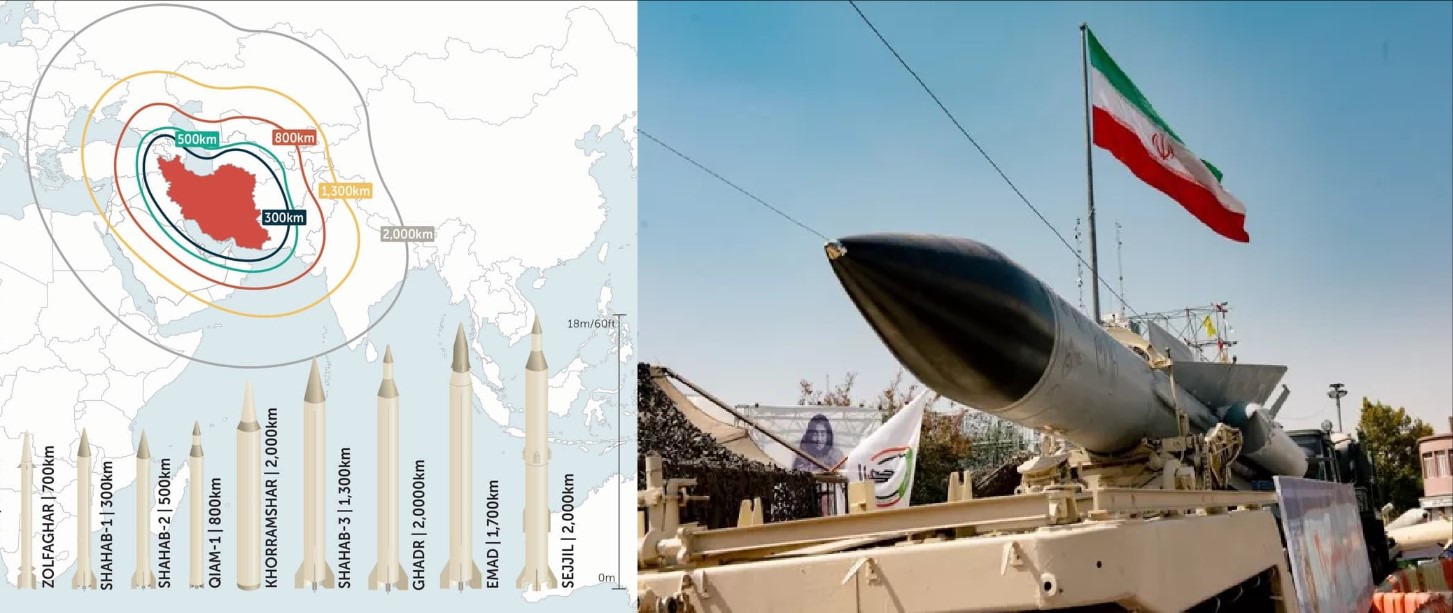
At the core of the reported plan is the Khorramshahr-4 ballistic missile, known in Iran as “Khyber.” The missile, unveiled by Iran’s Islamic Revolutionary Guard Corps (IRGC) Aerospace Force, is among the most powerful conventional weapons in Tehran’s inventory. With a range of roughly 2,000 kilometers, it can strike targets across Israel and reach U.S. military facilities in Turkey and parts of southeastern Europe if launched from western Iran.
Defense analysts note that the missile’s significance lies not only in its extended range but also in its heavy payload. Capable of carrying a warhead estimated at up to 1,500 kilograms, the Khorramshahr-4 is designed to cause extensive damage to hardened or high-value targets, including air bases, command centers, and critical infrastructure. Its advanced fuel system allows it to remain stored for long periods and launched on short notice, significantly reducing warning time for defenders.
Iranian officials have framed the missile as a purely defensive tool, but regional rivals view it as a central element of Tehran’s threat posture toward Israel. From Iranian launch sites, major Israeli cities including Tel Aviv and Haifa fall well within range.
Focus on U.S. Bases in the Gulf
While Israel is a key concern, U.S. military planners are reportedly more alarmed by the immediate threat to American forces stationed around the Persian Gulf. According to U.S. defense officials, Iran has positioned thousands of short-range ballistic missiles and armed drones that could be used in coordinated “swarm” or saturation attacks against forward-deployed U.S. bases.
One of the most sensitive targets is Al Udeid Air Base in Qatar, the largest U.S. military facility in the Middle East and home to the Combined Air Operations Center, which oversees American air activity across the region. The base is protected by multiple layers of air defense, including Patriot missile batteries and THAAD systems, but those defenses rely on finite interceptor stocks.
Analysts say Iran’s strategy would likely involve firing large numbers of relatively inexpensive weapons simultaneously. Solid-fuel missiles such as the Fateh-110 and Fateh-313, with ranges of up to 500 kilometers, along with the longer-range Zolfaghar missile, could be launched alongside waves of Shahed-series loitering munitions. The goal would be to exhaust defensive interceptors, allowing some warheads to penetrate and damage runways, aircraft shelters, and command facilities.
The Question of the U.S. Mainland
Despite the scale of Iran’s regional missile capabilities, intelligence agencies emphasize that Tehran does not currently possess an operational intercontinental ballistic missile (ICBM) capable of striking the continental United States. Major U.S. cities such as New York, Washington, or Los Angeles lie nearly 10,000 kilometers from Iran, far beyond the reach of its declared missile forces.
Iran has publicly stated that it observes a self-imposed missile range limit of around 2,000 to 2,500 kilometers. However, Western defense experts closely monitor Iran’s space launch program, noting that rockets such as the Simorgh and the solid-fuel Qaem-100 use technologies similar to those required for long-range ballistic missiles. While these systems are officially intended to place satellites into orbit, analysts argue that, in theory, the technology could be adapted for longer-range military use. No evidence suggests such a capability has been deployed operationally.
Regional Balance of Power
Iran today maintains one of the largest and most diverse missile arsenals in the Middle East. The heavy emphasis on short-range missile systems reflects Tehran’s assessment that any future conflict with the United States would be fought primarily around the Persian Gulf, Iraq, Syria, and the eastern Mediterranean. U.S. military facilities in Bahrain, Kuwait, Qatar, and the United Arab Emirates are all within range of multiple Iranian missile types.
American military commanders have repeatedly stated that they are prepared to defend these installations, but they also acknowledge that no defense system can guarantee complete protection against a determined saturation attack. As a result, bases across the region have reportedly raised alert levels, dispersed aircraft, and reinforced hardened shelters.
A Volatile Moment
The latest intelligence warnings come amid escalating rhetoric from both Tehran and Washington, raising fears that miscalculation could trigger a broader regional conflict. While diplomats on both sides continue to stress that neither country seeks war, the visible movement of missiles, air-defense systems, and military forces has narrowed the margin for error.
For now, U.S. officials maintain that the American homeland remains out of reach, but the concentration of Iranian firepower aimed at nearby U.S. bases underscores the serious risks facing tens of thousands of American service members in the region. As one senior defense analyst observed, Iran’s missile force is less about reaching across oceans and more about making the immediate neighborhood too dangerous for any adversary to ignore.
About the Author
Aditya Kumar:
Defense & Geopolitics Analyst
Aditya Kumar tracks military developments in South Asia, specializing in Indian missile technology and naval strategy.