Indrajaal Unveils India’s First Anti-Drone Patrol Vehicle with 4 km Neutralisation Capability
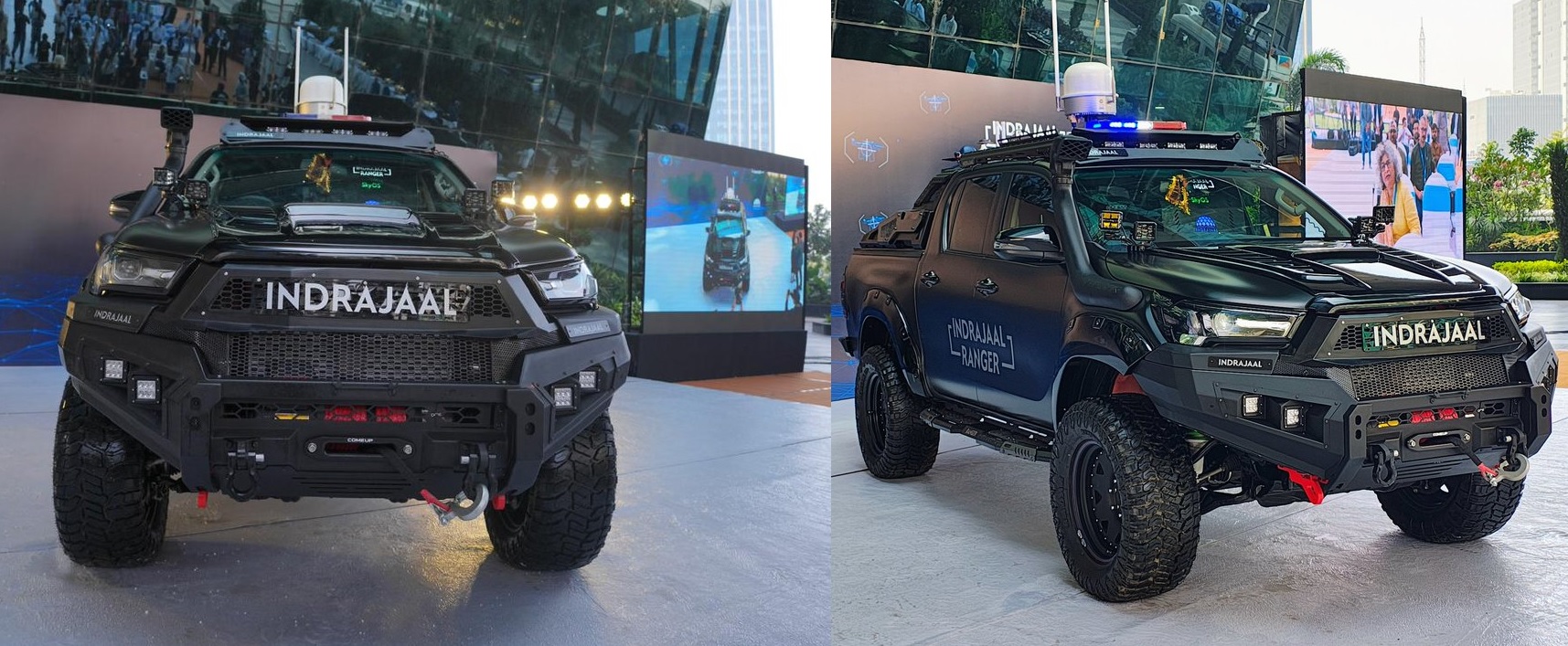
n a major boost to India’s internal security and border protection architecture, Indrajaal Drone Defence has launched the country’s first Anti-Drone Patrol Vehicle (ADPV) — a fully mobile, AI-enabled counter-drone platform capable of detecting, tracking, and neutralising hostile drones while on the move. The system, showcased as the Indrajaal Ranger, marks a technological leap in India’s response to the rapidly growing menace of drone-based smuggling, reconnaissance, and terrorist operations.
A Patrol Vehicle That Fights in Motion
Unlike traditional counter-UAS systems that operate from fixed locations, the ADPV is built on a rugged all-terrain 4×4 vehicle and is engineered for high-mobility missions along vulnerable borders, urban corridors, and critical infrastructure zones.
According to Indrajaal:
-
Drone detection range: up to 10 km
-
Neutralisation range: up to 4 km
-
Response time: real-time tracking and engagement even while the vehicle is moving
-
Coverage: 360-degree situational awareness through AI-driven autonomous monitoring
The ADPV integrates electro-optical sensors, RF-capture arrays, radar modules, and autonomous decision-support algorithms to identify drone types, assess threat levels, and initiate countermeasures almost instantly.
Built to Counter Drone-Led Smuggling and Terror Operations
The urgency for such a system was reinforced by multiple recent incidents that exposed how drones have become a preferred smuggling tool for cross-border networks:
-
ISI-backed drone routes have been used to drop weapons, drugs, IEDs, and cash deep inside Indian territory.
-
The Border Security Force (BSF) has neutralised over 255 Pakistani drones in 2025 alone, highlighting a massive spike in drone-based trafficking attempts.
-
Urban centers including Delhi, Mumbai, and Chandigarh have reported cartel-driven drone drops, indicating smuggling networks have extended their operations beyond border states.
Indrajaal notes that India’s ₹3-lakh-crore drug trafficking ecosystem is increasingly dependent on drones, making counter-drone mobility essential.
The Indrajaal Ranger: What’s Inside the Machine
While full specifications remain classified, sources indicate the Ranger includes:
-
AI-enabled autonomous threat evaluation platform
-
Multi-layered sensor fusion suite for radar, RF, EO/IR detection
-
Electronic warfare-based soft-kill options
-
Hard-kill interceptors for situations where disabling via jamming is not sufficient
-
Encrypted communication and battlefield networking
-
360° continuous surveillance dome
-
High-output power systems to support EW operations on the move
Indrajaal’s proprietary “Wide Area Drone Defence System (WADDS)” software forms the backbone of the Ranger, enabling scalable response protocols across varied terrains and threat densities.
Why This Matters Now
India is facing an unprecedented rise in drone-based incidents, with infiltrations along the Pakistan border increasing by more than 400 percent over the past three years. Cartel networks now rely heavily on drones to conduct rapid, low-risk deliveries of heroin and synthetic drugs into Indian territory. At the same time, security agencies have recently intercepted IED-laden drones in Punjab and Kashmir, revealing a deepening link between drone technology and terrorist operations. Critical infrastructure — airports, refineries, and military bases — is also experiencing heightened hostile surveillance, highlighting the growing sophistication of drone-enabled reconnaissance.
Traditional fixed counter-drone systems are no longer adequate to tackle these evolving threats, as adversaries continually alter flight paths, timings, and payload tactics. This dynamic environment demands mobile counter-drone solutions that can respond instantly to unpredictable drone routes. The Anti-Drone Patrol Vehicle (ADPV) addresses this challenge by providing a fast-moving, frontline defence shield capable of detecting, tracking, and neutralising hostile drones in real time, even while in motion.
India’s Counter-Drone Warfare
The deployment of the ADPV marks a decisive shift in India’s approach to drone defence, signalling the country’s move toward integrated, indigenous, and autonomous security solutions rather than reliance on imported systems. With its advanced mobility and AI-enabled capability, the Indrajaal Ranger is expected to strengthen national security across multiple operational environments.
Security experts believe the vehicle will become vital for safeguarding border regions such as Punjab, Rajasthan, and Jammu, where cross-border drone activity has surged. It is also poised to enhance the safety of major metropolitan cities by countering criminal drone operations within urban spaces. Beyond this, the ADPV is expected to play a significant role in securing VIP events, critical infrastructure, and sensitive defence corridors, where rapid and precise threat response is essential. It will also support police forces, CAPFs, and military units during high-risk deployments requiring immediate counter-drone action.
The Indrajaal Ranger is now expected to undergo evaluation by major central agencies, including the BSF, CRPF, NSG, and several state police forces, marking the beginning of a new era in India’s fight against aerial threats.
“Every Drone Intercepted is a Life Protected”
At the launch event, officials emphasised that the system is designed to save lives, not just intercept drones. With India facing an unprecedented wave of drone-enabled smuggling, terror infiltration, and espionage, the ADPV offers a crucial real-time defence layer.
Indrajaal’s innovation may soon become a standard tool across India’s borders and cities — marking a decisive step toward modern, AI-driven homeland security.
About the Author
Aditya Kumar:
Defense & Geopolitics Analyst
Aditya Kumar tracks military developments in South Asia, specializing in Indian missile technology and naval strategy.