Indonesia Plans Dual Missile Defense with India's BrahMos and China's CM-302 under “Missile Umbrella” Project
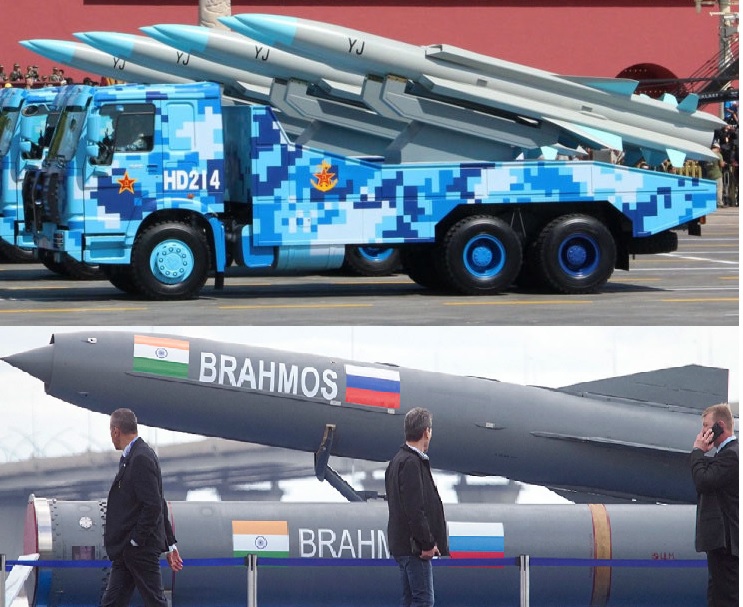
Indonesia is reportedly moving toward an ambitious — and geopolitically sensitive — push to modernize its coastal strike capability by acquiring two supersonic cruise missiles from very different producers: India/Russia’s BrahMos and China’s CM-302. Local and regional defence outlets say Jakarta is exploring a dual-track procurement and an integration concept informally being called Project “Missile Umbrella”, aimed at creating complementary layers of standoff lethality to deter and, if needed, deny access to hostile surface forces approaching Indonesia’s long coastline.
Why two different missiles?
The logic of a “missile umbrella” is simple: depth and redundancy. A layered coastal defence uses different missiles that overlap in range, speed, and flight profiles so that no single point of failure — a countermeasure, an interception attempt, or a diplomatic supply cutoff — disables the whole system. Reports indicate Indonesia sees the BrahMos as the longer-range, precision strike layer and the CM-302 as an additional supersonic anti-ship punch to saturate defences or provide alternative launch options from different platforms.
Specifications (export/service variants)
BrahMos (Indian-Russian joint venture)
BrahMos is a ramjet-powered supersonic cruise missile family capable of ship, land, sub-surface and air launch. Exported versions are the likely model for Indonesia. Headline figures for export/standard tactical variants:
-
Range (export): ~290 km (export-limited).
-
Speed: Mach 2.8–3.5 (sustained supersonic cruise).
-
Warhead: ~200–300 kg high-explosive / semi-armour-piercing.
-
Guidance: inertial navigation with multi-GNSS and active radar/IR terminal seeker options; sea-skimming terminal profile.
-
Launch platforms: vertical/box canisters on ships, road TELs for land-based batteries; submarine/air adaptations exist.
Operationally, BrahMos is prized for its combination of speed, accuracy and a proven service record — suitable as a precision standoff layer in a coastal umbrella.
CM-302 (China — YJ-12 family derivative claims)
The CM-302 is a Chinese supersonic anti-ship cruise missile design promoted for export. Publicly available and manufacturer-claimed figures are:
-
Range (export): commonly reported ~280–400 km, with export-sensitive figures often around ~280–290 km.
-
Speed: Mach 2–3.3 depending on profile (supersonic cruise with high terminal speed).
-
Warhead: roughly ~250 kg high-explosive, designed for heavy terminal effects against large ships.
-
Guidance & profile: air-breathing/ramjet propulsion enabling high speed and sea-skimming terminal approach.
-
Launch platforms: typically ship-launched and coastal variants; air-launched derivatives are conceptually possible.
Public material mixes manufacturer claims with observed data; nonetheless, the CM-302 is positioned as a high-speed anti-ship weapon useful for saturation attacks or rapid-response coastal defence.
Integration — technical and operational realities
Marrying missiles from two different vendors (and two geopolitical competitors) into a single “Missile Umbrella” is possible, but not plug-and-play. Key integration challenges include:
-
Fire-control interoperability: Coastal batteries require integrated C2, targeting datalinks, engagement sequences, and deconfliction rules. Indonesia would likely develop middleware or local systems to fuse targeting data for both BrahMos and CM-302 launchers.
-
Sensor suites and targeting: Both missiles benefit from over-the-horizon targeting (satellites, maritime patrol aircraft, ship sensors). Investments in shore radars, airborne ISR and secure datalinks are needed to cue missiles beyond line-of-sight.
-
Logistics and sustainment: Dual suppliers mean separate training pipelines, spare-parts chains, and sustainment contracts — increasing complexity and cost.
-
Political and export constraints: Export restrictions and supplier political decisions can affect availability, upgrade paths and integration of certain features (for example, range variants or particular seekers).
Strategic and political implications
A dual-supplier Missile Umbrella gives Jakarta a stronger, more resilient deterrent — but it also raises diplomatic balancing acts. Procuring BrahMos signals closer defence ties with India (and indirect Russian involvement), while acquiring CM-302 hardware engages China’s defence industry. Benefits include stronger deterrence across Indonesia’s archipelago and operational redundancy; downsides include dependence on divergent suppliers and potential diplomatic friction if regional tensions escalate.
What’s next — procurement, testing and posture
If Indonesia proceeds, expect a phased approach: purchase agreements for one or both systems, personnel training, emplacement of coastal batteries, and combined live-fire exercises to validate layered engagements. Parallel investments in maritime ISR, hardened infrastructure, and secure C2 will be necessary to make the umbrella credible.
Final thought
Project “Missile Umbrella” is a pragmatic way for a medium-power state to use diverse suppliers and layered capabilities to maximise deterrence across long coastal approaches. Technically feasible and strategically sensible from Jakarta’s perspective, success depends on harmonising C2, logistics, and diplomatic commitments while absorbing the cost and complexity of operating two different supersonic missile families.
About the Author
Aditya Kumar:
Defense & Geopolitics Analyst
Aditya Kumar tracks military developments in South Asia, specializing in Indian missile technology and naval strategy.