Indonesia Launches First Domestically Built Merah Putih-Class Frigate
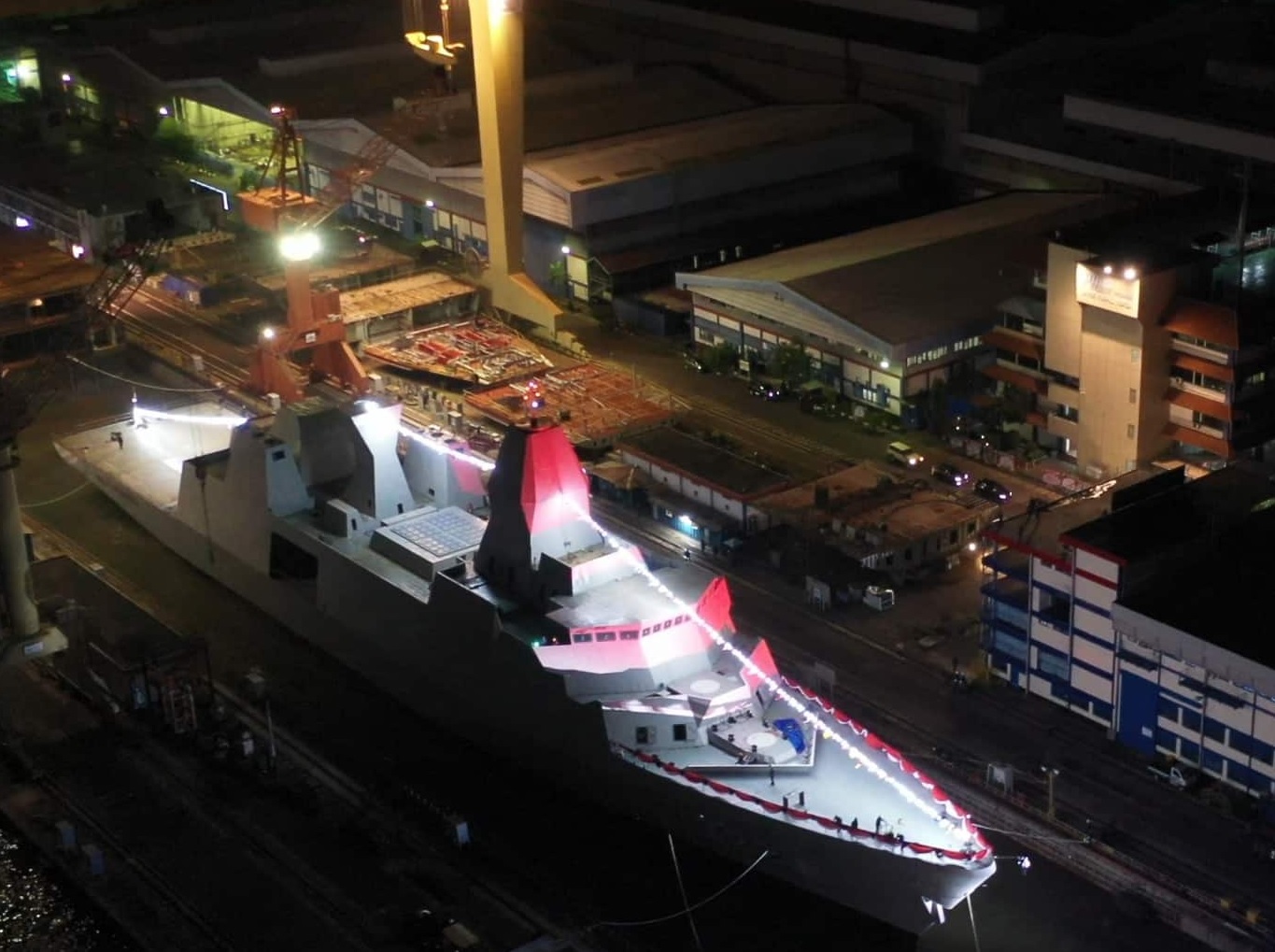
On 18 December, Indonesia officially named and launched KRI Balaputradewa (322), the first domestically constructed Merah Putih (Red White)-class frigate, marking a major milestone in the country’s naval modernisation and defence-industrial development. The warship is the largest principal surface combatant ever built in Indonesia, underscoring Jakarta’s ambition to strengthen maritime power while expanding indigenous shipbuilding capabilities.
The frigate is the lead vessel of a two-ship programme being constructed by state-owned shipbuilder PT PAL Indonesia and is based on Babcock International’s Arrowhead 140 design, a modern frigate platform selected by several navies worldwide. The launch positions Indonesia among a limited group of countries capable of building large, complex surface combatants domestically.
From design partnership to domestic construction
The Merah Putih-class frigate programme has followed a structured, multi-year development path that reflects Indonesia’s gradual transition from foreign dependence to local execution in warship construction.
The programme formally began on 16 September 2021, when Babcock and PT PAL Indonesia signed a design licence agreement for the Arrowhead 140–based frigate. This agreement established the framework for technology transfer, design adaptation, and long-term industrial cooperation.
Physical construction commenced on 9 December 2022 with first steel cutting for Frigate #1, later named KRI Balaputradewa. This milestone marked Indonesia’s entry into the construction of modern large surface combatants using advanced modular shipbuilding techniques. Progress continued with the keel laying of Frigate #1 on 25 August 2023, formally recognising the ship as a hull under construction.
The programme entered a parallel build phase in 2024. First steel cutting for Frigate #2 took place on 5 June 2024, followed by its keel laying on 15 November 2024, demonstrating PT PAL’s growing ability to manage simultaneous frigate construction.
The timeline culminated on 18 December 2025, when KRI Balaputradewa (322) was officially launched, signalling the completion of the primary hull construction phase and the transition to outfitting and trials.
A name rooted in Indonesia’s maritime heritage
The frigate is named after Balaputradewa, a 9th-century king of the Srivijaya Kingdom, one of Southeast Asia’s most powerful maritime empires. Centred in Sumatra, Srivijaya once controlled vital sea lanes across the Malacca Strait and dominated regional trade routes linking the Indian Ocean and the South China Sea.
The name underscores Indonesia’s intention to connect its modern naval resurgence with a deep historical maritime legacy, reinforcing the country’s identity as a strategic archipelagic power.
Government and industry signal strategic importance
Indonesia’s Minister of Defence, Sjafrie Sjamsoeddin, described the launch as clear evidence of the nation’s technological progress and a key step toward reducing dependence on foreign defence products. He emphasised that domestic shipbuilding is central to Indonesia’s long-term military modernisation strategy, particularly for protecting sea lines of communication and extensive maritime approaches.
PT PAL Indonesia CEO Kaharuddin Djenod highlighted that the Merah Putih programme is not merely about delivering two warships. Instead, it is intended to build sustainable national capabilities, including systems integration, advanced naval engineering, and programme management, forming the foundation for future surface combatant projects.
Arrowhead 140 heritage and Turkish combat systems
The Merah Putih-class frigates are derived from the Arrowhead 140 design, itself based on the proven Iver Huitfeldt-class platform. While detailed specifications have not been officially released, the design typically features a hull length of around 140 metres, high endurance, and a flexible multi-mission combat architecture suitable for air defence, surface warfare, and anti-submarine operations.
A defining feature of the Indonesian variant is its extensive use of Turkish-made combat systems, reflecting expanding defence-industrial cooperation between Indonesia and Türkiye. The ships are expected to be equipped with sensors and radar systems from ASELSAN, a combat management system from HAVELSAN, and missile systems along with vertical launch systems (VLS) supplied by ROKETSAN.
Next steps and programme outlook
Following its launch, KRI Balaputradewa will undergo an extended outfitting and systems integration phase, during which propulsion systems, sensors, weapons, and command-and-control suites will be installed. This will be followed by harbour trials and sea trials to validate performance and combat readiness.
No official timeline has yet been announced for the frigate’s commissioning into the Indonesian Navy, and the launch schedule for the second Merah Putih-class frigate has not been disclosed. Nevertheless, the successful launch of the lead ship represents a decisive step forward.
As Indonesia accelerates its naval modernisation amid evolving regional security dynamics, the Merah Putih-class frigate programme stands as a flagship example of how strategic partnerships, domestic industry, and maritime heritage are being combined to shape the future of the Indonesian Navy.
About the Author
Aditya Kumar:
Defense & Geopolitics Analyst
Aditya Kumar tracks military developments in South Asia, specializing in Indian missile technology and naval strategy.