India’s Solar Group Attracts Overseas Inquiries for NATO- and Russian-Jet-Compatible 125 kg Air Bomb
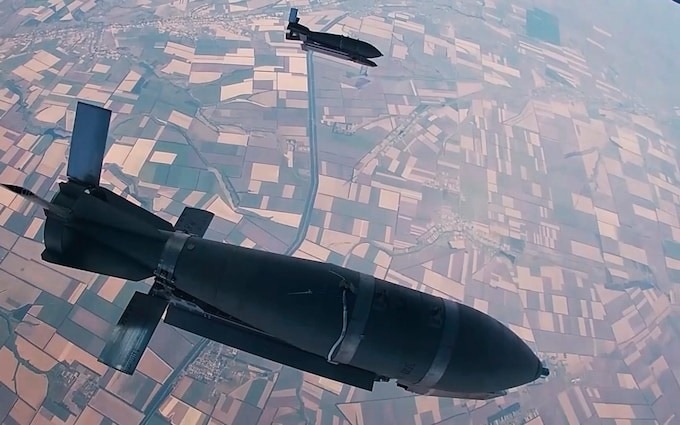
NAGPUR / NEW DELHI : India’s private defence industry has crossed a significant technological and commercial threshold as Solar Group, through its subsidiary Economic Explosives Ltd, confirmed receiving multiple international inquiries for its newly developed Universal 125-kilogram General Purpose (GP) air bomb—one of the rare aerial munitions globally designed to operate seamlessly across both NATO-standard and Russian-origin combat aircraft.
Industry officials familiar with the programme say the interest reflects a growing demand among air forces operating mixed fighter fleets for weapons that eliminate long-standing logistical and operational constraints. The bomb, developed at Solar Group’s Nagpur facilities, is emerging as a potential export breakthrough for India at a time when New Delhi is aggressively expanding its footprint in the global defence market.
Breaking a Decades-old Operational Barrier
For decades, air forces fielding aircraft from different geopolitical blocs have been forced to maintain parallel stocks of munitions. Western fighters typically use NATO-standard 14-inch or 30-inch suspension lugs, while Russian aircraft rely on distinct beam rack and lug configurations. This incompatibility has required separate supply chains, specialised storage, and aircraft-specific integration—an expensive and risky limitation during high-tempo operations.
Solar Group’s Universal 125 kg air bomb addresses this challenge through a proprietary dual-compatibility suspension and adapter architecture. According to defence engineers involved in the project, the design allows the weapon to be mounted on both Western and Eastern pylons without permanent aircraft modification or complex field-level changes. The result is a single munition that can be deployed across an entire mixed fleet, significantly simplifying logistics while improving wartime flexibility.
From Indian Air Force Requirement to Export Interest
The bomb was initially conceived to meet an urgent requirement from the Indian Air Force for approximately 2,000 lightweight tactical bombs to replenish operational stocks. During trials, the weapon reportedly exceeded baseline expectations.
Sources indicate that the munition has successfully completed carriage and release trials on the Su-30MKI, with certification processes underway for the Rafale operated by India. Compatibility assessments also cover the MiG-29, Mirage 2000, and the indigenous Tejas LCA.
Defence analysts say the weapon’s certification across such a diverse set of platforms is what has triggered international attention. Countries in Southeast Asia, Africa, and the Middle East—many of which operate combinations of Russian Sukhois alongside American or European fighters—are reportedly evaluating the bomb as a cost-effective, politically non-aligned alternative to traditional suppliers.
Strategic and Commercial Momentum
The Universal bomb’s debut follows closely on the heels of a ₹1,400-crore export order secured by Solar Industries in late 2025 for specialised defence products, underscoring the group’s rapid transition from an industrial explosives supplier to a full-spectrum defence manufacturer. While state-run entities historically dominated India’s aerial munitions sector, private firms are now emerging as credible competitors with export-ready systems.
Defence procurement experts note that the weapon’s appeal extends beyond engineering. By offering a munition that is not tied to a single geopolitical ecosystem, Solar Group positions itself as a supplier of choice for air forces seeking strategic autonomy. “A bomb that can fly on both Russian and Western aircraft is more than a technical solution—it’s a diplomatic enabler,” said a New Delhi-based defence acquisition consultant. “It allows India to engage markets that traditional suppliers often cannot.”
Tactical Role and Design Philosophy
Weighing 125 kilograms, the bomb falls into the lightweight tactical class, optimised for close air support, anti-personnel missions, and the destruction of soft-skinned vehicles and field fortifications. The high-explosive fragmentation warhead is designed to maximise lethality while remaining suitable for precision employment from modern fighter platforms.
Engineers involved in the programme emphasise that the bomb’s modular architecture allows for future upgrades, including potential guidance kits, aligning it with global trends toward low-cost precision strike solutions.
A Marker of India’s Defence Export Ambitions
As India pushes toward a defence export target of ₹35,000 crore by 2026 under the Make in India initiative, programmes such as the Universal 125 kg air bomb are increasingly viewed as proof that indigenous private industry can deliver globally competitive, interoperable systems.
With international inquiries now translating into formal evaluations, Solar Group’s latest weapon may soon become one of the most visible symbols of India’s evolving role—not just as a defence consumer, but as a versatile and innovative supplier on the world stage.
About the Author
Aditya Kumar:
Defense & Geopolitics Analyst
Aditya Kumar tracks military developments in South Asia, specializing in Indian missile technology and naval strategy.